I just spent a couple of weeks judging and umpiring, first at the Baker Cup (US High-School Team Race Championships) and then at the National Intercollegiate Championships for Women, Team Racing and Co-Ed Dinghies. All these events were in predominantly light wind, so a big part of the responsibility of my fellow judges and umpires, and myself, was to enforce rule 42 PROPULSION.
There are three different “authoritative” sources regarding rule 42. First is the rule itself. Second is the Official ISAF Interpretation.(http://www.sailing.org/tools/documents/42interpretations2010final-%5B8881%5D.pdf)
And third is the Class Rules of the class involved. In the case of the Baker Cup, there are no class rules, as no class is specified in the sailing instructions (the boats were Club 420s supplied by the Organizing Authority, but class rules did not apply). In the case of the collegiate championships, the class is “Collegiate Dinghies” as defined in the Collegiate Dinghy Class Rules (http://www.collegesailing.org/archive/2009-2012_PR_And_2009_CDCR.pdf).
At all the events above save the ICSA Team Race championships, I was asked to present my view of rule 42 at the Competitors’ Meeting, as a guide to what the judges or umpires would be looking for. The gist of my comments is below. Note that in these comments I use the colloquial term “cheating” for breaking rule 42. I don’t mean that breaking rule 42 is any worse than breaking some other rule, I just mean that the boat involved was trying to propel the boat illegally and thus breaking a rule intentionally, i.e., cheating.
The people who drafted rule 42 (and I was one of them, at least for parts of it) did not think that good seamanship meant sitting like statues in the boat; we all know that there is nothing more seamanlike (or more pleasing) than a well-executed roll tack, or a combination of rudder and heel that turns a boat perfectly with minimum drag. The perfect rule would allow such acts of seamanship and penalize all the things people might do to propel the boat without good seamanship.
The rule consequently is a bit complicated. It has three parts: 42.1 tells us what the rule is all about and contains some exceptions to prohibited actions; 42.2 lists some actions that are simply prohibited whether or not they propel the boat; and 42.3 lists more exceptions, which are actions allowed even if they do propel the boat.
The rule is designed to reward good seamanship and to penalize “air rowing” or sculling around the course (in addition to lots of other actions we never even think about, such as literally paddling, or running the motor). Most rule-42 violations are either the result of poor seamanship or deliberate efforts to break the rule.
Let me give an example. A dinghy comes to the leeward mark. As she begins to round, the crew moves to leeward and heels the boat. This action steers the boat around the mark with minimum use of the rudder, and is good seamanship, so it’s allowed under the rule. Then, when the boat reaches a close-hauled course, the crew flattens it. According to the rule 42.1, it’s legal to “adjust the trim of sails and hull”, so the flattening is simply good seamanship, allowed under the rule. (The ISAF Interpretations say that this flattening is illegal if it has “the effect of a stroke of a paddle”, but in Club 420’s this basically can’t happen, and in any case, I think the Interpretation is wrong because rule 42 doesn’t say anything even vaguely like that. But if you’re sailing, say, a Vanguard 15, you might want to bring the rig up smoothly and use the flattening to take a higher angle rather than to gain speed; that’s apparently legal even under the ISAF Interpretations.)
So what can go wrong? Well, what judges see all the time is this: Either the roll was too small or too great and the skipper had to use too much rudder during the rounding, or the flattening was mistimed, or the sheet was too tight or too loose. Either way, the boat ends up sitting more or less dead in the water, at the leeward mark. Then the skipper (or skipper and crew) solves this problem by stepping down to the leeward tank to heel the boat again, and then coming back up to windward to flatten the boat again. This is “rocking”, which is prohibited by the rule. As a fellow judge once put it to me, you don’t get two bites out of that apple!
For another example, consider the start. Just before the starting signal, a boat headed below close-hauled heels to leeward, turns up to close-hauled, and then flattens. The heel facilitates steering and the flattening is trimming the hull to its new upwind heel angle, so all of this is good seamanship and doesn’t break rule 42 (with the same caveat as above, regarding “stroke of a paddle” in the Interpretations – very easily-driven boats should probably moderate that flattening a little, or use it to gain gauge instead of speed).
But consider a boat that finds herself halfway into the second row just before the start. She’s already close hauled, trying to get to the line before the starting signal, but in bad air. To gain way, she heels and then flattens. The original heel was not to facilitate steering (the boat didn’t turn) and so the purpose of the combined heel and flattening is simply to propel the boat, which is illegal. (Note that this rocking need not actually propel the boat – the mere action is illegal according to rule 42.2(b).) When I’m on-the-water judging for large fleets, I especially watch the boats that are a half-length behind or going too slowly, one or two seconds before the starting signal – they’re the ones most likely to cheat in order to get a seat in the front row at the start.
There’s one action at the starting line that’s allowed even though we might not think of it as the best seamanship. If a boat is moving slowly and is above close hauled, she’s allowed to scull her way down to a close-hauled course. This rule-42 exception might be thought of as a “mercy clause” – if the wind is very light, a boat caught in irons might have no other way to turn to a close-hauled course and get moving again other than sculling to turn the boat. We didn’t want to leave boats sitting in irons, so we allowed that specific action. But note that the exception is very restrictive: the boat must be above close-hauled when she starts sculling, and she has to turn toward a close-hauled course (which might mean going through head to wind and onto the opposite tack).
Easily the most common action whistled in the high-school and college championships this year was illegal sculling – either the boat was below close-hauled and the driver wanted to turn down further without gaining way, or she sculled one way and then reversed the helm and sculled the other way, or she backed her mainsail and sculled as if to turn the boat downwind without actually turning the boat (“crabbing”). All of these actions are illegal – as is sculling into the second jibe of a two-turn penalty, which we saw (and whistled) a few times.
Out on the course, we did see some pumps and other prohibited actions that were attempts to establish overlaps at zones or to get bow-out at the finish. These actions are all well understood by the competitors to be illegal, and were simply the result of yielding to temptation in a stressful moment. They’re also cheating, so nobody really had much of a problem with the umpires calling those actions. One call involved ooching in non-surfing conditions*, and that did raise some questions: the crew of a boat was flexing her knee repeatedly and forcefully as she stood holding the boom out, dead downwind. The rule says “sudden forward body movement, stopped abruptly”, and the girl’s coach argued that rapid motions of the knee were not motions of the body, just the knee; but our attitude was, the knee bone’s connected to the thighbone and the … well, you get the gist. Besides, if she wasn’t ooching, what was she doing? Dancing to the beat of a different drummer?
Almost all the other violations we saw were isolated actions, such as roll tacks or jibes in the college championships that broke the college class rules (i.e., the mast aggressively left the perpendicular more than once) or rocking after a jibe was complete. These violations were probably just bad seamanship; several coaches pointed out to us that the boats carried out the maneuver so badly that they didn’t actually gain from it. But rocking breaks rule 42.2, which simply bans the action regardless of whether it propels the boat. (To see why the rule is written this way, imagine trying to judge whether a crew rocking their boat actually propelled her, when she was sailing downwind in a good breeze – any rule that required such judgment would be unenforceable.)
So to avoid getting penalized under rule 42 we should learn how to do really good roll tacks and jibes that don’t break the rule, and learn exactly how and when to heel the boat when rounding a mark, to steer without using the rudder, then flatten the boat. In other words, we should practice good seamanship until it’s second nature. And we should curb the temptation to yanking on the mainsheet just as we get to the zone or by jibing and over-flattening right at the finish line to go bow-out on the boat alongside us – that’s not only not good seamanship, it’s cheating.
*The Class Rules for the Collegiate Dinghy Class allow ooching, but only in surfing conditions.
0bfb7e01-f339-41ab-81c7-11fe187a1fed|0|.0
Two boats, A and B, enter the zone at the windward mark on the same tack. A enters the zone clear ahead of B. After they’re both in the zone, B tacks twice while A just sails on inside the zone. The question is, does B, who was clear astern at the zone, still have to give A mark-room under rule 18.2(b)?
When I first heard this question, my immediate answer was “No.” After B tacks, the boats become on opposite tacks on a beat to windward and therefore rule 18 no longer applies (see rule 18.1(a)). It seemed to me that if the whole rule turns off, so does every part of it, including rule 18.2(b). When B tacks back, rule 18 applies afresh and because both boats are inside the zone, rule 18.2(b) can’t come into play because neither boat enters the zone during this new application of rule 18. In effect, my argument was that rules have no memory of the previous times they applied. When a rule begins to apply, it’s a new situation entirely, and what happened the last time the rule applied is irrelevant.
My second thought was that the answer doesn’t much matter, at least in fleet racing. If B is already clear astern of A and tacks twice while A just sails on, B is going to be so far behind A that mark-room just isn’t going to come into play.
Then last month, the ISAF Team Racing Rapid Response Working Party took up this issue in a proposed Rapid Response Call. (The answer is important in team racing because boats frequently stop at marks, and if the non-tacking boat is dead in the water or nearly so, the boat that tacks twice can easily become overlapped inside her.) The working party was asked to select one of two alternative answers, essentially “Yes, the boat that was clear astern at the zone still has to give the other boat mark-room under rule 18.2(b)” and “No, the boat that was clear astern at the zone no longer is required by rule 18.2(b) to give mark-room” (my answer). To my surprise, the committee voted five-to-one in favor of “Yes” – exactly the opposite of my interpretation!
Here’s the argument supporting the group’s answer: The new version of rule 18.2(c), in force since January 1, 2010, says:
(c) When a boat is required to give mark-room by rule 18.2(b), she shall continue to do so even if later an overlap is broken or a new overlap begins. However, if the boat entitled to mark-room passes head to wind or leaves the zone, rule 18.2(b) ceases to apply.
Note that only the boat entitled to mark-room is mentioned. By inference, the only way she can lose those rights under rule 18.2(c) is by tacking or leaving the zone – the rule is clearly written so that the other boat cannot affect those rights by her own actions, and in fact that was the reason for the urgent change in the rule (see my earlier blog on this topic). The implication in our windward-mark scenario is that even though rule 18 is clearly not in effect during the time the boats are on opposite tacks, the overall wording of rules 18.2(b) (which says “thereafter”) combined with the new 18.2(c) preserve the memory of how the boats entered the zone, when rule 18 applied earlier.
Regardless of the actual meaning of the words in rule 18 (which is all we’re supposed to go on), the “yes” answer seems fairer – why should a boat that is required to give room “thereafter” (rule 18.2(b)), even if overlaps change (rule 18.2(c)), be able to get out of that obligation by tacking twice? Shouldn’t this be just like coming from clear astern and establishing a new overlap?
OK, now let’s continue this question a little further: What if both boats tack? In particular, what if B tacks first (turning rule 18 off), then A also tacks? Now they’re on the same tack again, so rule 18 applies again. Does B still owe A mark-room under rule 18.2(b)?
Here, we’d like to say no, because rule 18.2(c) says “if the boat entitled to mark-room passes head to wind or leaves the zone, rule 18.2(b) ceases to apply,” and clearly A, the boat entitled to mark-room, passes head to wind when she tacks. But that interpretation has two big problems, at least in my mind. First, when A passes head to wind, rule 18 doesn’t apply (remember, B had already tacked so at that point A and B were on opposite tacks on a beat to windward). So now we’re not just saying rule 18 has memory; parts of it apply even when the overall rule doesn’t! And second (although this might seem a little technical), while rule 18 isn’t in effect there is no boat “entitled to mark-room”. So how do we apply the words of rule 18.2(c) to boat A?
I’d like to ask the readers of this blog three simple questions:
- Do you think if B tacks twice and A doesn’t, that B still must give A mark-room under rule 18.2(b)? In other words, does rule 18 have “memory” of the last time it applied, as long as the boat entitled to mark-room doesn’t tack and doesn’t leave the zone?
- Do you think that if both boats tack, the boat that was clear astern at the zone is still required to give the other boat mark-room when they’re on the same tack again?
- How clear is rule 18 on this issue? In other words, do the answers to questions 1 and 2 seem obvious to you?
In closing, I should add that I’m perfectly prepared to discover that I’m the only one who thinks there’s a problem here, and that everybody else agrees that the current rule is perfectly clear, one way or the other. So, let me know!
5c5bea88-de9c-4910-8f10-4dfd06048c2d|0|.0
I think there are two separate issues here. The first is consistency in
the rules. Consistency is good because consistent language makes the
rules easier to read and, more importantly, easier to remember. So on
that level, Butch is definitely right: using boat and equipment to
determine starting, finishing and overlaps, and then using just hull
length to determine whether a boat is in the zone is inconsistent, and
to that extent it's wrong.
But the other consistency issue is between how the zone is defined
and how we decide whether a boat is in the zone. Right now, both use
hulls only – the zone is 3 hull lengths (2 for match and team racing,
and when the SIs change the definition), and whether a boat is in the
zone is determined by her hull only. So Butch's idea of using hull and
equipment for entering and leaving the zone would induce an
inconsistency there. (Note that Butch does not commit on whether the
equipment would need to be in proper position.)
Butch would solve this new inconsistency by changing the definition
of zone size to include the length of a boat including hull and
equipment. That would make all the definitions consistent – starting,
finishing, overlapping, zone size and being in the zone. Again, this
proposal avoids the issue of whether the equipment must be in normal
position, but in my opinion that's not the most important issue, which
is practicality.
What would it mean for the size of the zone to be defined by the
overall length of the boat nearer to the mark (let's say, with crew and
equipment in normal position)? Consider a class with a 24-foot hull and
a 5-foot sprit, including a little piece of batten to keep the sheets
from wrapping around the sprit. This boat enters the zone when she's
about 90 feet from the mark. Let's say she's just dropping her chute as
she enters. As soon as her sprit is retracted, the zone instantly
shrinks by 15 feet, or about 5/8 her former length. Can she actually
leave the zone because of this? I think maybe she could, in light air
anyway. Then when did she enter the zone? Does rule 18.2(b) apply to
the overlaps that existed when she first entered the zone, or when she
enters the zone the second time?
I understand Butch's position, and I've got a different solution:
Base all the criteria on a boat's hull length. There's rarely a
difference between hull and (hull + equipment) at a windward start, and
we could live with hulls instead of hulls plus equipment for downwind
starts. The change from hull and equipment to simply hull to determine
finishes was already proposed this year, and actually was adopted by
ISAF for match racing, to get around the problem of defining "in normal
position", which judges and umpires don't seem to be able to resolve.
(In particular, if a boat drops her chute at a downwind finish, is the
chute "in normal position" while it floats out in front of her during
the drop?)
As for overlaps, as an umpire I can tell you that it would be a lot
easier to determine overlaps if the criterion for overlaps used only
hulls, rather than hulls and equipment. It's almost impossible to
determine whether the spinnaker on one boat overlaps a transom of
another, especially as the crew trims it in and out and the overlap can
be broken and re-established every few seconds, as a result.
Also, it's not clear how the rules work when the spinnaker of one
boat is floating out over the stern of another. The boats are
overlapped, certainly; but which one is leeward and which is windward?
If the boat behind moves slowly forward until her spinnaker touches the
backstay of the boat ahead, who just fouled whom? Umpires would say
that since the last point of certainty was when the boat behind was
clear astern, that boat should be treated as if she were still clear
astern, but this says, in effect, that they weren't overlapped when
they were.
All in all, I'm with Butch. Let's clear this up. Let's make boats'
hulls the only criteria for starting, finishing, zone size, and
overlaps. That would make the rules more consistent and also easier to
use on the water.
8a8c2d9c-94e1-4ff0-bf69-f19ba4628e0a|1|4.0
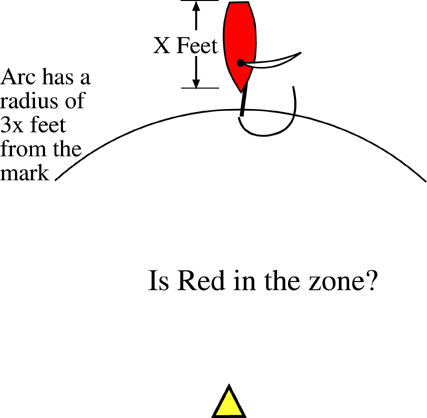
If you answered the quiz question "yes", you answered incorrectly because the boat in the diagram is not yet in the "zone". The definition of ZONE states that it is the area around a mark within a distance of three hull lengths (shown by the arc) but then it goes on to say "A boat is in the ZONE when any part of her hull is in the ZONE".
If you look again at the diagram, you'll see that part of the sprit and spinnaker are inside the arc defining the zone but no part of the hull has made it.
In every other situation where there is a question about a boat reaching a certain point (such as starting, finishing or establishing an overlap), the rules use that part of the boat that is furthest in front e.g. hull, crew or equipment. For the purposes of an overlap or finishing, the equipment must be in its normal position.
In my opinion, using hull length to determine when a boat is in the zone is inconsistent and confusing. If a boat's sprit or equipment is used to determine when she has an overlap or when she is finished, why not use it to determine when she is in the zone?
In fact, I think one could make a good argument that hull length plus the sprit should be used to determine the size of the zone. The rules increased the size of the zone from two lengths to three lengths in order to give boats more distance and time to sort out mark roundings and in particular, leeward mark roundings. Boats with their sprits extended are considerably longer than just their hull lengths and it seems logical that their zone size take this length increase into consideration.
I would be interested to hear what other sailors have to say about this.
Butch Ulmer
[email protected]
4388f7c1-29db-4f6d-8ed9-9ba3565663cb|1|5.0
The 2009 ISAF AnnualConferences are over, and there have been some changes made to future versionsof the Racing Rules of Sailing (RRS). A few of those changes go into effect on January 1, 2010; the others won'tgo into effect until we have the next rulebook, in 2013. In this blog, I'll run though thechanges that go into effect this coming January 1.
When I show a rule below,any text that is struck through is in the current rule and will be deletedstarting in 2010, and any bold text is new for 2010.
There are six changes thatgo into effect this January 1: One change to rule 18, Mark-Room; one change tothe definition of Obstruction; onechange to the definition of Partyto a hearing; one change to Appendix B for windsurfers to agree with the changein rule 18; a new mark-room rule in Appendix C for match racing; and a bunch ofamendments to appendices having to do with advertising. The good news is, for most fleet sailors there willbe no impact from any of these changes.
IMMEDIATEChange 1, Rule 18.2(c)
This change simply corrects a mistake I and the restof the Section C Working Party made when we drafted the new rule 18, and isdiscussed at length in an earlier blog I published on this site. The change was proposed by the sameworking party who made the error in the first place, and had universal supportamongst sailors and rulies alike:
18.2 Giving Mark-Room
(c) When a boat is required to give mark-room by rule 18.2(b), she shall continue to do so even iflater an overlap is broken or anew overlap begins. However, if either boat passes head to wind or ifthe boat entitled to mark-room passeshead to wind or leaves the zone, rule 18.2(b) ceases to apply.
Without this change, a boatapproaching a leeward mark could spin just before she got to a pack of boatsthat she owed mark-room to, and then simply sail inside them without breakingany rules. This maneuver has beenused successfully a few times in both team racing and fleet racing, so the ISAFRRC felt this was important enough to warrant an urgent change. To work, the move had to be done inlight air, in slow, highly maneuverable boats such as Tech Dinghies orInterclubs, so unless you sail one of those classes you were never going to seeit – and even then, you might not have done so. In any case, the "spin and win" play won't workafter this coming January 1.
IMMEDIATECHANGE 2, Definition Obstruction:
This change removes boatsentitled to room or mark-room from the list of things that can beobstructions:
Obstruction An object that a boat could not pass without changingcourse substantially, if she were sailing directly towards it and one of herhull lengths from it. An object that can be safely passed on only one side andan area so designated by the sailing instructions are also obstructions. However, a boat racing is not an obstruction to other boats unless they are required to keepclear of her, give her room or mark-room or, if rule 22 applies, avoid her. A vessel underway, including a boat racing, isnever a continuing obstruction.
I discussed this issue atlength in a previous blog; in my opinion, it will clear up some potential"conflicts" between rule 18 (Mark-Room) and 19 (Room to Pass anObstruction), but it might also make it more difficult to see quickly whichboats around you are obstructions.
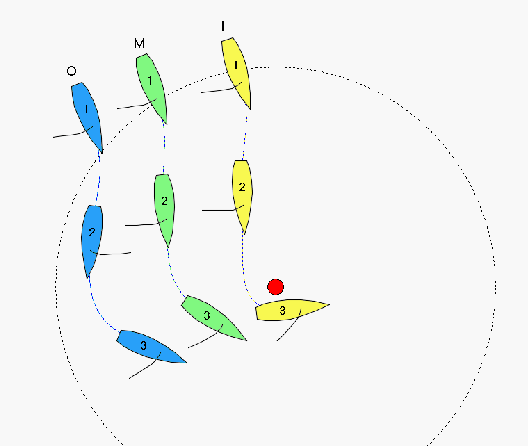
In order for this change towork properly, sailors must realize that if Boat O is required to give Boat Mroom at an obstruction, or mark-room at a mark, and Boat M is required to giveroom or mark-room to Boat I, then Boat O must give Boat M space to provide roomto Boat I. In the diagram below, Ois required by rule 18.2 to give M room to sail "to the mark". That means that in the absence of I, Mis only entitled to room to sail directly to a point near the mark where shewill begin to turn to round it. But because M owes mark-room to I, the space M needs to sail "tothe mark" includes the space she needs to give I to do likewise.
The Section C Working partyhad submitted a proposed new ISAF Case that said, "Room is defined as the space needed for a seamanlikemaneuver, and it is not seamanlike to break therules." This proposed Casewas not approved by ISAF, though the ISAF Racing Rules Committee agreed thatthe principle was valid in general. The reason they didn't approve the new Case was the followingargument: Suppose that two boatsare on starboard tack, approaching the starting line to start, and the Z Flagor Black Flag is flying from the RC boat (see rules 30.2 and 30.3). If the leeward boat luffs the windwardboat, she must give that boat room to keep clear (see rule 16.1). But if the windward boat breaks theplane of the starting line, she will break rule 30.2 or 30.3, so according tothe general principle above, it would not be seamanlike for her to do so. Thus, if in keeping clear she is forcedto enter the "forbidden triangle", she could get the leeward boatdisqualified and claim exoneration for breaking rule 30.2 or 30.3. This is clearly not the result we intendedwhen we drafted the Case! Ipredict that a new Case will be submitted next year, saying something like,it's not seamanlike to break to rules of Part 2 and rule 31. If you have some good words to achievethis succinctly and clearly, please let me know!
IMMEDIATECHANGE 3, Definition Party
This change came from theISAF Race Officials Committee, and is simply common sense. The problem came up as a result of aredress hearing at last year's US Olympic Trials (the Hall v. Rioscontroversy). The change is asfollows:
Party A party to a hearing: aprotestor; a protestee; a boat requesting redress or for which redress isrequested by the race committee or considered by the protest committee underrule 60.3(b); a race committee acting under rule 60.2(b); a boat or competitor that may be penalized underrule 69.1; a race committee or an organizingauthority in a hearing under rule 62.1(a).
Under the current rules, if a boat requests redressthen she is a "party" to the redress hearing (so she gets the rightto question witnesses, to remain in the room while other witnesses arequestioned, to ask for a reopening of the hearing under certain conditions, toappeal the decision, etc.); but if the redress hearing was originally requestedby the race committee or brought by the protest committee on the boat's behalf,then she is not entitled to those privileges. This is clearly unfair and unintended. In drafting the change, Charley Cook,the ISAF Race Officials Committee chairman, realized that the same privilegesshould be granted to race committees and protest committees when they wereinvolved in the situation that led to the hearing. For some reason, the ISAF Racing Rules Committee didn’t wantto make protest committees parties to hearings involving their own actions, sothey only extended the definition to race committees. Theoretically, this means that if a competitor files forredress based on an improper action of the protest committee and a new panel isformed to hear the redress request, then the old protest committee cannot bothtestify about their actions and defend them – they have to be excused from theroom during the argument phase of the protest (see rule 63.3(a) – I read"protest committee" there as meaning the current panel, not the old one). In practice this doesn't happen, and inany case the change is good, and shouldn't be very controversial.
IMMEDIATECHANGE 4, Appendix B
Appendix B, for windsurfing, restates rule 18.2(c);so when ISAF changed that rule (see CHANGE 1 above) they had to change AppendixB as well. For the record, here'sthe change:
Rule B3.1(c)
Rule 18.2(c) is changed to:
When a board is required to give mark-room by rule 18.2(b), she shall continue to do so even iflater an overlap is broken or anew overlap begins. However, if either board the board entitled to mark-roompasses head to wind rule 18.2(b)ceases to apply.
IMMEDIATECHANGE 5, Appendix C
This is a new rule for match racing, unrelated to anyof the other changes. It says:
C2.12 Rule 18.2(e) is changed to ‘If a boatobtained an inside overlap andfrom the time the overlap began,the outside boat has been unable to give mark-room, she is not required to give it.’
Obviously, if you're not a match racer this new rulewon't affect you directly. But it'san interesting change, and needs some explanation. Rule 18.2(e) says "If a boat obtained an inside overlapfrom clear astern and, from the time the overlap began, the outside boat has been unable to give mark-room, she is not required to give it." The phrase "obtained [the] insideoverlap from clear astern"was not in the 2005-2008 rules, and the match-race folks wanted to revert tothe old rule.
Why would they want that? Consider the situation shown in the diagram below, takenfrom Match Race Call UMP 34. Themark is to be left to starboard.
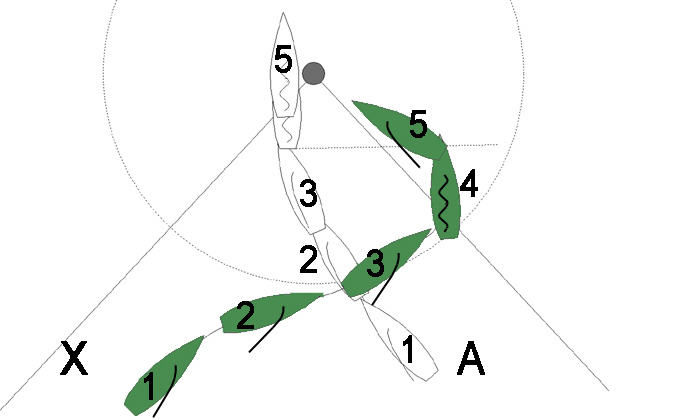
In this situation, when A and X enter the zone theyare on opposite tacks, so rule 18 does not apply to them; and so when X tacksrule 18 applies but rule 18.2(b) doesn't -- meaning that the only mark-room rule that could apply is rule18.2(a), which simply gives the inside boat mark-room. At about position 4, X becomes theinside boat, and as soon as X passes head to wind, A is required to give X mark-room. But A physically cannot provide thatroom, so X has to go the wrong side of the mark and when she protests, she winsthe protest. The reason rule18.2(e) doesn't apply here is that X established the overlap by tacking, notfrom clear astern. Note that rule18.3 doesn't apply because A is not fetching the mark – she has to tack to passto windward of it (see definition Fetch).
Under the new rule C2.12, A does not have to provideroom if she cannot do so from the time the overlap begins, i.e., from the timeX passes head to wind. On the faceof it, this seems like a good change, but I don't think it is wellthought-out. Consider the simpleand very common situation diagrammed below:
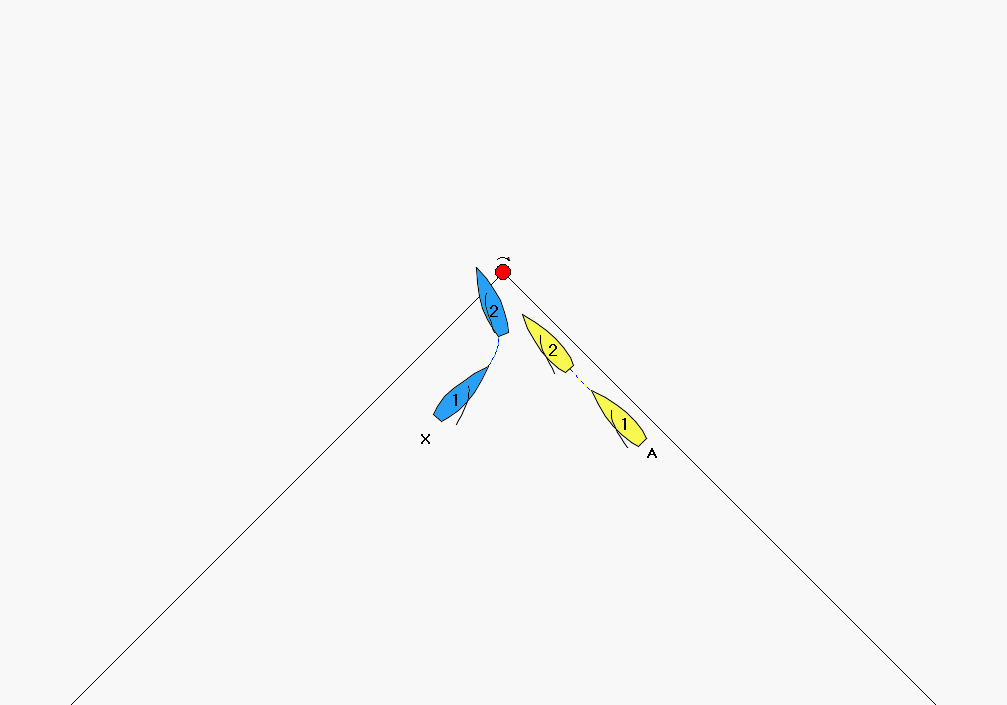
In this case, X tacks ahead and to leeward of A, andso close to the mark that she cannot physically give A mark-room. Using the same arguments as before, wesee that rule 18.2(a) applies from the time X passes head to wind, so she mustgive A mark-room. If she cannot doso and the boats are fleet racing, X breaks rule 18 when she fails to givemark-room – rule 18.2(e) does not apply because the overlap was established byX's tack, not from clear astern.
But if the boats are match racing under new ruleC2.12, X does not have to give A mark-room because there is no physical way shecan provide space for A between her and the mark. Rule C2.12 says that since she was not able to provide roomfrom the time the overlap began, she does not have to do so. A must go thewrong side of the mark, and if she protests she receives a green flag. Furthermore, if she interferes with X'smark rounding she may well break rule 23.2 (see my earlier blog on thistopic).
Note that rule 13 applies between positions 1 and 2,and X must keep clear of A while she's tacking; but if X is a length or soahead of A, that isn't hard for her to do. Additionally, after X completes her tack she must initiallygive A room to keep clear, but in the situation above A can easily keep clearby going the wrong side of the mark.
So, I think this is a new match-racing move for X,and guess what? It gives the boaton the left side of the leg control over the boat on the right – exactly theopposite of the current match race status!
IMMEDIATE CHANGE 6, Advertising
The last change is purely technical; it simplyconforms all the rules that refer to advertising to the wording in theAdvertising Code in ISAF Regulation 20. We used to have categories of advertising, with Category A being themost restrictive. These Categorieshave been eliminated in the Code, so ISAF removed the references to Category Ain the RRS, and at the same time cleaned up some other wording. There was clearly no urgency about thischange (most of which was in Appendix K, which is not even a rule), and the changewould normally have waited until 2013 to take effect; but because there weregoing to be other Immediate Changes (see 1-5 above) anyway, ISAF went ahead andmade the advertising edits "urgent", putting them into effect thiscoming January 1. For the record,here they are:
J1.2 Thenotice of race shall include any of the following that will apply and thatwould help competitors decide whether to attend the event or that conveys otherinformation they will need before the sailing instructions become available:
(1) that competitor advertising will be restricted toCategory A or that boats will be required to display advertising chosen andsupplied by the organizing authority (see ISAF Regulation 20) and otherinformation related to Regulation 20;
J2.2 Thesailing instructions shall include those of the following that will apply:
(1) that competitor advertising will be restricted toCategory A (see ISAF Regulation 20) and other information related toRegulation 20;
Appendix K
2 ADVERTISING
See ISAF Regulation 20. 2.1 Competitor advertising will be restricted to
Include other applicable Category A. asfollows: ______.
information related to
Regulation 20.
See ISAF Regulation 2.2 Boats may [shall] [may] be required to display
20.(d) 20. advertisingchosen and supplied by the
organizing authority.
Appendix LSee ISAF Regulation 21 ADVERTISING
20.3(d)
information on the suppliedbythe organizing authority
advertising material. as follows: ______.
60d81875-a115-40b3-968b-f8a06858a9b0|1|3.0
The
following two-picture sequence provides visual evidence of why tacking
in the zone at a windward mark is such a dangerous thing to do.
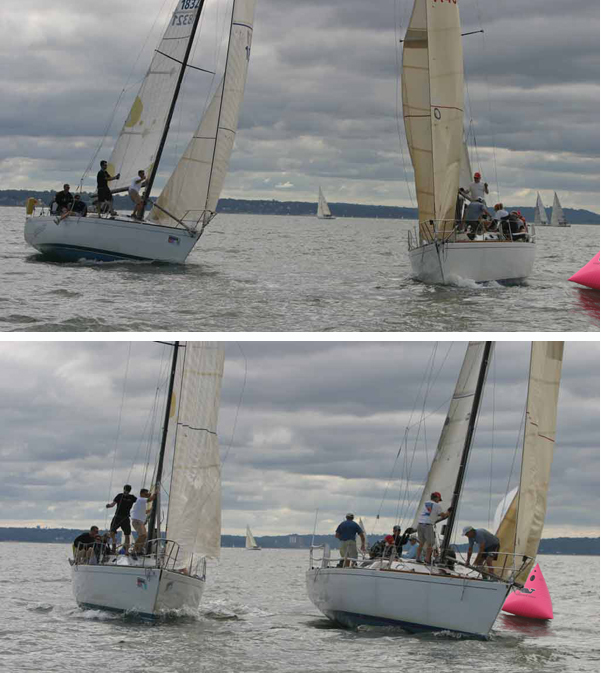
In the
first picture, the boat on the left is on starboard tack and the boat
on the right is either on port tack or has just passed head to wind and
is tacking. (Her angle of heel would indicate she's still on port tack
but her genoa seems to indicate that she has reached or passed head to
wind.
In the second picture, the port tack boat has probably completed her
tack or is just above a close hauled course and the starboard tack boat
has luffed above close-hauled and the boats appear to be overlapped by
a reasonable amount.
Let's look at the situation rule by rule.
THE RULES:
If the right hand boat is on port tack, Rule 10 ON OPPOSITE TACKS applies and states that …"a port tack boat shall keep clear
of a starboard tack boat".
If on the other hand, the boat on the right has passed head to wind,
Rule 13 WHILE TACKING applies. It says, "After a boat passes head to
wind, she shall keep clear" of other boats until she is on a
close-hauled course"
Right here it's worth looking at the first part of the
definition of KEEP CLEAR. It says "One boat keeps clear of another if
the other can sail her course with no need to take avoiding action…".
Clearly, given the proximity of the boats to each other and
the apparent speed of the boat on starboard tack, "avoiding action" on
her part is going to be a necessity. Whichever rule applies, the right
hand boat is in tough shape!
So far, the presence of the mark and the fact that both boats are in the ZONE
has had no impact on the situation. However, Rule 18.3 TACKING WHEN
APPROACHING A MARK puts the nail in the coffin of the boat on the
right.
Rule 18.3 applies when:
A. Two boats are approaching a mark on opposite tacks.
B. One of them changes tack and is subject to Rule 13 in the ZONE.
C. The other boat is fetching the mark.
Since all these conditions have been met, Rule 18.3 applies here. The rule goes on the say that the boat that tacked;
(a) shall not cause the other boat to sail above close-hauled to avoid her or prevent the other boat from passing the mark on the required side and
(b) shall give mark-room if the other boat becomes overlapped inside her.
The left hand boat appears to have overstood the mark but still
had to luff above close-hauled to avoid the boat that tacked. Note that
had she decided to duck under the boat that tacked (certainly a
possibility), she would be entitled to mark-room.
Taken in sequence, there are a string of rules that the port
tack boat could be protested for breaking. In each case, even if the
issue was in doubt (obviously there is no doubt here), a Protest
Committee is likely to come down in favor of the boat on starboard so
this is truly a "no win" scenario.
What should the port tack boat do?
1. Don't go to the port tack layline. It's just asking for trouble.
2.
If you find yourself there anyway (the wind does go left from time to
time), consider bearing off and sailing fast so that your tack to round
the mark will be outside the zone.
3. If you're on the layline and can do it, duck the starboard boat or
boats. Giving up a couple of boatlengths is better than a DSQ.
4. If you're on the port layline and clearly crossing the starboard
boat (s), don't tack at the mark. Continue on port tack and let the
starboard boat(s) round inside you. Once again, you'll be giving up a
little distance but that's better than the alternative.
Another factor to consider here is Rule 14 AVOIDING CONTACT.
The starboard tack boat is required to take avoiding action if he
thinks the port tack boat is not keeping clear. A Protest Committee is
going to listen carefully if the starboard boat says, " I altered
course to avoid contact".
Even if his judgment of the distance between the boats is questionable,
the PC is likely to give him the benefit of the doubt because he
avoided contact.
f485efb7-5290-418a-af9a-f1944cd06881|1|3.0
The ISAF Section C Working Party has made two submissions to ISAF that deal with rules 18 and 19. One is an "emergency" change in the definition of Obstruction, to go into effect January 1, 2010, and the other is a proposed ISAF Case dealing with the meaning of Room.
Before we get into the submissions themselves, let's look at the problem the working party is trying to solve. There are a number of scenarios in which Rule 18, Mark-Room, and Rule 19, Room to Pass an Obstruction, appear to conflict. Consider the following scenario, taken from a team-race call suggested by Matt Knowles. The boats are at a reach mark to be followed by a run:
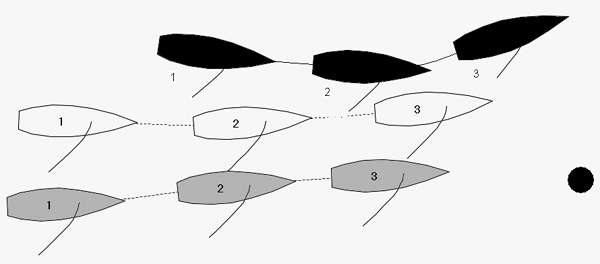
Black is clear ahead of both Grey and White when she enters the zone, and Grey is inside White when they the zone. Grey and White are sailing faster than Black. Grey sails to pass to leeward of Black, and White elects to sail between Grey and Black. In doing so, White forces Black to luff up. Black protests White under rule 18.2(b) for not being given mark-room, and White protests Grey under rule 19 for not giving her room to pass to leeward of Black.
White's argument is that Black is an obstruction to both Grey and White because they both owe Black mark-room (see definition 'Obstruction'). So when Grey elects to go to leeward of Black, she must give White room to do so, too. By sailing up toward White between positions 1 and 2, Grey fails to give White room, causing White to sail too close to Black and thus forcing Black above her course to the mark. White admits she broke rule 18.2(b) with respect to Black but claims she was compelled to do so. She points out that when it became clear that Grey was not going to give her room under rule 19 at position 2, she could not avoid both Black and Grey. So that means Grey should be disqualified, and White exonerated under rule 64.1(c) for her breach of rule 18.2(b).
Grey sees it a different way. White is required to give mark-room to both Grey and Black, and from positions 1 through 3 that means giving them room to sail to the mark. White could easily have seen that at position 1 that she would not be able to go between Black and Grey and still give mark-room to both of them, so she wasn't "compelled" to break rule 18.2(b). Therefore White should not be exonerated. Grey says she herself broke no rule; she was entitled to room under rule 18.2(b) and was simply taking the room to which she was entitled.
(Note that Grey can insure she is blameless by bearing off toward the wrong side of the mark to give White room to pass between her and Black, and protesting White. Now White has clearly broken rule 18.2(b) by not giving Grey room to sail to the mark, and Grey has given room as required by rule 19.)
This apparent conflict between rules 18 and 19 is caused at least in part by the fact that Black is an obstruction to both White and Grey. That's because the definition of Obstruction says a boat racing is an obstruction only if they both "required to keep clear of her, give her room or mark-room or, if rule 22 applies, avoid her." If those words " give her room or mark-room" were removed, then White's case disappears. Black would only be an obstruction as long as both Grey and White are clear astern of her, and after that, Grey would be under no obligation to give White room to pass to leeward of Black.
This is the substance of the submission the Section C Working Party has put forward to ISAF. The definition Mark-Room would say "… However, a boat racing is not an obstruction to other boats unless they are required to keep clear of her or, if rule 22 applies, avoid her. …"
But wait; think about the following scenario:
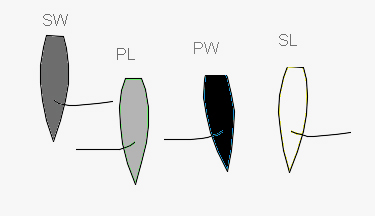
Under the current definition, PW is an obstruction to both PL and SW because, even though PW has right of way over neither of them, they both owe her room to pass SL. This means that SW must give PL room to pass between her and PW. Under the proposed definition, neither PL nor PW would be obstructions to SW. SW would still be required to give PL and PW room to pass SL because SL has right of way over all those boats; but why should SW give PL room to avoid PW?
The answer is a basic principle, not explicitly stated in the Racing Rules of Sailing, but nonetheless clearly implied: Room is defined as the space needed for a seamanlike maneuver, and it is not seamanlike to break the rules. Because SW owes PL room to pass between her and SL, and because PL cannot do that without giving room to PW, thus SW must give PL room to give PW room.
Because this is not explicit in the rules, nor in the ISAF Cases, the Section C Working Group has proposed a new ISAF Case that makes this principle explicit. The summary of the proposed Case says "When a boat is entitled to room, the space she is entitled to includes space to comply with the rules."
Before making these submissions, the working group spent a lot of time thinking of scenarios where the change to the definition of Obstruction might cause problems. Despite our efforts, we could think of none. Can you think of any place on the racecourse where the words "give her room or mark-room" are necessary in the definition of Obstruction? If you can, please let me know by commenting on this blogsite, or contact any of the members of the Section C Working Party: Ben Altman, Chris Atkins, Dick Rose, Richard Thompson, or myself, by e-mail. E-mail addresses for Ben Altman, Dick Rose and me are on the US SAILING website, at http://raceadmin.ussailing.org/Rules/Committee.htm.
62bf0ac9-4707-4cc9-bfbd-de7ad913f312|1|5.0
During a recent day race, the Race Committee signaled a course change to the right at the leeward mark. The change mark was not in the water at that time but the original mark was still in position because it was being used by other classes. The windward leg was short for the boats involved and the visibility was unlimited.
Although the course change was reasonably significant, the short length of the leg meant that the new mark would not be very far from the old mark.
As the leading boats neared the vicinity of the old mark, it was obvious that no new mark had been set. A mark boat with a mark in it was in sight but since the mark was in the boat, no one paid much attention to it.
Just before the lead boats reached the old mark (having decided to race to it), the mark boat dropped the new mark about 200 yards in front of one of the trailing boats. The trailing boat continued on to the new mark, rounded it and was first to finish. The lead boats tacked back to port, reached off to round the new mark and finished well behind the boat that had been trailing.
A request for redress was filed and after a short hearing, the Protest Committee granted redress and abandoned the race.
In the protest hearing, the Race Committee representative, in defense of what happened, asked two questions of the protestor:
1."Why didn't you just sail to the new spot indicated by the new bearing and range"?
2. "Suppose fog had set in-what would you have done then?"
A couple of points came out in response to question #1.
The first was that the mark boat was in approximately the right spot indicated for the change mark. However it had been in evidence throughout the race (given the good visibility and the short length of the legs). The assumption by the leaders was that if he were going to drop a new mark, he'd have done it already.
The second point was that all the boats were navigating by eyeball. No one had bothered with electronic navigation because the marks had been clearly visible from the starting line before the race started. Therefore, the position of the new mark became somewhat of a question as boats sailed away from the leeward mark.
The issue of decreased visibility is an interesting one. For cruising boats with electronic aids for navigation (which these were), one would expect no trouble finding a new mark assuming it is in the right position. However, what about smaller one design boats that have no electronic capabilities? Is it fair to continue a race when the mark can't be easily seen?
Obviously, the density of the fog or anything else adversely impacting the visibility has to be considered. Bad visibility is a relative term. One quarter of a mile is one thing, one quarter of a boat length is quite another.
Rule 33 deals with changing the next leg of a race and the first paragraph of the rule ends by saying that the new mark need not be in position when the course change is signaled. So when does it have to be in position?
There is no guidance in the rules or appeals on when a change mark should be in place so I checked with a number of experts including Mary Savage, Rob Overton, Dave Perry and Peter Reggio to get their opinions.
Here is an amalgamation of what they had to say:
As a competitor, you know that the race committee must tell you that the next leg is being changed before you reach the mark that starts that leg.
Also, the race committee has to tell you where the new mark will be using one of the methods found in Rule 33 (a) or (b).
You should have every expectation that the race committee will have the new mark in place in time for you to approach and round it using the tactics that you see fit to use in that race. There will probably be a difference in your tactics if the visibility is bad and you cannot see either the mark or your competition but you can assume that the mark is where the race committee said it would be.
Do not expect the race committee to abandon a race if the visibility deteriorates or even if they make a minor mistake. In general, this is not a road PRO's like to travel. If you feel that you have been disadvantaged by the race committee's actions (or lack of action), be prepared to request redress.
Common sense is the rule of the day for both competitors and race committees in this situation.
If you're the PRO or you're running the mark boat, put yourself in the competitors' shoes.
1. The new mark needs to be in the right spot.
2. The new mark needs to be in the water early enough for the boats to make a good approach.
3. If the mark boat has a problem, it should get to the right spot and fly Flag M.
If you're a competitor, remember race committees make mistakes so punch the position of the new mark into your GPS regardless of the conditions. If you're sailing a small boat without electronics and the visibility goes bad, time your tacks with your stopwatch and use your compass to keep track of the wind direction.
cd91ce13-6333-424b-b859-af9cadd90b45|0|.0
There's been a new spate of discussion about when, in thedefinition of mark-room, a boat is "sailing to the mark" andwhen she's "at the mark". Unlike the earlier discussion of this topic when the new rules firstcame out, most of this recent discussion comes out of match racing. In that discipline, in many races there aremore umpires than skippers and tacticians combined, to decide when precisetransition points have been reached; and for consistency of calls, everybodywants the umps to have as little latitude of interpretation as possible. Of course, in fleet and team racing, whichdo not have such resources, such precision is impossible to achieve; but itstill might be helpful to try to define what is meant.
I'veargued before in the UK-Halsey blogsite that the distinction between the rightsof a boat "sailing to the mark" and "at the mark" is notimportant for the purpose of rule 18.2, Giving Mark Room, because when a boatis nearly at a mark, her course "to the mark" and her proper coursearound it are essentially the same, so the exact moment when she ceases to besailing to the mark and is now at the mark is irrelevant. But there's a related issue, where thedistinction might be important: Rule18.5 says,
"When a boat is taking mark-room to whichshe is entitled, she shall be exonerated
(a) if, as a result of the other boat failingto give her mark-room, she breaks a rule of Section A, or
(b) if, by rounding the mark on her propercourse, she breaks a rule of Section A or rule 15 or 16."
The rules of SectionA deal with keeping clear, so both parts of the rule exonerate a boat forfailing to keep clear if she's simply taking mark-room to which she's entitled,and the other boat gets in her way; this makes sense, as the other boat wasn'tsupposed to do that.
Rules 15 and 16 area different matter. Rule 15 requires aboat that gains right of way by her own actions to initially give the otherboat room to keep clear, and rule 16 requires a right-of-way boat that changes courseto give the other boat room to keep clear. Exonerating a right-of-way boat from breaking these rules puts a mightyweapon in her hand. She can now carryout actions against the boat that owes her mark-room, which she could not doanywhere else on the racecourse.
The opportunity to take such aggressive actions withoutpenalty is, of course, the grist of the match racing mill, so naturally matchracers and umpires want to know exactly when a boat is "rounding themark"; seeing that this is in some way related to "at the mark",they want to know if"rounding themark" in rule 18.5 is the same as the transition in the definition of mark-roomfrom "sailing to the mark" to "at the mark".
My answer is "Being at the mark is related, but notidentical, to rounding it." To see why I say they're related, consider thesituation at a port-rounding leeward mark, where the inside boat (S) is onstarboard tack, with right of way over the port-tack boat (P) outside her. Suppose S is just entering the zone andshe's not at that moment sailing toward the mark. If she turns to her course to the mark in such a way that Pcannot keep clear, she breaks rule 16. Does she get exonerated for thatbreach? I think we'd all say, no, shedidn't change course "by rounding the mark", she did it while sailingto the mark. So she would getexonerated if she broke a rule of Section A (which she can't do, she's theright-of-way boat) but not for breaking rules 15 or, as in this case, 16.
On the other hand, suppose S has sailed to the mark and, forwhatever reason (maybe there's a current she misestimated) she ends up aimingat the wrong side of the mark and needs to turn to starboard at the lastsecond, to get to the correct side of the mark. She has right of way, so she doesn't need her mark-room to turnto pass on the right side of the mark; but if she turns so fast that she failsto give the other boat room to keep clear, ordinarily she'd run afoul of rule16. In this case, however, I think sucha turn is exonerated by rule 18.5. Shebroke rule 16 "by rounding the mark". In effect, her right to exoneration is the same as under the2005-2008 RRS.
Note that the turn of the boat at the edge of the zone mighthave pretty much the same radius at that of the boat at the mark – thedifference is that at the mark she turns sharply by rounding the mark, whereasat the edge of the zone she's turning sharply to sail to the mark, and that'snot an exonerated action.
So "at the mark" and "by rounding themark" are not synonymous, but they're related by the fact that a boat boatcannot be rounding the mark when she's still sailing to it, only when she's atit. (On the other hand, even if she's at the mark, a sharp turn that's not toround the mark would still get her into trouble if she breaks rule 16 when shedoes it.)
This gets us back to the question of when a boat is at amark. Unfortunately, it turns out to bedifficult to define the moment of arrival "at the mark" precisely(which is why the rule-writers didn't put a more precise definition into therules). For example, we might betempted to say that a boat is "at the mark" when the mark isalongside her, i.e., the mark is abeam of some part of her hull and equipmentin normal position. But that clearlydoesn't work – consider a boat like the one in the scenario above, whicharrives at the mark with the mark directly in front of her. Surely if she's only inches from the markshe's "at" it in any reasonable sense of the word; yet she's notalongside the mark. Conversely, a boatapproaching the mark might turn away from the mark so that the mark is abeam ofher bow, but if she's two of her lengths from the mark with nothing but waterbetween her and it, she's surely not "at" the mark in any reasonablesense.
Another approach to defining "at the mark", whichI think I like, is to look at the boat's proper course. If a boat's proper course is to sail towardthe mark in preparation for rounding it (taking into consideration other boatsshe needs to give mark-room to or keep clear of), then she's sailing "tothe mark"; if her proper course is to turn to round the mark (even if thatturn is counter to the direction to the next mark, and even if she's somedistance from the mark), she's "at" it. And, if she does turn to round it while taking mark-room to whichshe's entitled and she thus breaks rule 15 or 16, she's exonerated for doingso.
And that, I'm afraid, is the best we can do for the matchracers.
b15f556c-aa8d-40f4-881c-3f725c5203c3|0|.0
There's been a new spate of discussion about when, in thedefinition of mark-room, a boat is "sailing to the mark" andwhen she's "at the mark". Unlike the earlier discussion of this topic when the new rules firstcame out, most of this recent discussion comes out of match racing. In that discipline, in many races there aremore umpires than skippers and tacticians combined, to decide when precisetransition points have been reached; and for consistency of calls, everybodywants the umps to have as little latitude of interpretation as possible. Of course, in fleet and team racing, whichdo not have such resources, such precision is impossible to achieve; but itstill might be helpful to try to define what is meant.
I'veargued before in the UK-Halsey blogsite that the distinction between the rightsof a boat "sailing to the mark" and "at the mark" is notimportant for the purpose of rule 18.2, Giving Mark Room, because when a boatis nearly at a mark, her course "to the mark" and her proper coursearound it are essentially the same, so the exact moment when she ceases to besailing to the mark and is now at the mark is irrelevant. But there's a related issue, where thedistinction might be important: Rule18.5 says,
"When a boat is taking mark-room to whichshe is entitled, she shall be exonerated
(a) if, as a result of the other boat failingto give her mark-room, she breaks a rule of Section A, or
(b) if, by rounding the mark on her propercourse, she breaks a rule of Section A or rule 15 or 16."
The rules of SectionA deal with keeping clear, so both parts of the rule exonerate a boat forfailing to keep clear if she's simply taking mark-room to which she's entitled,and the other boat gets in her way; this makes sense, as the other boat wasn'tsupposed to do that.
Rules 15 and 16 area different matter. Rule 15 requires aboat that gains right of way by her own actions to initially give the otherboat room to keep clear, and rule 16 requires a right-of-way boat that changes courseto give the other boat room to keep clear. Exonerating a right-of-way boat from breaking these rules puts a mightyweapon in her hand. She can now carryout actions against the boat that owes her mark-room, which she could not doanywhere else on the racecourse.
The opportunity to take such aggressive actions withoutpenalty is, of course, the grist of the match racing mill, so naturally matchracers and umpires want to know exactly when a boat is "rounding themark"; seeing that this is in some way related to "at the mark",they want to know if"rounding themark" in rule 18.5 is the same as the transition in the definition of mark-roomfrom "sailing to the mark" to "at the mark".
My answer is "Being at the mark is related, but notidentical, to rounding it." To see why I say they're related, consider thesituation at a port-rounding leeward mark, where the inside boat (S) is onstarboard tack, with right of way over the port-tack boat (P) outside her. Suppose S is just entering the zone andshe's not at that moment sailing toward the mark. If she turns to her course to the mark in such a way that Pcannot keep clear, she breaks rule 16. Does she get exonerated for thatbreach? I think we'd all say, no, shedidn't change course "by rounding the mark", she did it while sailingto the mark. So she would getexonerated if she broke a rule of Section A (which she can't do, she's theright-of-way boat) but not for breaking rules 15 or, as in this case, 16.
On the other hand, suppose S has sailed to the mark and, forwhatever reason (maybe there's a current she misestimated) she ends up aimingat the wrong side of the mark and needs to turn to starboard at the lastsecond, to get to the correct side of the mark. She has right of way, so she doesn't need her mark-room to turnto pass on the right side of the mark; but if she turns so fast that she failsto give the other boat room to keep clear, ordinarily she'd run afoul of rule16. In this case, however, I think sucha turn is exonerated by rule 18.5. Shebroke rule 16 "by rounding the mark". In effect, her right to exoneration is the same as under the2005-2008 RRS.
Note that the turn of the boat at the edge of the zone mighthave pretty much the same radius at that of the boat at the mark – thedifference is that at the mark she turns sharply by rounding the mark, whereasat the edge of the zone she's turning sharply to sail to the mark, and that'snot an exonerated action.
So "at the mark" and "by rounding themark" are not synonymous, but they're related by the fact that a boat boatcannot be rounding the mark when she's still sailing to it, only when she's atit. (On the other hand, even if she's at the mark, a sharp turn that's not toround the mark would still get her into trouble if she breaks rule 16 when shedoes it.)
This gets us back to the question of when a boat is at amark. Unfortunately, it turns out to bedifficult to define the moment of arrival "at the mark" precisely(which is why the rule-writers didn't put a more precise definition into therules). For example, we might betempted to say that a boat is "at the mark" when the mark isalongside her, i.e., the mark is abeam of some part of her hull and equipmentin normal position. But that clearlydoesn't work – consider a boat like the one in the scenario above, whicharrives at the mark with the mark directly in front of her. Surely if she's only inches from the markshe's "at" it in any reasonable sense of the word; yet she's notalongside the mark. Conversely, a boatapproaching the mark might turn away from the mark so that the mark is abeam ofher bow, but if she's two of her lengths from the mark with nothing but waterbetween her and it, she's surely not "at" the mark in any reasonablesense.
Another approach to defining "at the mark", whichI think I like, is to look at the boat's proper course. If a boat's proper course is to sail towardthe mark in preparation for rounding it (taking into consideration other boatsshe needs to give mark-room to or keep clear of), then she's sailing "tothe mark"; if her proper course is to turn to round the mark (even if thatturn is counter to the direction to the next mark, and even if she's somedistance from the mark), she's "at" it. And, if she does turn to round it while taking mark-room to whichshe's entitled and she thus breaks rule 15 or 16, she's exonerated for doingso.
And that, I'm afraid, is the best we can do for the matchracers.
b68668b3-e56e-4c78-891a-1ed6ba6b7435|0|.0