We just received our first shipment of Dave Perry's new edition of "Understanding the Racing Rules of Sailing through 2012". As I mentioned in an earlier posting, Dave's book is my bible on the rules and I wouldn't be without it. Indeed, I can't imagine any serious racer not having a copy. As he does in his rules seminars, Dave brings the rules to life with his writing. When combined with the simple-to-understand illustrations, you have the perfect recipe for digesting a tough and sometimes hard-to-understand entree.
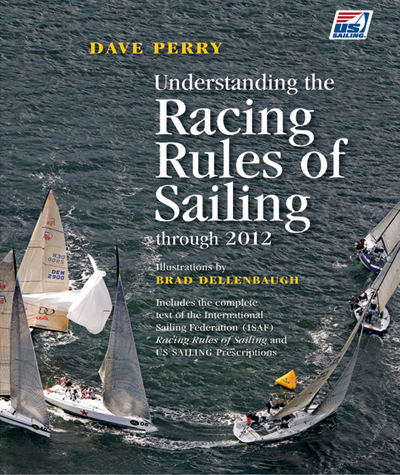
The book takes each of the rules apart, piece by piece and explains what they mean and how they work. He often gives an historical perspective e.g. it used to be this way, now it's that way and cites ISAF cases by number where they help clarify a situation. You come away not only knowing the rule but often how it ended up saying what it says.
In the same blog posting where I referred to Dave's book as my rules bible, I recommended a book by Bryan Willis (2009-2012 The Rules in Practice) and called attention to the different perspective used in the Willis book. I think that someone who is serious about the racing rules should own both of them. There is no such thing as too much knowledge of the rules and I for one intend to read them side by side. IMHO a good understanding of the rules is worth two or three places in every major regatta you sail in.
Both books are in stock and available at the UK-Halsey store. The prefect gifts for the sailors you know!
7c1b510a-d858-49df-94eb-b78a113c7d7a|0|.0
Note: This is the third in my series of blogs on the new Section C rules that come into effect January 1, 2009. In these blogs, I’ll refer to the 2005-2008 Racing Rules of Sailing as the “old rules” and to the 2009-1012 version as the “new rules”.
The focus of these blogs is on changes in the game induced by the new rules of Section C, and on places where it looks as if there might be a game change, but I believe there will be none.
In my last blog, we looked at a restriction placed by the new rules on mark rounding – under the old rules a boat clear ahead was granted right of way and freedom from rule 16 (Changing Course) as long as she was turning to round the mark; under the new rules she is only given room to sail her proper course and only gets freedom from rule 16 as long as she is doing so. I argued that, at the end of the rounding, the old rule allowed her to turn past her course to the next mark without breaking rule 16, while the new rule only allows her to turn to that course – after that, she risks breaking rule 16.
In this blog, we’ll look at what appears to be a huge difference between old rule 18 and new rule 18 (Mark-Room): the old rule granted boats right of way to boats that would ordinarily have to keep clear under the rules of Section A (port/starboard, windward/leeward, etc.). The new rule 18 doesn’t do that. And although that looks like a huge game change, I don’t think it will make any difference at all, other than making it easier to remember which boat has rights.
Non-Game Change 2. The preamble to Section A of Part 2 (When Boats Meet) says “A boat has right of way when another boat is required to keep clear
of her” Old rule 18 says, in several places, that such-and-such a boat “shall keep clear of” the other boat. Putting two and two together, we get that the other boat was just granted right of way. So, for example, whereas a starboard-tack boat has right of way over a port-tack boat on the open race course, under the old rules a port-tack boat that was clear ahead at the zone got right of way over the starboard-tack boat behind her, and she kept that right of way throughout the rest of the rounding. Under the new rule 18, the words about keeping clear have been removed, so throughout the rounding, a starboard-tack boat always has right-of-way over a port-tack boat, a leeward boat always has right-of-way over a windward boat, etc.
Let’s see how this works for two boats overlapped at the zone at a leeward mark to be left to port. There are four cases: (1) they’re both on port tack; (2) they’re on opposite tacks with the starboard-tack boat inside; (3) they’re on opposite tacks with the port-tack boat inside; and (4) they’re both on port tack.
Case 1: Both on starboard tack. The inside boat is also the leeward boat, so she has right of way. She can do a “tactical rounding” (see my last blog) and the other boat has to give her room to do so. If she’s not restricted by rule 17, she can sail any course she wants as long as she doesn’t turn too sharply and break rule 16. If the inside boat falls astern of the other boat, she is technically required to keep clear, but usually there’s no issue as she’s going slower than the other boat. If there’s any danger of fouling the other boat she has to sail toward the mark (no tactical rounding!), and the other boat has to give her room to do so. No change in the game from old rule.
Case 2, inside boat on starboard, outside boat on port. The inside boat has right of way, and can sail anywhere she pleases, subject to rule 16. However, under rule 18.4 she cannot sail farther from the mark before she jibes than her proper course. No game change here, except at gate marks, which I’ll cover in another blog. When she jibes onto port tack, she becomes the keep-clear boat and only gets room to sail to the mark and then round it – no change in the game.
Case 3, inside boat on port tack, outside boat on starboard. Now the inside boat is required by rule 10 to keep clear, so she only has the right to sail to the mark, and the outside boat is required to give her room to do so. Room to sail to the mark generally means room to sail to a point where she can begin a tight, seamanlike rounding, but if there are other boats around that she is required to keep clear of or to whom she owes room, she is entitled to additional room to sail around them (because it would be unseamanlike to break the rules). If she wants a tactical rounding, she should jibe to starboard so she’ll be the leeward, right-of-way boat. No game change. When the outside boat jibes to go around the mark, the inside boat must still keep clear under rule 11. No game change.
Under the old rules, if the outside, right of way boat fell astern of the inside boat she lost her right of way and had to keep clear. This would appear to have given the inside boat more power, but in practice in fleet racing the previously inside boat would normally continue on the course she was originally on, and if she swung wide for a tactical rounding it wouldn’t matter because the other boat was clear astern and unable to prevent such a move regardless of right of way. At the mark, the rights of the inside/clear-ahead boat are substantially the same under the new rules as under the old ones (see my first blog).
Case 4, both boats on port tack. The analysis here is identical to that for case 3, except that the outside boat never jibes. No game change.
Now let’s look at what happens when one of the boats is clear ahead at the zone. This time, there are three cases: (1) They are on the same tack; (2) they’re on opposite tacks with the starboard-tack boat ahead; and (3) they’re on opposite tacks with the port-tack boat ahead.
Case 1, boats on same tack. No change from the old rules because the boat ahead has right of way under rule 12. If they are on starboard tack and the boat ahead jibes, she keeps her right of way under the old rules but loses it under the new rules; however, in practice she will only jibe when she’s at the mark, and at that point the boat astern has to give her room to go around the mark on her proper course, so she’s lost no actual rights. If they’re both on port tack, it’s a parade around the mark under both sets of rules. (Note that in team racing the situation is much different – under the old rules if both boats were on port tack the boat ahead could sail wide and then slow down, and if the boat astern sailed into an outside overlap, the inside boat could just sit there, allowing teammates to go inside her while the other boat had to sail all the way around her. Under the new rules she can still sail wide at first, but if the other boat sails into an outside overlap so the boat ahead becomes the windward boat, she is only entitled to mark-room. At that point she has to sheet in and go around the mark, because the definition of mark-room only includes room to round the mark “promptly” on her proper course; sitting there with sails luffing is not “promptly” rounding, and letting other boats without rights to pass inside her is surely not her proper course. But in fleet racing this ploy makes no sense – there’s no benefit to holding another boat up and letting the leaders get away while the boats behind close up the gap.)
So the only change from deletion of the change in right of way will be that now everybody will be able to see and remember who has right of way – it’s the same as on the open course.
c7884a5e-b0b9-4311-9209-126ea6d0bd53|1|5.0
This is the second in a series of blogs on the new Section C rules that come into effect January 1, 2009. In these blogs, I’ll refer to the 2005-2008 Racing Rules of Sailing as the “old rules” and to the 2009-1012 version as the “new rules”.
In the last blog, we looked at the changes in the game due to the new, larger zone and examined the new definition “Mark-room”, which says “Room for a boat to sail to the mark, and then room to sail her proper course while at the mark …”. I argued that the first part, about sailing to the mark, is pretty much what we all thought was required by the old rules, even though they didn’t actually say it. Then I claimed that the second part, about proper course, doesn’t actually give a boat entitled to mark-room any more freedom than the current rules do.
But there is one situation where the change from “room to round” in the old rules to “proper course” in the new rules will make a game change; and, ironically, it’s a place where the boat entitled to room gets less rights under the new rules than she did under the old ones.
Game Change 2. Let’s picture the situation where boat A is clear ahead of boat B at the zone, with nobody outside A. Under new rule 18 (Mark-Room), B will owe A mark-room throughout the rounding. If she’s smart, A does a “tactical rounding”, i.e., she starts wide, planning to come in close to the mark at the end of her turn. (The only time A will not be able to do a tactical rounding is if B has right of way and is able to establish an outside overlap on A inside the zone. In that situation, A must sail directly to the mark.) The tactical rounding is faster for most boats than a “seamanlike” rounding because most boats slow considerably when they turn sharply. Not only that, but a wide approach allows the boat to come to the mark already on a close-hauled course, so she gets to take a higher line on the next leg. But there’s often a third reason for A to do a tactical rounding – she secretly hopes that B will take the bait and try to go inside her and she plans to “shut the door” on B at the end of her turn. Because A is entitled to mark-room, she’ll be exonerated for breaking the basic right of way rules and rules 15 and 16 as well, as long as she is sailing her proper course to round the mark. If she’s smart, A plans to make this move in such a way that contact with B, if any, is minimal; that way, A can’t be penalized for breaking rule 14 (Avoiding Contact).
But what happens if A misjudges her turn and sails too deep as she approaches the mark? Under the old rules, if she wanted to close out B badly enough she could luff up above close-hauled, maybe even head to wind, to close the door; this usually breaks rule 16 (Changing Course) because B has the mark alongside her at that point and doesn’t have room to keep clear of A. Under the old rules, A was exempted from rule 16 because she’s turning to round the mark. Under the new rules she’s only exempted (“exonerated”) if she’s on her proper course around the mark. Since sailing head-to-wind is hardly her proper course, under the new rules her last-minute desperate maneuver to close the door on B breaks rule 16 and if there’s contact either between the boats or between B and the mark, A will undoubtedly be protested and either have to do her turns or risk disqualification.
In passing, note that in addition to breaking a rule, A is sailing slowly for no good reason when she luffs head to wind. If A were to simply sail her proper course, even if B goes in there A will have better speed and it will be a very short time – maybe seconds – on the windward leg before B will feel the effect of A’s backwind and have to tack away. And A will not have lost distance on the boats ahead.
cd546504-d69c-44db-85f0-ceed9c9cb5ae|0|.0