You’re in first place in a team race, coming up to the starboard-rounding windward mark on starboard tack, with one teammate close astern and the other, far behind. An opponent is approaching on port tack, overstood by about two boatlengths and bow-even with you. You’d like to hold up the opponent using your starboard-tack advantage, and let your teammate slip through behind you. You will then tack and secure the 1-2 winning combination. So you sail past the mark to intercept the opponent as your teammate approaches the mark. The opponent bears off sharply, intending to duck you and follow your teammate around the mark. You bear off to prevent that move. She immediately bears off more and protests, and the umpires signal a penalty on you. The dreamed-of 1-2 suddenly turns into a 1-4-6, and your team has its work cut out, even to get back in the race.
What happened here?
The simple answer is, you broke rule 16.2, which says “…when after the starting signal a port-tack boat is keeping clear by sailing to pass astern of a starboard-tack boat, the starboard-tack boat shall not change course if as a result the port-tack boat would immediately need to change course to continue keeping clear.”
Rule 16.2 is deleted for match racing (though limited by a strange MR Call that prohibits the starboard-tack boat from dialing down more than 90° relative to the true wind direction) but still applies in team racing, and in the situation above it’s very difficult to dial down and prevent the opponent from ducking you without breaking the rule, because the boats are so close.
Note the words “sailing to pass astern …” in rule 16.2. The rule makers didn’t use the obvious alternative, “on a course to pass astern …”, and I think that was intentional. In my view at least, there’s a real distinction between the two phrases. “Sailing to pass astern” signifies a clear intent, not a compass course. So a boat that’s bearing off to pass astern of another boat is “sailing to pass astern” of that boat, even if her bow is still aimed at the other boat – or even if it’s aimed ahead of that boat, as long as it’s clear that the port-tacker is keeping clear by sailing to pass astern of the other boat, not to cross her.
So, what could you have done at that windward mark, to avoid breaking rule 16.2? Obviously, your opponent won’t duck you if that means sailing below the layline, so one answer is to slow while you’re still at the mark and wait for her to commit to crossing ahead of you. Once she can no longer duck you, there’s nothing that prohibits you sheeting in and sailing up to her line, forcing her to tack. Rule 16 only applies to boats changing course, and you’re not doing that.
A second course of action would have been to sail toward her and then, while the boats still far enough apart so you aren’t tacking too close, tack to leeward of your opponent. You may not secure a clear 1-2 immediately if your teammate is too far back, but you now have the opportunity to luff your opponent at the next mark to achieve the balance you were looking for.
A third alternative is to bear off early and hard, so the other boat didn’t have to change course immediately to keep clear, then sail straight at her. That would keep you out of trouble with respect to rule 16.2, but if your opponent doesn’t duck but instead continues on a close-hauled course, you risk having her cross you. You could dial back up to keep that from happening, but now you’ve got to be careful not to break rule 16.1, which says, “When a right-of-way boat changes course, she shall give the other boat room to keep clear.” If your opponent can still keep clear by tacking, then you’re OK – you gave her room to keep clear. But if your dial-up puts her “like a deer in the headlights” you’re about to break rule 16.1. Once she’s crossing in front of your bow there’s nothing she can do to keep clear – tacking would be too close (breaking rule 13) and going straight will lead to a possible T-bone collision (breaking rules 10 and 14).
My friend Charles Higgins says he thinks the rules require her to tack, even though she can’t do so without breaking rule 13. Charles says, “If she tacks, I’m going to luff up and make sure she keeps clear – after all, she’s doing what I want her to do. If she continues to cross, I’m going to go as far as I can without hitting her, then bear off sharply and protest her on port-starboard.” To my mind, the problem with this argument is that it assumes a kind of tacit agreement between the two boats – if the port-tacker does what the starboard-tacker wants her to do, the latter won’t protest. But where in the rules can we find anything like that?
My opinion is that once the port-tack boat has nowhere to go without fouling the starboard-tack boat, it doesn’t matter which option she chooses as long as she doesn’t add to the chance of contact (see rule 14). As it’s clearly to her advantage to go straight, she might as well do so. If there’s contact she should win a protest under rule 16.1.
Suppose you do dial up and prevent your opponent from keeping clear, then you tack or duck so that she ends up keeping clear, after all? Then the incident should be green-flagged. Team Race Call B4 says, “A right-of-way boat changing course may comply with rule 16.1 by changing course further and thus giving the other boat room to keep clear.” So basically if you don’t actually hit your opponent, even if you earlier changed course in such a way that your opponent couldn’t keep clear, you can’t be penalized for breaking rule 16.1.
Finally, note that this whole argument applies equally to boats encountering each other anywhere on a beat, as long as they’re close together when the starboard-tack boat bears off to prevent the other boat from ducking her. And of course it also applies to fleet racing situations, because the applicable rules for fleet and team racing are the same in this situation.
6afb750e-6297-4938-98b9-cf555d833c50|0|.0
Rule 32.1 allows a race committee to abandon a race for several specific reasons: (a) errors in the starting sequence; (b) foul weather; (c) insufficient wind making it unlikely that any boats will finish within the time limit; or (d) a mark missing or out of position. Then rule 32.1(e) plays a trump card, allowing the RC to abandon a race ”for any other reason directly affecting the safety or fairness of the competition.” The rule then goes on to add one caveat: ”However, after one boat has sailed the course and finished within the time limit, if any, the race committee shall not abandon the race without considering the consequences for all boats in the race or series.”
I understand the reason we need the catch-all reason for abandonment in rule 32.1(e): Suppose the race committee learns that a big ship is about to come through the race area and the RC decides that the probability that someone will get hurt or drown is too great to continue racing. Even if the fleet is able to get out of the way safely, the race will have become disasterously unfair to those who had to turn on their engines to avoid being run down by the freighter or got caught on the wrong side of the ship. Of course in such circumstances the RC should abandon all races currently in progress and wait for the ship to come through before restarting.
But in the absence of big ships, deadly squalls and other similar catastrophes, I’m not at all sure what rule 32.1(e) allows, especially with regard to fairness. I’ve heard it said that if the wind changes more then X degrees (30? 40?) or drops below Y knots (4? 3?) the race should be abandoned, even if it’s on its last leg. But suppose a competitor carefully studies the weather patterns before going out on the racecourse and concludes that there will be a big shift to the right sometime in the midafternoon. If she protects the right side in each race after 1 o’clock, is it unfair to the other competitors when she’s in the right place to take advantage of the shift when it occurs? Or is it more unfair to her if the race committee abandons the race because the beat is now almost a fetch or the run is a reach? Suppose a competitor expects the sea breeze to fill in and heads offshore to pick up the first bit of it; is it unfair for her to lead that race by a mile when the sea breeze does fill in? Or is it more unfair for the race committee to take that huge lead away from her by abandoning the race?
One person’s luck is another’s skill, and before abandoning a race RCs should make very sure that whatever happened that made the race ”unfair” in their estimation was really not predictable. I remember the first time I sailed on the Charles River near Cambridge MA as a college Freshman, I was convinced that the huge shifts and puffs coming across the river off the skyscrapers of Boston were random and that the races were a crap-shoot. Then, at the end of the day, I looked at the results and saw that the same sailor (Terry Cronberg, a student at MIT and an All-American that year) had won almost every race. Moral: RCs should assume that the sailor who benefits from big changes in the wind or other conditions is skillful, not lucky.
And what’s this bit about considering the consequences on all boats in the race or series if one or more boats have finished? I’ve been involved in a lot of decisions about whether to abandon a race, and all good race committees consider the effect of abandonment on all the boats, no matter whether one has finished or not. What additional consideration did the rule-makers have in mind, after one or more boats have finished? I’ve actually been present when the RC chairman said, ”OK, we need to consider the effect of abandonment on all the boats. Here goes: The ones that have already finished will lose the benefit of having finished ahead of the other boats, and the ones that haven’t finished will avoid finishing behind them. There, that’s done; let’s abandon.”
But, silly as this sounds, what are RC members supposed to do to fulfill the ”consideration” requirement? I frankly don’t know, except that the rule clearly intends to set a higher standard for abandoning a race after boats have finished within the time limit than before, while putting no limit on when that abandonment can occur (a feature I’ve already ranted about: see my blog ”Fairness” on this site).
The next question is what a protest committee’s role is, in all this. It’s common for on-the-water judges to be involved (usually by VHF radio) in the original decision to abandon, and of course if a boat requests redress for such an action, those judges have to recuse themselves. But in the case of redress, what can the protest committee look at?
The request for redress has to be based (in this case) on the assertion that the race committee acted ”improperly” in abandoning the race (see rule 62). In my mind at least, ”improper” means that the RC either broke a rule or acted in some egregiously unfair manner – for example, they abandoned the race because the local guy wasn’t winning, or something like that. It doesn’t mean that the decision was an error in judgement. Because of the breadth of scope granted to race committees by rule 32.1(e), I don’t think the protest committee can reexamine the RC’s reasons for abandoning, beyond ensuring that they weren’t trying to favor a certain sailor. But how about the requirement that the RC consider the effect on all the boats in the race or series? I think the protest committee has to at least ask what the RC did to ensure that this rule was followed; but what would constitute a good answer?
The US SAILING Race Management Handbook says (p. 275), ” Because of the significance of a race committee’s decision to abandon a race in which one (or more) competitor has finished, the only justifiable reason for taking such action is safety considerations. ” I’m beginning to think rule 32.1 should be changed in line with that advice. RCs could still abandon for reasons of safety, but not for reasons of fairness -- how can abandonment possibly be fair to a boat that’s already won the race?
By the way, it’s too late now to initiate changes to the 2013 RRS. The deadline for sending Submissions to ISAF is the end of this month (July 2011), and, at least in the United States, the process of rule-writing and approval is too long to get anything done on a new initiative in the time left. And ISAF has a requirement that all proposals for changes in the main body of the 2013 RRS have to be made this year. (This gives the people responsible for appendices, calls, and other similar documents a year in which to draft changes to agree with the new rules.) Of course, if there’s a completely world-stopping problem that has to be solved, ISAF can make exceptional changes in the last year of the rulebook cycle – but as far as I know this has never happened and I don’t expect it will happen next year.
f9db4c22-a714-401f-9ae0-36a7ba088f1a|0|.0
There is an error in my blog of 14 April about notification requirements for protests and times for voluntary penalties. Protest flags are not required for boats under 6 meters in length (about 20 feet). My blog erroneously gave 8 meters (about 25 feet) as the minimum length for the flag requirement.
1b80ff8b-a0ce-4703-a971-525d94deeab0|0|.0
Last month, Scuttlebutt published an article by Peter Wilson, complaining that we, as competitors and judges alike, are neither obeying nor enforcing the Fundamental Principle of our sport, as stated in Sportsmanship and the Rules at the beginning of our rulebook. In particular, he notes that sailors are not doing their turns when they know they've broken a rule, and they're not protesting when they know they've been fouled. I've been thinking about that, and there's one thing we rules writers and regatta organizers might do to address this problem: Relax the time and notification requirements for protesting and for taking penalties.
Rule 61.1(a) says, "A boat intending to protest shall inform the other boat at the first reasonable opportunity. When her protest concerns an incident in the racing area that she is involved in or sees, she shall hail 'Protest' and conspicuously display a red flag at the first reasonable opportunity for each. She shall display the flag until she is no longer racing. ..."
The rule goes on to say that these notification requirements are relaxed in certain cases: no hail is required if the boats are too far apart to hear hails, no flag is required for boats shorter than 8 meters (about 25 feet), and none of the requirements apply if there was injury and damage and it's clear that one boat intends to protest. But these are just common-sense exceptions and in most cases don't relieve a protestor of the basic requirement, which is to "inform the other boat at the first reasonable opportunity."
Most protest committees give the protestor a little slack when it comes to the flag - after all, a crewmember has to be freed up to take care of it, and in many boats that means going below, grabbing the flag and tying it up on the shroud or backstay - but in the case of the hail, most protest committees interpret "first reasonable opportunity" to mean "almost immediately". Hailing doesn't involve getting a flag out of the cabin, and if there are no injured crewmembers to care for or damage to fix, protest committees feel that there's really no excuse for delaying the hail.
The requirements for taking a voluntary penalty are similarly strict. Rule 44.2 says "After getting well clear of other boats as soon after the incident as possible, a boat takes a One-Turn or Two-Turns Penalty by promptly making the required number of turns in the same direction ... ." Again, "as soon after the incident as possible" pretty much means right away, unless the boat is among other boats and needs to get clear. Otherwise, there's no excuse for not immediately sailing to a vacant spot and "promptly" spinning.
The assumption, in both instances, is that competitors understand the rules well enough to know, immediately after the incident, who was right and who was wrong. But is that a realistic assumption? Maybe in team or match racing, where competitors know the rules (and the plays) as if they were written on the insides of their eyelids; but what of ordinary sailors who understand the rules moderately well but may not be actively thinking of which rules apply, in rapidly changing situations? In many scenarios, more than one rule applies, so competitors must work through which rules do apply and, if those rules have different outcomes, which ones prevail over the others. And it's reasonable that the crew might discuss the issues before deciding who, if anybody, was at fault.
In match racing, there are two umpires following every move and discussing, as the race progresses, which boat has what rights under the rules at any given time. Despite the fact that those umps are (presumably) experts on the rules and have nothing to do but to decide which boat is right and which boat is wrong, it frequently takes them a minute or two to come to a decision after an incident. Why do we expect sailors, who are generally not "rulies" and who have to pay attention to little things like sailing their boats as well as to the rules, to be faster than match-race umpires in deciding which boat should take a penalty?
In any case, what's the hurry?
There are two arguments in favor of immediate, or almost immediate, protest notification and penalty-taking: The first is to keep a clear relationship between the incident and the protest and/or penalty, and the second is to encourage (well, require) competitors in a self-policing sport to know the rules well enough to know at all times which rules apply and to which boat.
I question the premises of both these arguments. First, consider the issue of tying the protest to the incident. In the vast majority of racing, incidents where rules are broken are quite rare; I'm pretty confident that if a boat is involved in an incident with another boat and, a few minutes later, the other boat tells her she's protesting, the protestee will generally know what it's all about, but if there's any doubt about it she could always ask "What for?" The second argument, that the current notice requirements induce sailors to learn the rules, is patently false - faced with a rules question such as those in the UK/Halsey Rules Quiz, how many ordinary sailors can come up with the right answer without thinking about it? Actually, how many skippers could come up with the correct answer at all, without some discussion with their crew? Yet that's exactly what we require everybody to do on the racecourse.
It is clear that the requirements of rules 44.2 and 64.1 are disincentives to taking voluntary penalties and protesting - which is the heart of Sportsmanship and the Rules. Every time some Opti sailor is fouled and his or her protest is thrown out by the protest committee because he waited for the other boat to spin and/or had to think about the incident before protesting, that kid learns a lesson: Don't protest. And of course the other kid learns a lesson, too: Don't spin.
What can be done about the severe time requirements for hailing and taking penalties? I have two suggestions. The first is easy - rules 44 and 64 can be modified by sailing instructions, so local regattas and series could have an SI saying something like 'Rules 44.2 and 64.1 are changed by replacing the words "as soon after the incident as possible" in rule 44.2 and the two instances of "at the first reasonable opportunity [for each]" in rule 64.1 with "before the end of the leg on which the incident occurs, or, if the incident occurs inside the zone of a mark, before the end of the next leg".' Or, if the race committee thinks that's too generous, state a different limit in time or distance.
My second suggestion is to change the Racing Rules of Sailing. This is a little tricky because the RRS have to accommodate the full range of competitions from novice racing to the Olympics, but perhaps both rules could make some reference to the decision process aboard the boats involved. For example, rule 44.2 might say, "as soon as possible after she decides she may have broken a rule ..." or something like that. Such wording would guide protest committees toward a real-life fact: Deciding which boat broke what rules can take time, and the less experienced the sailors, the more time should be allowed for turns and/or protests, in order to preserve the fundamental principle of our sport.
ad05e8db-7bb2-48d0-b6a2-00b0dfe01842|0|.0
In his excellent rules blog “Unruly” (http://rulestalk.blogspot.com/), Matt Knowles poses the following question:
“Fleet racing downwind in Lasers, light air, approaching the pin end of a downwind finish. The boats enter the zone [as shown in the diagram below]. At position 3, Blue bears off to avoid Yellow and protests. What should the decision be?”
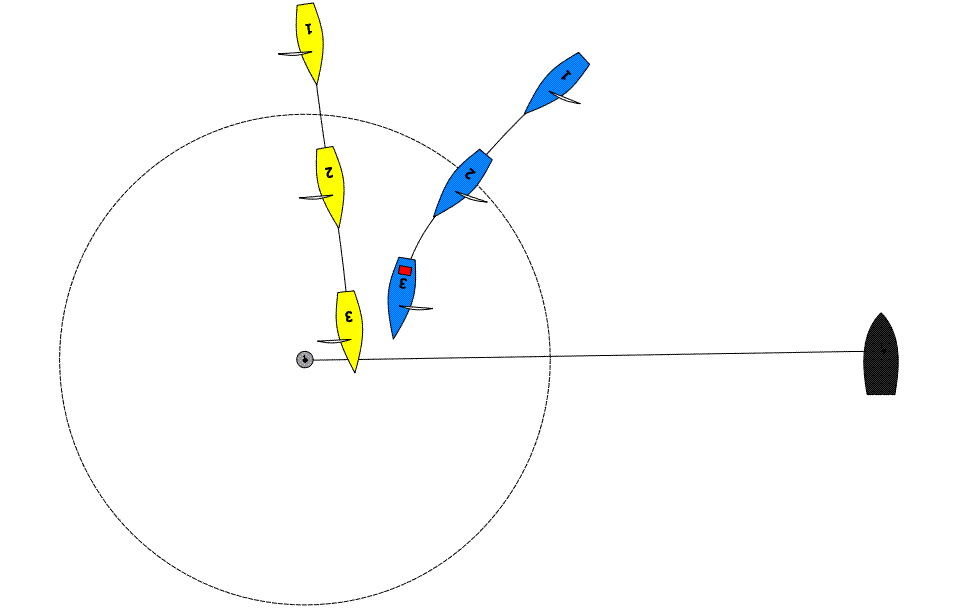
Matt’s answer (with which I agree) is as follows:
“Yellow enters the zone overlapped inside Blue, and is therefore entitled to mark-room.
“Mark-room is room for a boat to sail to the mark, and then room to sail her proper course while at the mark.
“Proper course is a course a boat would sail to finish as soon as possible in the absence of the other boats referred to in the rule using the term.
“At position 3, Yellow is at the mark and has finished. Blue must give her room to sail her proper course. However, because she has finished she does not have a proper course.
“Yellow fails to keep clear of Blue, who has right of way under rule 10. Rule 18.5 begins ‘when a boat is taking mark-room to which she is entitled...’ We must decide whether she is taking mark-room. Because here mark-room is room to sail a proper course, and she does not have a proper course, she cannot be taking mark-room. Yellow is therefore not taking mark-room, and cannot be exonerated by rule 18.5.
"Penalize Yellow for breaking rule 10.”
This answer, while correct, goes contrary to the obvious intent of the rule, so until there’s an ISAF Case on it you might have a bit of a problem convincing protest committees that Blue is required to give Yellow room at the mark right up until Yellow finishes, but not thereafter. I suppose you could bring a copy of Matt’s blog (or this one) with you to the protest room, but Matt and I are hardly officially blessed authorities on the rules, so the protest committee might safely ignore us. Alternatively, if you’re in Blue you might just want to give Yellow room all the way through the incident, as the rule clearly intended you to do.
The primary problem here is with the current definition of mark-room:
“Room for a boat to sail to the mark, and then room to sail her proper course while at the mark. However, mark-room does not include room to tack unless the boat is overlapped to windward and on the inside of the boat required to give mark-room.”
In addition to Matt’s example, there’s another problem with this definition – the "sail to the mark" part doesn’t work well near the edge of zones around passing marks, where the proper course for a boat is to sail toward the next mark, not toward the passing mark. Under the current definition, if boats are running on opposite tacks past a passing mark surrounded by navigable water and the port-tack boat (P) enters the zone clear ahead of the starboard-tack boat (S) but S establishes a late inside overlap in the zone, P can turn toward the mark and force S to the wrong side of it – again, clearly not what was intended by the rule.
The ISAF Section C Working Party, which re-wrote Part 2, Section C of the RRS (i.e., rules 18, 19 and 20), didn’t actually go out of business in 2009 when those rules came into effect, but was appointed by the ISAF Racing Rules Committee to monitor problems with, and reactions to, the new Section C rules – getting help from people like Matt, of course. The WP, of which I confess to being a member, has been aware of Matt’s problem (as well as the passing-mark problem) for some time, and just this week, Richard Thompson, another member of the WP, presented to the ISAF Racing Rules Committee the WP’s latest thoughts on how to fix it. Here’s what the WP is thinking about:
PROPOSED Definition Mark-Room
Mark-Room for a boat is
(a) room for her to leave the mark on its required side, and
(b) when her proper course is to round the mark or pass close to it, room for her to sail to the mark and room to round or pass as close to it as she could in the absence of the boat required to give her mark-room.
However, mark-room does not include room for her to tack unless the boat required to give her mark-room is overlapped to leeward and outside of her, and only if she would be fetching the mark after her tack.
The proposed change in the last sentence solves an entirely different problem, and I won’t address it here. Note that the new definition, unlike the current one, would first state the basic requirement, to allow the boat entitled to room the opportunity to pass on the mark’s required side. It would then amplify this requirement in the situation where a boat’s proper course is to round the mark or pass close to it. So at a passing mark that the boats will not sail near, only part (a) applies, and the port-tack boat in my example above cannot use her right to mark-room to drive the starboard-tacker to the wrong side of the mark. Part (b) is intended to catch the meaning of the current “sailing to” and “at the mark” requirements, but without requiring the reader to decide which of these states applies at a given time. It also removes the requirement for room to sail a proper course at the mark – all the boat with mark-room would be entitled to do is round the mark as closely as she would have done in the absence of the other boat.
In addition to solving Matt’s problem, this would correct a problem originally pointed out by Butch on this blogsite, shortly after the new Section C rules came out: The proper-course phrase allows a long-keeled boat considerably more room at the mark than she has traditionally been allowed.
The wording above is not a formal proposal as yet; the WP did not feel the proposal had received sufficient consideration by this year’s deadline for ISAF Submissions. The only time the WP can now submit a proposal to ISAF is August 1, 2025 for consideration at the ISAF Annual Conference in November 2011. Unless the submission is made on an “emergency basis”, even if it is approved the changes would not go into effect until January 2013.
Clearly, I think the proposal solves Matt’s finishing-line problem, but I could be wrong. If you have any ideas about this proposed change, please comment here (or, if you like, on “Unruly”), or drop me an e-mail message.
13502614-b31f-4c4d-96ea-3e58a64baaad|2|3.5
In my most recent two blogs on this site, I’ve pointed out a couple of problems with the current rule 20: A boat hailed for room to tack can’t legally pass the hail on to a boat that’s to windward of her; and a leeward port-tack boat approaching a starboard-tack boat can legally use rule 20 to “scrape off” the boat to windward of her, then duck the starboard-tacker. Both of those are unintended consequences of the way rule 20 is written, and the US Racing Rules Committee has proposed to change the rule in 2013, to fix those problems.
In this blog, I’ll explore another problem with current rule 20: It starts with the words “When approaching an obstruction, a boat sailing close-hauled or above may hail for room to tack and avoid another boat on the same tack,” so if a boat hails for room to tack when she’s not on a close-hauled course (say, she’s on a reaching leg) then she doesn’t break any rule.
OK, I agree that’s a technicality. But what isn’t a technicality is that the hailed boat doesn’t have to respond if the hailing boat is not sailing close hauled or above, because in that circumstance rule 20 doesn’t apply. Suppose Larry is sailing a slow, old cruising boat and Will is to windward in his brand-new hot racing boat. They’re both on starboard tack approaching a pile of rocks that Larry isn’t fetching, and Larry hails for room to tack. Will looks under the boom and sees that Larry isn’t even close to what Will thinks of as a close-hauled course, so he shouts “You’re not close hauled! I don’t have to tack!”
Of course, Larry might protest and later, after somebody picks him up off the rocks, convince a protest committee that he was indeed close hauled when he hailed, but so what? His boat is gone. Rule 20 is supposed to be a safety rule, and as such, it should require Will to tack and, if he thinks Larry was below his close-hauled course, protest. In order for that to happen, the rule needs to apply regardless of the hailing boat’s course.
Both US SAILING and the Royal Yachting Association (the British equivalent of US SAILING) are proposing to move the expression about the hailing boat’s course down into the section about when a boat shall not hail. This, I think, fixes the problem: the windward boat has to either tack or hail “You tack” and give the other boat room to tack and avoid her. So under that rule, Larry’s boat will float to sail another day.
There’s one problem with the British proposal, though, which in my opinion makes the US proposal better: The Brits simply move the course issue into rule 20.3 When Not to Hail, leaving rule 20 as beginning,
“When approaching an obstruction, a boat may hail for room to tack and avoid another boat on the same tack. After a boat hails, …”.
We felt that with nothing about a close-hauled course, nor about needing to change course for the obstruction, etc., this introduction gives too little information about what the rule is all about and where on the race course it should be used; so new readers will simply say “What the hey?”
To solve this problem and to make the rule look more like the other rules of Section C (and of the rest of Part 2), we’re proposing to move all of the stuff about when a boat can hail to the front of the rule. So our rule 20 would begin:
“When approaching an obstruction, a boat may hail for room to tack and avoid a boat on the same tack, but she shall not hail if
(a) she is sailing below close-hauled,
(b) she can avoid the obstruction safely without making a substantial course change, or
(c) the obstruction is a mark and a boat that is fetching it would be required by rule 20.2(b) to change course as a result of the hail.
This proposal and the rest of the US SAILING Racing Rules submissions to ISAF are available at http://raceadmin.ussailing.org/Rules/ISAF_Rules_Submissions.htm. Please take a look at them and tell me what you think. These changes won't be acted on by ISAF until November, so now is the time for us to catch any mistakes we’ve made, or to turn away from the direction we’re going, if the proposed changes aren’t good ones. Fill out the response form on the page above, send me an email, or submit a comment to this blogsite. Whatever way you choose to comment, I’ll be happy to read it and either suggest to the US Racing representatives to ISAF that we change our submission, or discuss the matter further with you.
9ae05432-8f21-45f1-bf0b-28abc85b77be|0|.0
Situation: In a dinghy race, two boats, PL and PW, are on port tack, approaching S on starboard tack. S is on the starboard-tack layline outside the zone (see diagram). PL is bow-out on PW but overlapped with her, and PL will have to change course substantially to avoid S. At position 1, she hails PW for room to tack. At the moment she hails, there is no chance PL will be able to tack short of S, but PW can do so easily, and does. Then PL ducks S and tacks on her hip. PL fetches the mark nicely but PW, alas, does not. PW protests. What is your call?
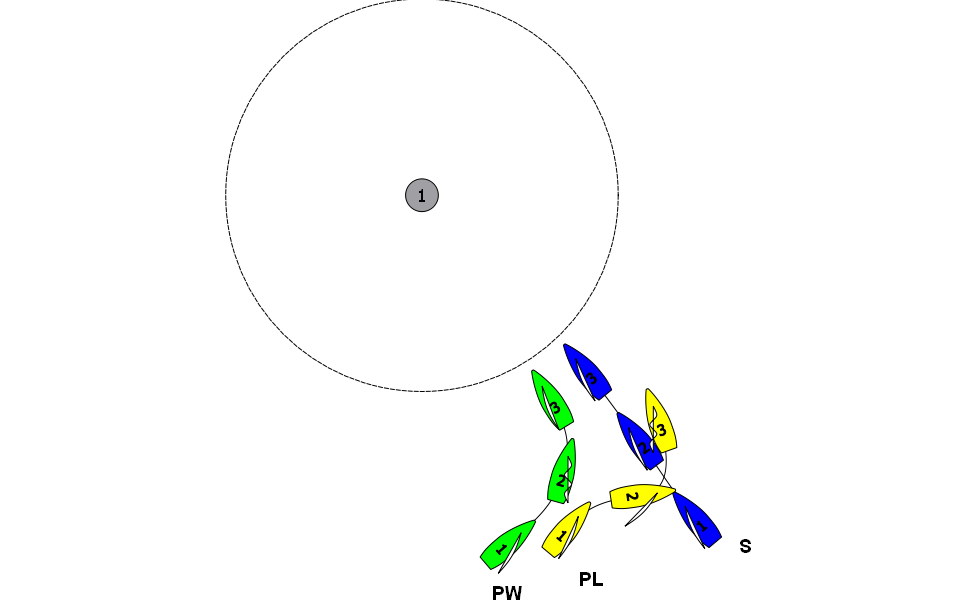
Analysis: Rule 20 HAILING FOR ROOM TO TACK allows PL to hail because she’s on a close-hauled course, S is an obstruction to both her and PW, PL will have to change course substantially to avoid S, and of course S is not a mark so there’s no issue of whether SW is fetching the obstruction. Rule 20 requires PW to tack as soon as possible or to hail, “You tack!” and she elects to tack as soon as possible, which is pretty much immediately. The same rule requires PL to tack as possible after PW tacks, but “as soon as possible” for PL is after she passes S, so that’s when she tacks. No rule is broken; PW is simply screwed.
I can hear you saying “But PW could have hailed ‘You tack!’ and then claimed room to pass behind S!” Unfortunately, the Preamble to Section C says that if rule 20 applies (and it surely applies here, as PL has already hailed for room to tack) then rule 19 does not. So PL is under no obligation to give PW room to duck S, and if PW tries to go between PL and S, PL can bear away to avoid a collision between PW and S (see rule 14), and then protest. The protest committee should find that PW broke rule 11 (Windward/Leeward) and PL broke no rule.
It’s actually a little worse than that for PW, because even if she manages to duck S without fouling PL, she’s still stuck for what to do when PL tacks just after she passes S, as required by rule 20. PW is required to give PL room to tack and clear her, but how can she do that when S is right in the way? So PW is likely to break rule 20 even if she didn’t break rule 11 when she ducked S.
The US SAILING Racing Rules Committee is proposing to change the Preamble to Section C so that rule 19 still applies in this situation. We still have to allow boats to hail when they’re inside the zone, and obviously such a hail could prevent a boat from sailing to the mark, so we still have to “turn off” rule 18 when rule 20 applies, and we propose to do so, inside rule 20 itself.
The ISAF Submissions from US SAILING are posted on the US SAILING website, at http://raceadmin.ussailing.org/Rules/ISAF_Rules_Submissions.htm, along with a convenient form for comments and suggestions. There are several submissions, and unfortunately they are hard to read because of the required ISAF format, but I urge anybody who is interested in what’s happening with the Racing Rules of Sailing to wade through those submissions and, if you find things you don’t like (or that you do like), fill out the comment form. These changes won't be acted on by ISAF until November -- they're only proposals at this point -- so now is the time for us to catch any mistakes we’ve made, or to turn us away from the direction we’re going, if the proposed changes aren’t good ones.
0ea4b61f-b03c-42ba-838b-87a1c6fdc5b7|1|5.0
Three keelboats, L, M and W are all on the same tack, with L to leeward, M in the middle, and W to windward. They are approaching a rock pile that L needs to substantially change course to avoid but M and W do not. L cannot tack without fouling M and M cannot tack without fouling W. The rock pile is not a mark. (See diagram below.)
At position 1, L hails M for room to tack. M hears the hail but W does not, or at least there’s no response from her. So at position 2, M hails W for room to tack, and W immediately tacks in response to the hail; but she also hails “Protest!” and puts up a red flag. M tacks immediately after W, and L tacks immediately after M.
W files her protest correctly, and there is a hearing. Assuming the facts found are as stated above, what is the correct decision for the protest committee?
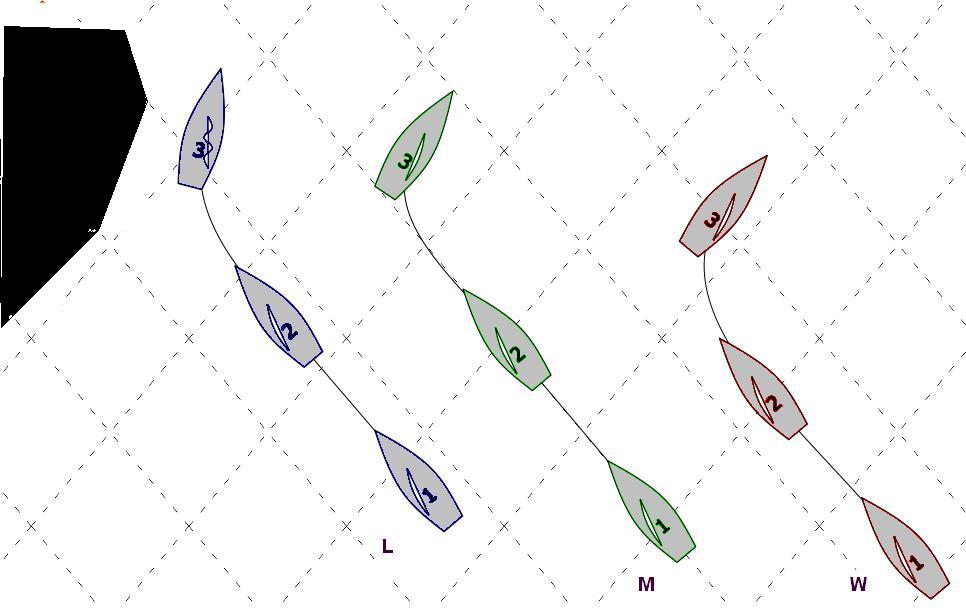
I think most of us would say that Rule 20 worked here exactly as it was intended to do – L needed room to tack to avoid the rocks, and she hailed M correctly as described in the first paragraph of rule 20.1. M passed the hail on to W, and everybody responded as rule 20.1 requires. But actually, there’s nothing in the rule that allows M to pass on the hail to W. L’s hail is perfectly legal, because passing the obstruction requires a substantial change of course for her. But M’s hail is not legitimate because there is no obstruction that requires her to change course at all. M does not have to change course substantially to avoid the rocks, and although as a right-of-way boat L is an obstruction to M, at the time of her hail M does not need to change course to avoid her – and if L were to tack, she would no longer be an obstruction to M. So M’s hail does not conform to the requirements of rule 20, and she breaks the first sentence of rule 20.3, When Not to Hail. Disqualify M.
This answer seems wrong, to me and to lots of other people in the rules community including the entire US Racing Rules Committee. So this year, we are proposing to ISAF to change rule 20 by adding a sentence: " A boat that has been hailed for room to tack may always hail for room to tack and avoid a third boat.” If ISAF accepts our submission, the rule will change in 2013.
We’ve proposed some other changes, too, and I’ll cover them in future blogs. The entire list of rules submissions to the 2010 ISAF Conference in November will soon appear on the US SAILING website; when that happens, I’ll be interested in any comments about them.
3a48a62e-2e3f-4b80-9718-56f513ca69c7|0|.0
In the course of umpiring, I of course see plenty of fouls. Mostly, they’re caused by boat-handling errors – in situations where boats are maneuvering very closely, a few inches one way or another can make the difference between a well-executed play and a foul. And all the rules Part 2 of the RRS are involved, at one time or another.
But patterns do sometimes emerge, and we saw a definite pattern at the Opti Team Race Nationals this July that led me to think that rule 15 is not well understood, even at the top level of Opti sailors, where coaches are common.
The team-race rules are almost exactly the same as the regular rules for fleet racing, making me think that maybe lots of top Opti sailors are ignorant of (or ignoring) rule 15 in fleet racing as well; so I thought a brief review might be a good idea.
The situation the umpires saw repeatedly is roughly the one shown in UK-Halsey Quiz 8. One boat (Green in the quiz) is on starboard tack, luffing her sails just below the starting line and another boat (Red) comes in on starboard tack from behind her. Red establishes an overlap very close to leeward of Green (in the case of Optis, a few inches away) and almost immediately makes contact with the other boat. In the quiz, Red doesn’t change course during the incident, but at the Opti TR Nationals we saw a number of incidents where the overtaking boat also luffed up toward the boat that was luffing her sails on the line.
Either with a change of course or without, Red breaks rule 15, ACQUIRING RIGHT OF WAY, which says: “When a boat acquires right of way, she shall initially give the other boat room to keep clear, unless she acquires right of way because of the other boat’s actions.”
In the starting-line case, the overlap is clearly not established because of Green’s actions: she was just sitting on the line minding her own business. And if Red comes in too close to Green, there’s nothing Green can do to keep clear. If she trims in, she’ll slide down into Red because she hasn’t established any lift on her foils; if Green just sits there, Red runs into her boom.
The amazing thing, to us, was that frequently after this happened Red protested Green and Green did her turn. Of course, this means that the umpires never got involved in that protest, so all we could do is bemoan the fact that the wrong boat was spinning. And of course having one boat already at the back of the fleet at the start is not a great way for a team to win. We wondered afterwards, how many races would have had the opposite outcome if Green had known her rules and stood up for her rights!
On the open race course, and even before the start, the call between rule 15 and the right-of-way rule (such as rule 11, requiring the windward boat to keep clear) comes down to subtleties: Did the windward boat do something, like bear off, that established the overlap? Did the new keep-clear boat do all she could to keep clear? Did the other boat give her room to do so? But at the starting line, with one boat almost dead in the water and the other boat coming in to leeward of her with good way on, there’s rarely a close decision. The boat coming from astern was at least partially responsible for the overlap, so rule 15 almost always applies, and there’s really nothing the new windward boat can do to avoid the contact. So, if there’s contact very soon after the overlap is established, it’s almost always because the boat coming from astern didn’t initially give the new windward boat room to keep clear.
So next time you’re the boat luffing on the line, don’t take any nonsense from a boat that comes in to leeward of you and starts yelling “Up, up!” or something like that. If you have room to do so, trim in and hike out, so you’ll keep clear of the other boat; if you don’t have room and there’s contact, protest under rule 15.
ffb8041b-4209-4354-8281-8542494dc46c|2|3.0
Rule 32.1 says, in part, “After the starting signal, the race committee may shorten the course (display flag S with two sounds) or abandon the race (display flag N, N over H, or N over A, with three sounds), as appropriate, …
(a) because of an error in the starting procedure,
(b) because of foul weather,
(c) because of insufficient wind making it unlikely that any boat will finish within the time limit,
(d) because a mark is missing or out of position, or
(e) for any other reason directly affecting the safety or fairness of the competition.”
The rule goes on to say that if even one boat has sailed the course and finished within the time limit, if any, the race committee cannot abandon a race without considering the consequences for all boats in the race or series.
The parts of rule 32.1 I’d like to address here are the clause in (e) and the lack of any time limit for when the race committee might abandon a race. Lately, I’ve heard about and experienced two rather bizarre applications of (e) above. In both cases, the abandonment happened after the race was concluded – in fact, after all the sailors, and the race committee, were off the water.
The first situation was at a major regatta a few years ago. There was some confusion about what mark to round, and consequently some boats in the fleet went around the wrong mark. They were protested, the protest committee disqualified them for not sailing the course, and they then filed for redress, claiming that the fault was the race committee’s, not theirs.
The protest committee met to consider the redress issue, and brought in a number of skippers, as well as the race committee chairman, as witnesses. They determined that the error had in fact been entirely due to the race committee’s error, but rather than abandoning the race they decided to give average points to the four boats that had gone around the wrong mark.
Meanwhile, the race committee chairman had also become convinced that the error was his. He considered the consequences of abandonment to the boats that had rounded the mark correctly, but on balance he felt that it was unfair for some boats to have to go around a longer course than others, so he decided that the race should be abandoned. The abandonment was announced while the protest committee was still holding the redress hearing. You can imagine their surprise when they came out of the room and discovered that the race they had just been contemplating had been abandoned without their consent! There was, of course, a redress hearing, and I confess I don’t remember the final outcome. But according to the rules, the boats filing for redress had to demonstrate that the abandonment was “improper”, and I know that many judges (including myself) interpret that word very narrowly: Basically, for an action by the race committee to be improper, it has to either break a rule or be so egregiously unfair that it fails the “sniff test” for propriety (as for example when a race committee shortens a Junior regatta race because the local long-shot kid is winning). In our abandonment case, the race committee’s decision appears to have complied with the rules, and I’m not sure it meets the standard of impropriety. They did consider the consequences of abandonment on all the competitors, as required by rule 31.1, and having some boats disqualified for a race committee mistake was surely unfair to those boats.
The second case occurred just a few weeks ago. Again, it was a major regatta; this time, a team-race event. At the finish of one important race, the umpires mistakenly thought a boat had hailed the umpired to resolve a protest decision (displaying a yellow flag as required by Appendix D). So they penalized one of the boats involved in the incident that had led to the protest. That boat had already finished, so she was obliged to do two turns, return to the course side of the line, and finish again. She did so, and as a result her team lost the race.
The losing team requested redress, citing both the blown call and the race committee’s scoring – they claimed the race committee should have scored the boat’s first finish because the penalty was illegally imposed by the umpires. The protest committee decided not to award redress because rule D2.4(c) says, in part, “There shall be no request for redress or appeal by a boat arising from a decision, action or non-action by an umpire.” The blown call was clearly an action by an umpire, so redress could not be granted for it. And the race committee had scored the boat correctly because she had indeed done her turns and finished again.
Then the race committee chairman got into the act. He felt that the umpire’s action had been clearly unfair, so, after considering the consequences of abandoning the race on the other team (they would lose a victory they had not actually won on the water), he abandoned the race. The race was re-sailed the next morning, and the team that had been scored as winning the original race won the re-sail, so there was no request for redress.
Note that in both cases above, the race committee action had the effect of overruling a protest committee decision. In the first case, the abandonment granted a particular redress remedy different from what the protest committee had come up with; and in the second case, the abandonment effectively granted redress where the rules specify that no redress is permitted. Also note that in both cases, the race was long over.
There are lots of other examples of races abandoned after they have been completed, and last year both US SAILING and the British Royal Yachting Association submitted changes to rule 32.1, limiting the time when a race committee can abandon a race. (We wanted to end this option when the race committee came ashore; the RYA wanted to end it after the racing was completed.) The proposals were opposed by the ISAF Race Officials Committee on the grounds that they constituted unwarranted interference in the race committees’ business, and the Racing Rules Committee rejected them.
This leaves an interesting question: When is the last time a race committee can abandon a race? They apparently can do so after the race is over and everybody is ashore, and I don’t see anything that would prevent them from abandoning a race several days after it was run but during the regatta, if they determine that the race in question was “unfair” and if they consider the impact of abandonment on the other boats. (“Well, Mary, what will be the effect on the other boats if we abandon the race?” “Well, Bob, the boats that are now scored in that race will lose those scores.” “OK, Mary, thanks. We’ve now considered the effect of abandonment on the other boats. Race abandoned.”)
But what if the race committee discovers some unfairness in a race, after the last race is run? After the prizes have been given out? After everybody has gone home? How about a week, month, or even a year later? Can the race committee of the America’s Cup in 1987 (when the New York Yacht Club lost the Cup) decide that the last race of that Defense was unfair, and abandon that race?
This is certainly an interesting question, and I’m not sure it will be resolved anytime soon, given the ISAF RRC rejection of the American and British submissions last year.
But the more I think about it, the less I think the problem is the timing of these abandonments. I think the key problem might be that “fairness” is too vague a word. What is fair to one boat may seem grotesquely unfair to another, and, unlike a protest committee, the race committee need not hear both sides of that argument.
Suppose a race begins in 8 knots of breeze, and the first of two windward/leeward laps goes well. Then the wind dies out and fills in from astern. The tail-end boats catch the new breeze, and it becomes clear that they will sail around the hole where the leaders are sitting, becalmed, and the last will be first.
The race committee observes this and says, “Hey, that’s unfair, isn’t it? Those leaders worked hard in good breeze to go to the front of the fleet, and now the tail-enders are going to sail right around them and finish first, simply because they were lucky enough to be where the wind filled in first.” Can they abandon the race? I think rule 32.1 says “Yes,” but I’m not happy with that. Aren’t vagaries in the wind (even unfair vagaries) part of sailboat racing?
How about if, in the middle of a dinghy race, a large cruising boat cuts across the race course? If only a few boats make it across the boat’s bows and the rest are delayed substantially, I’m guessing that the race committee would abandon the race under rule 32.1(e). But how about if the only boats affected are at the back of the fleet? I’m guessing most race committees wouldn’t abandon for them. How fair is that?
It seems to me that this whole fairness issue is a slippery slope.
Should the rule be changed, maybe by limiting rule 32.1(e) to unfairness caused by race committee actions? And if you think there should be a time after which a race committee should not be able to abandon a race, what do you think that time limit should be?
c09361a4-098a-4cd2-9088-08dc8e1c232e|1|5.0