Situation: In a dinghy race, two boats, PL and PW, are on port tack, approaching S on starboard tack. S is on the starboard-tack layline outside the zone (see diagram). PL is bow-out on PW but overlapped with her, and PL will have to change course substantially to avoid S. At position 1, she hails PW for room to tack. At the moment she hails, there is no chance PL will be able to tack short of S, but PW can do so easily, and does. Then PL ducks S and tacks on her hip. PL fetches the mark nicely but PW, alas, does not. PW protests. What is your call?
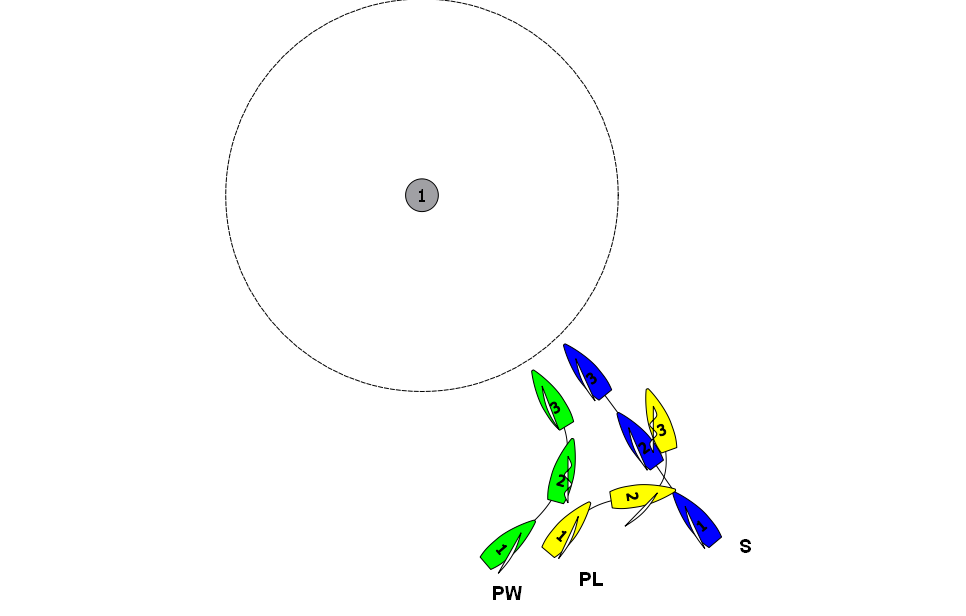
Analysis: Rule 20 HAILING FOR ROOM TO TACK allows PL to hail because she’s on a close-hauled course, S is an obstruction to both her and PW, PL will have to change course substantially to avoid S, and of course S is not a mark so there’s no issue of whether SW is fetching the obstruction. Rule 20 requires PW to tack as soon as possible or to hail, “You tack!” and she elects to tack as soon as possible, which is pretty much immediately. The same rule requires PL to tack as possible after PW tacks, but “as soon as possible” for PL is after she passes S, so that’s when she tacks. No rule is broken; PW is simply screwed.
I can hear you saying “But PW could have hailed ‘You tack!’ and then claimed room to pass behind S!” Unfortunately, the Preamble to Section C says that if rule 20 applies (and it surely applies here, as PL has already hailed for room to tack) then rule 19 does not. So PL is under no obligation to give PW room to duck S, and if PW tries to go between PL and S, PL can bear away to avoid a collision between PW and S (see rule 14), and then protest. The protest committee should find that PW broke rule 11 (Windward/Leeward) and PL broke no rule.
It’s actually a little worse than that for PW, because even if she manages to duck S without fouling PL, she’s still stuck for what to do when PL tacks just after she passes S, as required by rule 20. PW is required to give PL room to tack and clear her, but how can she do that when S is right in the way? So PW is likely to break rule 20 even if she didn’t break rule 11 when she ducked S.
The US SAILING Racing Rules Committee is proposing to change the Preamble to Section C so that rule 19 still applies in this situation. We still have to allow boats to hail when they’re inside the zone, and obviously such a hail could prevent a boat from sailing to the mark, so we still have to “turn off” rule 18 when rule 20 applies, and we propose to do so, inside rule 20 itself.
The ISAF Submissions from US SAILING are posted on the US SAILING website, at http://raceadmin.ussailing.org/Rules/ISAF_Rules_Submissions.htm, along with a convenient form for comments and suggestions. There are several submissions, and unfortunately they are hard to read because of the required ISAF format, but I urge anybody who is interested in what’s happening with the Racing Rules of Sailing to wade through those submissions and, if you find things you don’t like (or that you do like), fill out the comment form. These changes won't be acted on by ISAF until November -- they're only proposals at this point -- so now is the time for us to catch any mistakes we’ve made, or to turn us away from the direction we’re going, if the proposed changes aren’t good ones.
0ea4b61f-b03c-42ba-838b-87a1c6fdc5b7|1|5.0
Three keelboats, L, M and W are all on the same tack, with L to leeward, M in the middle, and W to windward. They are approaching a rock pile that L needs to substantially change course to avoid but M and W do not. L cannot tack without fouling M and M cannot tack without fouling W. The rock pile is not a mark. (See diagram below.)
At position 1, L hails M for room to tack. M hears the hail but W does not, or at least there’s no response from her. So at position 2, M hails W for room to tack, and W immediately tacks in response to the hail; but she also hails “Protest!” and puts up a red flag. M tacks immediately after W, and L tacks immediately after M.
W files her protest correctly, and there is a hearing. Assuming the facts found are as stated above, what is the correct decision for the protest committee?
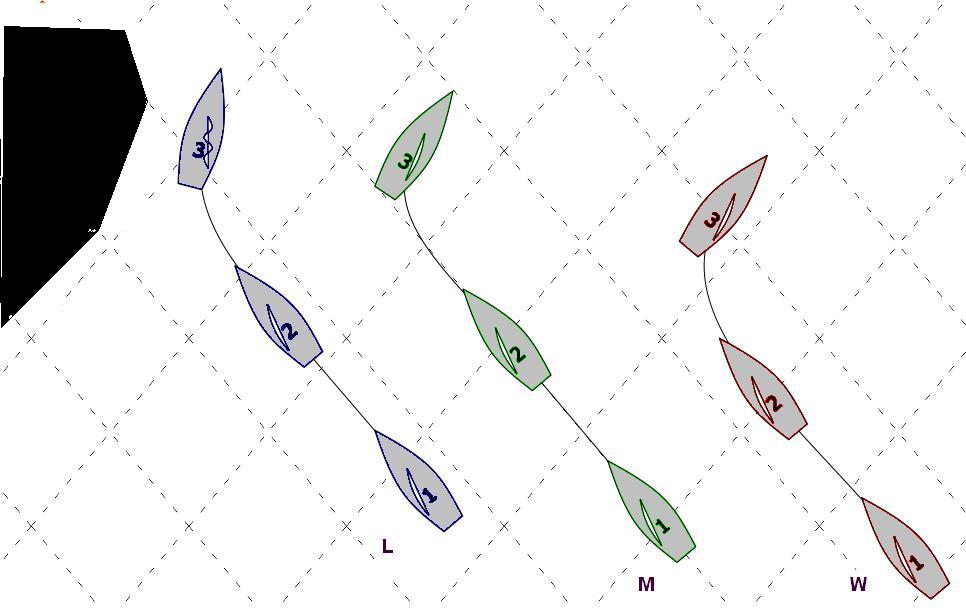
I think most of us would say that Rule 20 worked here exactly as it was intended to do – L needed room to tack to avoid the rocks, and she hailed M correctly as described in the first paragraph of rule 20.1. M passed the hail on to W, and everybody responded as rule 20.1 requires. But actually, there’s nothing in the rule that allows M to pass on the hail to W. L’s hail is perfectly legal, because passing the obstruction requires a substantial change of course for her. But M’s hail is not legitimate because there is no obstruction that requires her to change course at all. M does not have to change course substantially to avoid the rocks, and although as a right-of-way boat L is an obstruction to M, at the time of her hail M does not need to change course to avoid her – and if L were to tack, she would no longer be an obstruction to M. So M’s hail does not conform to the requirements of rule 20, and she breaks the first sentence of rule 20.3, When Not to Hail. Disqualify M.
This answer seems wrong, to me and to lots of other people in the rules community including the entire US Racing Rules Committee. So this year, we are proposing to ISAF to change rule 20 by adding a sentence: " A boat that has been hailed for room to tack may always hail for room to tack and avoid a third boat.” If ISAF accepts our submission, the rule will change in 2013.
We’ve proposed some other changes, too, and I’ll cover them in future blogs. The entire list of rules submissions to the 2010 ISAF Conference in November will soon appear on the US SAILING website; when that happens, I’ll be interested in any comments about them.
3a48a62e-2e3f-4b80-9718-56f513ca69c7|0|.0