The
following two-picture sequence provides visual evidence of why tacking
in the zone at a windward mark is such a dangerous thing to do.
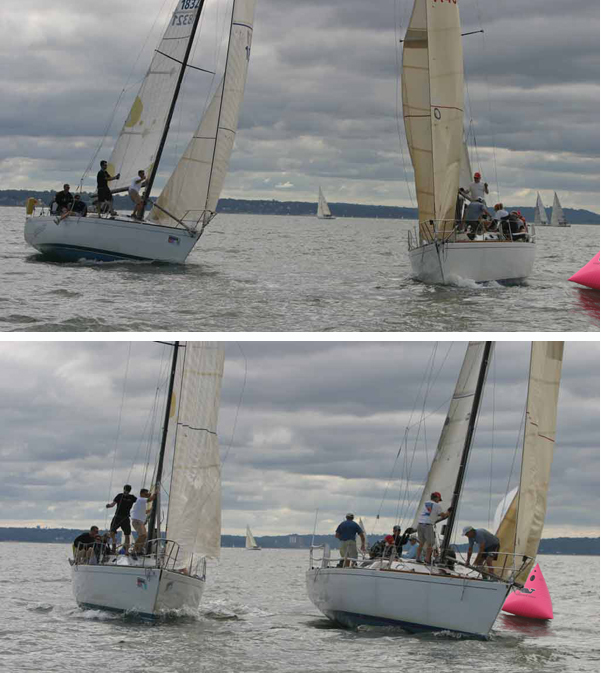
In the
first picture, the boat on the left is on starboard tack and the boat
on the right is either on port tack or has just passed head to wind and
is tacking. (Her angle of heel would indicate she's still on port tack
but her genoa seems to indicate that she has reached or passed head to
wind.
In the second picture, the port tack boat has probably completed her
tack or is just above a close hauled course and the starboard tack boat
has luffed above close-hauled and the boats appear to be overlapped by
a reasonable amount.
Let's look at the situation rule by rule.
THE RULES:
If the right hand boat is on port tack, Rule 10 ON OPPOSITE TACKS applies and states that …"a port tack boat shall keep clear
of a starboard tack boat".
If on the other hand, the boat on the right has passed head to wind,
Rule 13 WHILE TACKING applies. It says, "After a boat passes head to
wind, she shall keep clear" of other boats until she is on a
close-hauled course"
Right here it's worth looking at the first part of the
definition of KEEP CLEAR. It says "One boat keeps clear of another if
the other can sail her course with no need to take avoiding action…".
Clearly, given the proximity of the boats to each other and
the apparent speed of the boat on starboard tack, "avoiding action" on
her part is going to be a necessity. Whichever rule applies, the right
hand boat is in tough shape!
So far, the presence of the mark and the fact that both boats are in the ZONE
has had no impact on the situation. However, Rule 18.3 TACKING WHEN
APPROACHING A MARK puts the nail in the coffin of the boat on the
right.
Rule 18.3 applies when:
A. Two boats are approaching a mark on opposite tacks.
B. One of them changes tack and is subject to Rule 13 in the ZONE.
C. The other boat is fetching the mark.
Since all these conditions have been met, Rule 18.3 applies here. The rule goes on the say that the boat that tacked;
(a) shall not cause the other boat to sail above close-hauled to avoid her or prevent the other boat from passing the mark on the required side and
(b) shall give mark-room if the other boat becomes overlapped inside her.
The left hand boat appears to have overstood the mark but still
had to luff above close-hauled to avoid the boat that tacked. Note that
had she decided to duck under the boat that tacked (certainly a
possibility), she would be entitled to mark-room.
Taken in sequence, there are a string of rules that the port
tack boat could be protested for breaking. In each case, even if the
issue was in doubt (obviously there is no doubt here), a Protest
Committee is likely to come down in favor of the boat on starboard so
this is truly a "no win" scenario.
What should the port tack boat do?
1. Don't go to the port tack layline. It's just asking for trouble.
2.
If you find yourself there anyway (the wind does go left from time to
time), consider bearing off and sailing fast so that your tack to round
the mark will be outside the zone.
3. If you're on the layline and can do it, duck the starboard boat or
boats. Giving up a couple of boatlengths is better than a DSQ.
4. If you're on the port layline and clearly crossing the starboard
boat (s), don't tack at the mark. Continue on port tack and let the
starboard boat(s) round inside you. Once again, you'll be giving up a
little distance but that's better than the alternative.
Another factor to consider here is Rule 14 AVOIDING CONTACT.
The starboard tack boat is required to take avoiding action if he
thinks the port tack boat is not keeping clear. A Protest Committee is
going to listen carefully if the starboard boat says, " I altered
course to avoid contact".
Even if his judgment of the distance between the boats is questionable,
the PC is likely to give him the benefit of the doubt because he
avoided contact.
f485efb7-5290-418a-af9a-f1944cd06881|1|3.0