Racing Rules Blog

Butch Ulmer's discussion of the new rules changes

IN THE ZONE YET?

Posted by butch

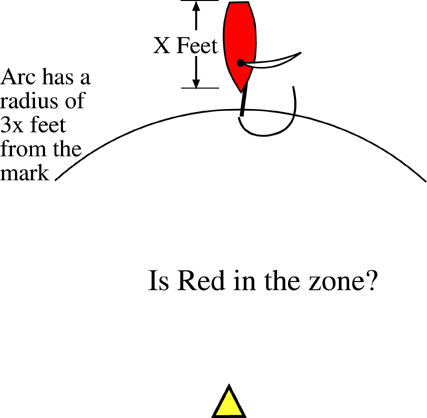
If you answered the quiz question "yes", you answered incorrectly because the boat in the diagram is not yet in the "zone".  The definition of ZONE states that it is the area around a mark within a distance of three hull lengths (shown by the arc) but then it goes on to say "A boat is in the ZONE when any part of her hull is in the ZONE".
If you look again at the diagram, you'll see that part of the sprit and spinnaker are inside the arc defining the zone but no part of the hull has made it.

In every other situation where there is a question about a boat reaching a certain point (such as starting, finishing or establishing an overlap), the rules use that part of the boat that is furthest in front e.g. hull, crew or equipment. For the purposes of an overlap or finishing, the equipment must be in its normal position.

In my opinion, using hull length to determine when a boat is in the zone is inconsistent and confusing. If a boat's sprit or equipment is used to determine when she has an overlap or when she is finished, why not use it to determine when she is in the zone?

In fact, I think one could make a good argument that hull length plus the sprit should be used to determine the size of the zone. The rules increased the size of the zone from two lengths to three lengths in order to give boats more distance and time to sort out mark roundings and in particular, leeward mark roundings. Boats with their sprits extended are considerably longer than just their hull lengths and it seems logical that their zone size take this length increase into consideration.

I would be interested to hear what other sailors have to say about this.

Butch Ulmer

[email protected]

Posted on: 12/22/2009 at 6:15 AM
Actions: E-mail | Kick it! | DZone it! | del.icio.us
Post Information: Permalink | Comments (3) | Post RSSRSS comment feed

Comments

Rob Overton United States

Wednesday, December 23, 2025 5:58 PM

Rob Overton

I think there are two separate issues here.  The first is consistency in the rules.  Consistency is good because consistent language makes the rules easier to read and, more importantly, easier to remember.  So on that level, Butch is definitely right: using boat and equipment to determine starting, finishing and overlaps, and then using just hull length to determine whether a boat is in the zone is inconsistent, and to that extent it's wrong.

But the other consistency issue is between how the zone is defined and how we decide whether a boat is in the zone.  Right now, both use hulls only – the zone is 3 hull lengths (2 for match and team racing, and when the SIs change the definition), and whether a boat is in the zone is determined by her hull only.  So Butch's idea of using hull and equipment for entering and leaving the zone would induce an inconsistency there.  (Note that Butch does not commit on whether the equipment would need to be in proper position.)

Butch would solve this new inconsistency by changing the definition of zone size to include the length of a boat including hull and equipment.  That would make all the definitions consistent – starting, finishing, overlapping, zone size and being in the zone.  Again, this proposal avoids the issue of whether the equipment must be in normal position, but in my opinion that's not the most important issue, which is practicality.  

What would it mean for the size of the zone to be defined by the overall length of the boat nearer to the mark (let's say, with crew and equipment in normal position)?  Consider a class with a 24-foot hull and a 5-foot sprit, including a little piece of batten to keep the sheets from wrapping around the sprit.  This boat enters the zone when she's about 90 feet from the mark.  Let's say she's just dropping her chute as she enters.  As soon as her sprit is retracted, the zone instantly shrinks by 15 feet, or about 5/8 her former length.  Can she actually leave the zone because of this?  I think maybe she could, in light air anyway.  Then when did she enter the zone?  Does rule 18.2(b) apply to the overlaps that existed when she first entered the zone, or when she enters the zone the second time?

I understand Butch's position, and I've got a different solution: Base all the criteria on a boat's hull length.  There's rarely a difference between hull and (hull + equipment) at a windward start, and we could live with hulls instead of hulls plus equipment for downwind starts.  The change from hull and equipment to simply hull to determine finishes was already proposed this year, and actually was adopted by ISAF for match racing, to get around the problem of defining "in normal position", which judges and umpires don't seem to be able to resolve.  (In particular, if a boat drops her chute at a downwind finish, is the chute "in normal position" while it floats out in front of her during the drop?)

As for overlaps, as an umpire I can tell you that it would be a lot easier to determine overlaps if the criterion for overlaps used only hulls, rather than hulls and equipment.  It's almost impossible to determine whether the spinnaker on one boat overlaps a transom of another, especially as the crew trims it in and out and the overlap can be broken and re-established every few seconds, as a result.  

Also, it's not clear how the rules work when the spinnaker of one boat is floating out over the stern of another.  The boats are overlapped, certainly; but which one is leeward and which is windward?  If the boat behind moves slowly forward until her spinnaker touches the backstay of the boat ahead, who just fouled whom?  Umpires would say that since the last point of certainty was when the boat behind was clear astern, that boat should be treated as if she were still clear astern, but this says, in effect, that they weren't overlapped when they were.  

All in all, I'm with Butch.  Let's clear this up.  Let's make boats' hulls the only criteria for starting, finishing, zone size, and overlaps.  That would make the rules more consistent and also easier to use on the water.

Adolfo Mrongowius Argentina

Friday, December 25, 2025 5:04 AM

Well guys, certainly boat´s hulls is very straightfwd. You seem to be aquainted with some sort of common sense right there and then and can only hope that´s contagious.
Should we not only review rules, but encourage coaches and tacts to act accordingly?
The blog has a lot of potential and future!
Merry Xmas

Wasabi United States

Thursday, January 07, 2026 1:04 PM

On the technical overlap scenario raised by Rob in his response to BU the common sense answer (and match racing answer) is that the boat ahead is leeward boat since it is dead downwind of the overtaking boat.  But the definition of  windward/leeward does not take into account this situation.  A change to the definition to add: "When two boats sailing directly down wind overlap, and the boat furthest away from the wind is not on either side of the other, the former boat is the leeward boat.

Comments are closed