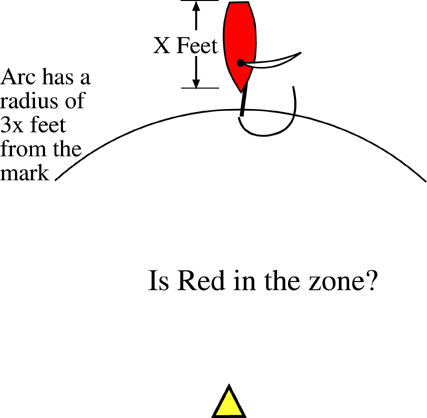
If you answered the quiz question "yes", you answered incorrectly because the boat in the diagram is not yet in the "zone". The definition of ZONE states that it is the area around a mark within a distance of three hull lengths (shown by the arc) but then it goes on to say "A boat is in the ZONE when any part of her hull is in the ZONE".
If you look again at the diagram, you'll see that part of the sprit and spinnaker are inside the arc defining the zone but no part of the hull has made it.
In every other situation where there is a question about a boat reaching a certain point (such as starting, finishing or establishing an overlap), the rules use that part of the boat that is furthest in front e.g. hull, crew or equipment. For the purposes of an overlap or finishing, the equipment must be in its normal position.
In my opinion, using hull length to determine when a boat is in the zone is inconsistent and confusing. If a boat's sprit or equipment is used to determine when she has an overlap or when she is finished, why not use it to determine when she is in the zone?
In fact, I think one could make a good argument that hull length plus the sprit should be used to determine the size of the zone. The rules increased the size of the zone from two lengths to three lengths in order to give boats more distance and time to sort out mark roundings and in particular, leeward mark roundings. Boats with their sprits extended are considerably longer than just their hull lengths and it seems logical that their zone size take this length increase into consideration.
I would be interested to hear what other sailors have to say about this.
Butch Ulmer
[email protected]
4388f7c1-29db-4f6d-8ed9-9ba3565663cb|1|5.0