The 2009 ISAF AnnualConferences are over, and there have been some changes made to future versionsof the Racing Rules of Sailing (RRS). A few of those changes go into effect on January 1, 2010; the others won'tgo into effect until we have the next rulebook, in 2013. In this blog, I'll run though thechanges that go into effect this coming January 1.
When I show a rule below,any text that is struck through is in the current rule and will be deletedstarting in 2010, and any bold text is new for 2010.
There are six changes thatgo into effect this January 1: One change to rule 18, Mark-Room; one change tothe definition of Obstruction; onechange to the definition of Partyto a hearing; one change to Appendix B for windsurfers to agree with the changein rule 18; a new mark-room rule in Appendix C for match racing; and a bunch ofamendments to appendices having to do with advertising. The good news is, for most fleet sailors there willbe no impact from any of these changes.
IMMEDIATEChange 1, Rule 18.2(c)
This change simply corrects a mistake I and the restof the Section C Working Party made when we drafted the new rule 18, and isdiscussed at length in an earlier blog I published on this site. The change was proposed by the sameworking party who made the error in the first place, and had universal supportamongst sailors and rulies alike:
18.2 Giving Mark-Room
(c) When a boat is required to give mark-room by rule 18.2(b), she shall continue to do so even iflater an overlap is broken or anew overlap begins. However, if either boat passes head to wind or ifthe boat entitled to mark-room passeshead to wind or leaves the zone, rule 18.2(b) ceases to apply.
Without this change, a boatapproaching a leeward mark could spin just before she got to a pack of boatsthat she owed mark-room to, and then simply sail inside them without breakingany rules. This maneuver has beenused successfully a few times in both team racing and fleet racing, so the ISAFRRC felt this was important enough to warrant an urgent change. To work, the move had to be done inlight air, in slow, highly maneuverable boats such as Tech Dinghies orInterclubs, so unless you sail one of those classes you were never going to seeit – and even then, you might not have done so. In any case, the "spin and win" play won't workafter this coming January 1.
IMMEDIATECHANGE 2, Definition Obstruction:
This change removes boatsentitled to room or mark-room from the list of things that can beobstructions:
Obstruction An object that a boat could not pass without changingcourse substantially, if she were sailing directly towards it and one of herhull lengths from it. An object that can be safely passed on only one side andan area so designated by the sailing instructions are also obstructions. However, a boat racing is not an obstruction to other boats unless they are required to keepclear of her, give her room or mark-room or, if rule 22 applies, avoid her. A vessel underway, including a boat racing, isnever a continuing obstruction.
I discussed this issue atlength in a previous blog; in my opinion, it will clear up some potential"conflicts" between rule 18 (Mark-Room) and 19 (Room to Pass anObstruction), but it might also make it more difficult to see quickly whichboats around you are obstructions.
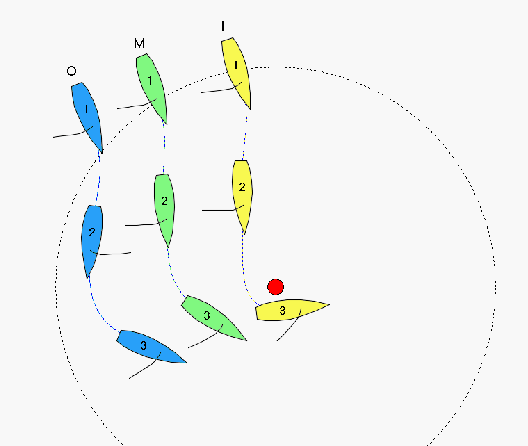
In order for this change towork properly, sailors must realize that if Boat O is required to give Boat Mroom at an obstruction, or mark-room at a mark, and Boat M is required to giveroom or mark-room to Boat I, then Boat O must give Boat M space to provide roomto Boat I. In the diagram below, Ois required by rule 18.2 to give M room to sail "to the mark". That means that in the absence of I, Mis only entitled to room to sail directly to a point near the mark where shewill begin to turn to round it. But because M owes mark-room to I, the space M needs to sail "tothe mark" includes the space she needs to give I to do likewise.
The Section C Working partyhad submitted a proposed new ISAF Case that said, "Room is defined as the space needed for a seamanlikemaneuver, and it is not seamanlike to break therules." This proposed Casewas not approved by ISAF, though the ISAF Racing Rules Committee agreed thatthe principle was valid in general. The reason they didn't approve the new Case was the followingargument: Suppose that two boatsare on starboard tack, approaching the starting line to start, and the Z Flagor Black Flag is flying from the RC boat (see rules 30.2 and 30.3). If the leeward boat luffs the windwardboat, she must give that boat room to keep clear (see rule 16.1). But if the windward boat breaks theplane of the starting line, she will break rule 30.2 or 30.3, so according tothe general principle above, it would not be seamanlike for her to do so. Thus, if in keeping clear she is forcedto enter the "forbidden triangle", she could get the leeward boatdisqualified and claim exoneration for breaking rule 30.2 or 30.3. This is clearly not the result we intendedwhen we drafted the Case! Ipredict that a new Case will be submitted next year, saying something like,it's not seamanlike to break to rules of Part 2 and rule 31. If you have some good words to achievethis succinctly and clearly, please let me know!
IMMEDIATECHANGE 3, Definition Party
This change came from theISAF Race Officials Committee, and is simply common sense. The problem came up as a result of aredress hearing at last year's US Olympic Trials (the Hall v. Rioscontroversy). The change is asfollows:
Party A party to a hearing: aprotestor; a protestee; a boat requesting redress or for which redress isrequested by the race committee or considered by the protest committee underrule 60.3(b); a race committee acting under rule 60.2(b); a boat or competitor that may be penalized underrule 69.1; a race committee or an organizingauthority in a hearing under rule 62.1(a).
Under the current rules, if a boat requests redressthen she is a "party" to the redress hearing (so she gets the rightto question witnesses, to remain in the room while other witnesses arequestioned, to ask for a reopening of the hearing under certain conditions, toappeal the decision, etc.); but if the redress hearing was originally requestedby the race committee or brought by the protest committee on the boat's behalf,then she is not entitled to those privileges. This is clearly unfair and unintended. In drafting the change, Charley Cook,the ISAF Race Officials Committee chairman, realized that the same privilegesshould be granted to race committees and protest committees when they wereinvolved in the situation that led to the hearing. For some reason, the ISAF Racing Rules Committee didn’t wantto make protest committees parties to hearings involving their own actions, sothey only extended the definition to race committees. Theoretically, this means that if a competitor files forredress based on an improper action of the protest committee and a new panel isformed to hear the redress request, then the old protest committee cannot bothtestify about their actions and defend them – they have to be excused from theroom during the argument phase of the protest (see rule 63.3(a) – I read"protest committee" there as meaning the current panel, not the old one). In practice this doesn't happen, and inany case the change is good, and shouldn't be very controversial.
IMMEDIATECHANGE 4, Appendix B
Appendix B, for windsurfing, restates rule 18.2(c);so when ISAF changed that rule (see CHANGE 1 above) they had to change AppendixB as well. For the record, here'sthe change:
Rule B3.1(c)
Rule 18.2(c) is changed to:
When a board is required to give mark-room by rule 18.2(b), she shall continue to do so even iflater an overlap is broken or anew overlap begins. However, if either board the board entitled to mark-roompasses head to wind rule 18.2(b)ceases to apply.
IMMEDIATECHANGE 5, Appendix C
This is a new rule for match racing, unrelated to anyof the other changes. It says:
C2.12 Rule 18.2(e) is changed to ‘If a boatobtained an inside overlap andfrom the time the overlap began,the outside boat has been unable to give mark-room, she is not required to give it.’
Obviously, if you're not a match racer this new rulewon't affect you directly. But it'san interesting change, and needs some explanation. Rule 18.2(e) says "If a boat obtained an inside overlapfrom clear astern and, from the time the overlap began, the outside boat has been unable to give mark-room, she is not required to give it." The phrase "obtained [the] insideoverlap from clear astern"was not in the 2005-2008 rules, and the match-race folks wanted to revert tothe old rule.
Why would they want that? Consider the situation shown in the diagram below, takenfrom Match Race Call UMP 34. Themark is to be left to starboard.
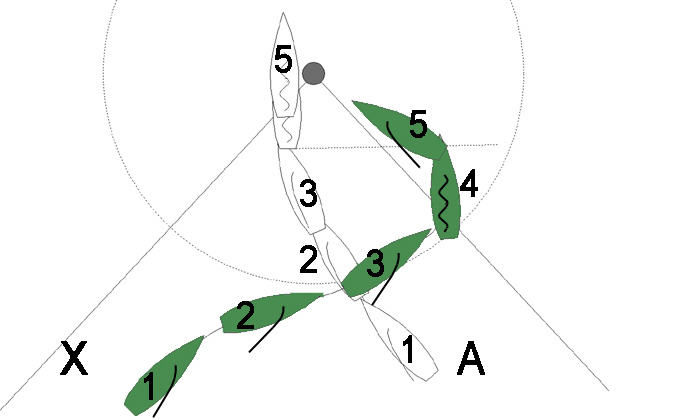
In this situation, when A and X enter the zone theyare on opposite tacks, so rule 18 does not apply to them; and so when X tacksrule 18 applies but rule 18.2(b) doesn't -- meaning that the only mark-room rule that could apply is rule18.2(a), which simply gives the inside boat mark-room. At about position 4, X becomes theinside boat, and as soon as X passes head to wind, A is required to give X mark-room. But A physically cannot provide thatroom, so X has to go the wrong side of the mark and when she protests, she winsthe protest. The reason rule18.2(e) doesn't apply here is that X established the overlap by tacking, notfrom clear astern. Note that rule18.3 doesn't apply because A is not fetching the mark – she has to tack to passto windward of it (see definition Fetch).
Under the new rule C2.12, A does not have to provideroom if she cannot do so from the time the overlap begins, i.e., from the timeX passes head to wind. On the faceof it, this seems like a good change, but I don't think it is wellthought-out. Consider the simpleand very common situation diagrammed below:
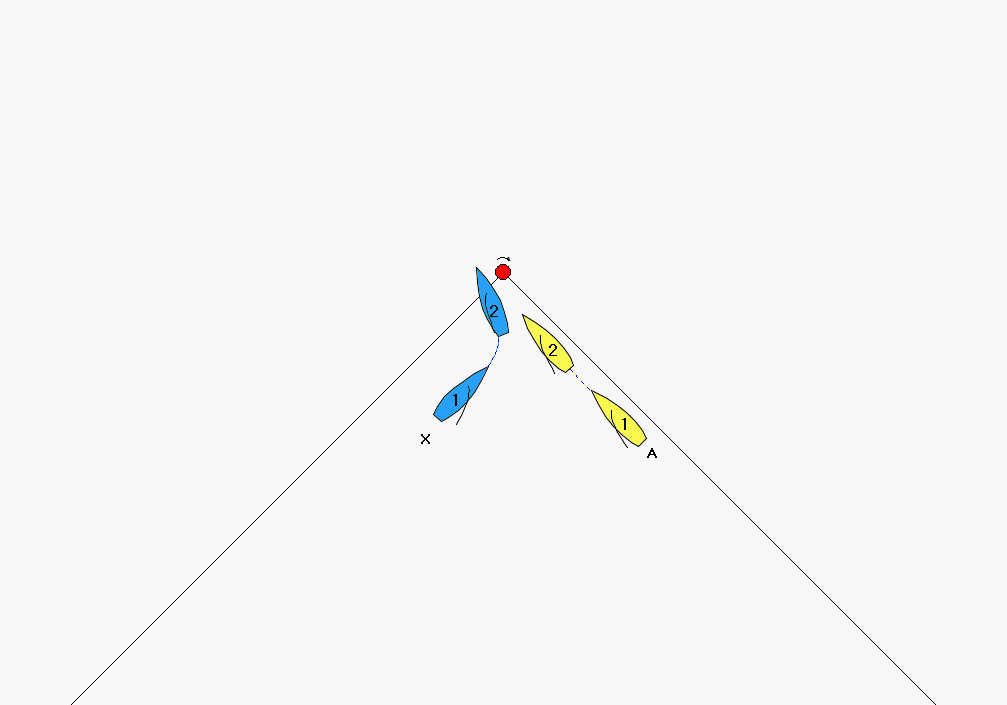
In this case, X tacks ahead and to leeward of A, andso close to the mark that she cannot physically give A mark-room. Using the same arguments as before, wesee that rule 18.2(a) applies from the time X passes head to wind, so she mustgive A mark-room. If she cannot doso and the boats are fleet racing, X breaks rule 18 when she fails to givemark-room – rule 18.2(e) does not apply because the overlap was established byX's tack, not from clear astern.
But if the boats are match racing under new ruleC2.12, X does not have to give A mark-room because there is no physical way shecan provide space for A between her and the mark. Rule C2.12 says that since she was not able to provide roomfrom the time the overlap began, she does not have to do so. A must go thewrong side of the mark, and if she protests she receives a green flag. Furthermore, if she interferes with X'smark rounding she may well break rule 23.2 (see my earlier blog on thistopic).
Note that rule 13 applies between positions 1 and 2,and X must keep clear of A while she's tacking; but if X is a length or soahead of A, that isn't hard for her to do. Additionally, after X completes her tack she must initiallygive A room to keep clear, but in the situation above A can easily keep clearby going the wrong side of the mark.
So, I think this is a new match-racing move for X,and guess what? It gives the boaton the left side of the leg control over the boat on the right – exactly theopposite of the current match race status!
IMMEDIATE CHANGE 6, Advertising
The last change is purely technical; it simplyconforms all the rules that refer to advertising to the wording in theAdvertising Code in ISAF Regulation 20. We used to have categories of advertising, with Category A being themost restrictive. These Categorieshave been eliminated in the Code, so ISAF removed the references to Category Ain the RRS, and at the same time cleaned up some other wording. There was clearly no urgency about thischange (most of which was in Appendix K, which is not even a rule), and the changewould normally have waited until 2013 to take effect; but because there weregoing to be other Immediate Changes (see 1-5 above) anyway, ISAF went ahead andmade the advertising edits "urgent", putting them into effect thiscoming January 1. For the record,here they are:
J1.2 Thenotice of race shall include any of the following that will apply and thatwould help competitors decide whether to attend the event or that conveys otherinformation they will need before the sailing instructions become available:
(1) that competitor advertising will be restricted toCategory A or that boats will be required to display advertising chosen andsupplied by the organizing authority (see ISAF Regulation 20) and otherinformation related to Regulation 20;
J2.2 Thesailing instructions shall include those of the following that will apply:
(1) that competitor advertising will be restricted toCategory A (see ISAF Regulation 20) and other information related toRegulation 20;
Appendix K
2 ADVERTISING
See ISAF Regulation 20. 2.1 Competitor advertising will be restricted to
Include other applicable Category A. asfollows: ______.
information related to
Regulation 20.
See ISAF Regulation 2.2 Boats may [shall] [may] be required to display
20.(d) 20. advertisingchosen and supplied by the
organizing authority.
Appendix LSee ISAF Regulation 21 ADVERTISING
20.3(d)
information on the suppliedbythe organizing authority
advertising material. as follows: ______.
60d81875-a115-40b3-968b-f8a06858a9b0|1|3.0
The
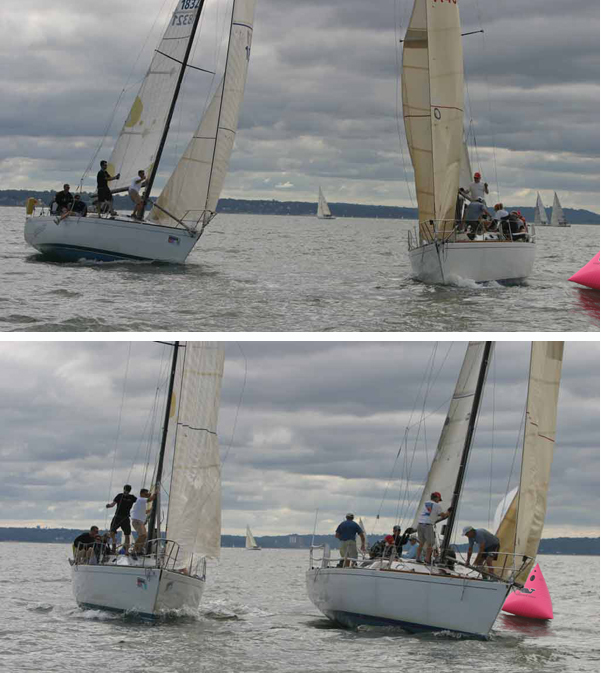
following two-picture sequence provides visual evidence of why tacking
in the zone at a windward mark is such a dangerous thing to do.
In the
first picture, the boat on the left is on starboard tack and the boat
on the right is either on port tack or has just passed head to wind and
is tacking. (Her angle of heel would indicate she's still on port tack
but her genoa seems to indicate that she has reached or passed head to
wind.
In the second picture, the port tack boat has probably completed her
tack or is just above a close hauled course and the starboard tack boat
has luffed above close-hauled and the boats appear to be overlapped by
a reasonable amount.
Let's look at the situation rule by rule.
THE RULES:
If the right hand boat is on port tack, Rule 10 ON OPPOSITE TACKS applies and states that …"a port tack boat shall keep clear
of a starboard tack boat".
If on the other hand, the boat on the right has passed head to wind,
Rule 13 WHILE TACKING applies. It says, "After a boat passes head to
wind, she shall keep clear" of other boats until she is on a
close-hauled course"
Right here it's worth looking at the first part of the
definition of KEEP CLEAR. It says "One boat keeps clear of another if
the other can sail her course with no need to take avoiding action…".
Clearly, given the proximity of the boats to each other and
the apparent speed of the boat on starboard tack, "avoiding action" on
her part is going to be a necessity. Whichever rule applies, the right
hand boat is in tough shape!
So far, the presence of the mark and the fact that both boats are in the ZONE
has had no impact on the situation. However, Rule 18.3 TACKING WHEN
APPROACHING A MARK puts the nail in the coffin of the boat on the
right.
Rule 18.3 applies when:
A. Two boats are approaching a mark on opposite tacks.
B. One of them changes tack and is subject to Rule 13 in the ZONE.
C. The other boat is fetching the mark.
Since all these conditions have been met, Rule 18.3 applies here. The rule goes on the say that the boat that tacked;
(a) shall not cause the other boat to sail above close-hauled to avoid her or prevent the other boat from passing the mark on the required side and
(b) shall give mark-room if the other boat becomes overlapped inside her.
The left hand boat appears to have overstood the mark but still
had to luff above close-hauled to avoid the boat that tacked. Note that
had she decided to duck under the boat that tacked (certainly a
possibility), she would be entitled to mark-room.
Taken in sequence, there are a string of rules that the port
tack boat could be protested for breaking. In each case, even if the
issue was in doubt (obviously there is no doubt here), a Protest
Committee is likely to come down in favor of the boat on starboard so
this is truly a "no win" scenario.
What should the port tack boat do?
1. Don't go to the port tack layline. It's just asking for trouble.
2.
If you find yourself there anyway (the wind does go left from time to
time), consider bearing off and sailing fast so that your tack to round
the mark will be outside the zone.
3. If you're on the layline and can do it, duck the starboard boat or
boats. Giving up a couple of boatlengths is better than a DSQ.
4. If you're on the port layline and clearly crossing the starboard
boat (s), don't tack at the mark. Continue on port tack and let the
starboard boat(s) round inside you. Once again, you'll be giving up a
little distance but that's better than the alternative.
Another factor to consider here is Rule 14 AVOIDING CONTACT.
The starboard tack boat is required to take avoiding action if he
thinks the port tack boat is not keeping clear. A Protest Committee is
going to listen carefully if the starboard boat says, " I altered
course to avoid contact".
Even if his judgment of the distance between the boats is questionable,
the PC is likely to give him the benefit of the doubt because he
avoided contact.
f485efb7-5290-418a-af9a-f1944cd06881|1|3.0