In his excellent rules blog “Unruly” (http://rulestalk.blogspot.com/), Matt Knowles poses the following question:
“Fleet racing downwind in Lasers, light air, approaching the pin end of a downwind finish. The boats enter the zone [as shown in the diagram below]. At position 3, Blue bears off to avoid Yellow and protests. What should the decision be?”
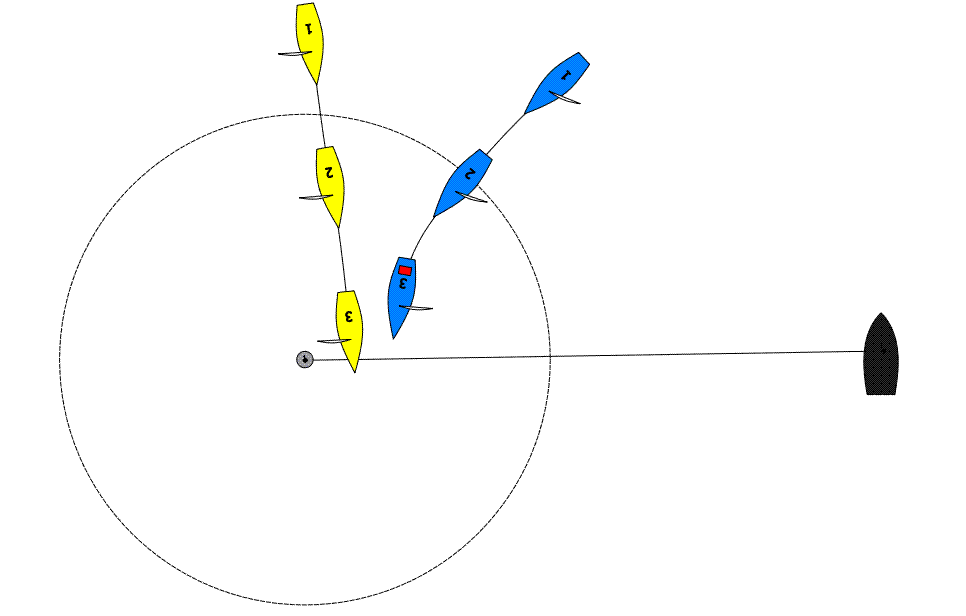
Matt’s answer (with which I agree) is as follows:
“Yellow enters the zone overlapped inside Blue, and is therefore entitled to mark-room.
“Mark-room is room for a boat to sail to the mark, and then room to sail her proper course while at the mark.
“Proper course is a course a boat would sail to finish as soon as possible in the absence of the other boats referred to in the rule using the term.
“At position 3, Yellow is at the mark and has finished. Blue must give her room to sail her proper course. However, because she has finished she does not have a proper course.
“Yellow fails to keep clear of Blue, who has right of way under rule 10. Rule 18.5 begins ‘when a boat is taking mark-room to which she is entitled...’ We must decide whether she is taking mark-room. Because here mark-room is room to sail a proper course, and she does not have a proper course, she cannot be taking mark-room. Yellow is therefore not taking mark-room, and cannot be exonerated by rule 18.5.
"Penalize Yellow for breaking rule 10.”
This answer, while correct, goes contrary to the obvious intent of the rule, so until there’s an ISAF Case on it you might have a bit of a problem convincing protest committees that Blue is required to give Yellow room at the mark right up until Yellow finishes, but not thereafter. I suppose you could bring a copy of Matt’s blog (or this one) with you to the protest room, but Matt and I are hardly officially blessed authorities on the rules, so the protest committee might safely ignore us. Alternatively, if you’re in Blue you might just want to give Yellow room all the way through the incident, as the rule clearly intended you to do.
The primary problem here is with the current definition of mark-room:
“Room for a boat to sail to the mark, and then room to sail her proper course while at the mark. However, mark-room does not include room to tack unless the boat is overlapped to windward and on the inside of the boat required to give mark-room.”
In addition to Matt’s example, there’s another problem with this definition – the "sail to the mark" part doesn’t work well near the edge of zones around passing marks, where the proper course for a boat is to sail toward the next mark, not toward the passing mark. Under the current definition, if boats are running on opposite tacks past a passing mark surrounded by navigable water and the port-tack boat (P) enters the zone clear ahead of the starboard-tack boat (S) but S establishes a late inside overlap in the zone, P can turn toward the mark and force S to the wrong side of it – again, clearly not what was intended by the rule.
The ISAF Section C Working Party, which re-wrote Part 2, Section C of the RRS (i.e., rules 18, 19 and 20), didn’t actually go out of business in 2009 when those rules came into effect, but was appointed by the ISAF Racing Rules Committee to monitor problems with, and reactions to, the new Section C rules – getting help from people like Matt, of course. The WP, of which I confess to being a member, has been aware of Matt’s problem (as well as the passing-mark problem) for some time, and just this week, Richard Thompson, another member of the WP, presented to the ISAF Racing Rules Committee the WP’s latest thoughts on how to fix it. Here’s what the WP is thinking about:
PROPOSED Definition Mark-Room
Mark-Room for a boat is
(a) room for her to leave the mark on its required side, and
(b) when her proper course is to round the mark or pass close to it, room for her to sail to the mark and room to round or pass as close to it as she could in the absence of the boat required to give her mark-room.
However, mark-room does not include room for her to tack unless the boat required to give her mark-room is overlapped to leeward and outside of her, and only if she would be fetching the mark after her tack.
The proposed change in the last sentence solves an entirely different problem, and I won’t address it here. Note that the new definition, unlike the current one, would first state the basic requirement, to allow the boat entitled to room the opportunity to pass on the mark’s required side. It would then amplify this requirement in the situation where a boat’s proper course is to round the mark or pass close to it. So at a passing mark that the boats will not sail near, only part (a) applies, and the port-tack boat in my example above cannot use her right to mark-room to drive the starboard-tacker to the wrong side of the mark. Part (b) is intended to catch the meaning of the current “sailing to” and “at the mark” requirements, but without requiring the reader to decide which of these states applies at a given time. It also removes the requirement for room to sail a proper course at the mark – all the boat with mark-room would be entitled to do is round the mark as closely as she would have done in the absence of the other boat.
In addition to solving Matt’s problem, this would correct a problem originally pointed out by Butch on this blogsite, shortly after the new Section C rules came out: The proper-course phrase allows a long-keeled boat considerably more room at the mark than she has traditionally been allowed.
The wording above is not a formal proposal as yet; the WP did not feel the proposal had received sufficient consideration by this year’s deadline for ISAF Submissions. The only time the WP can now submit a proposal to ISAF is August 1, 2025 for consideration at the ISAF Annual Conference in November 2011. Unless the submission is made on an “emergency basis”, even if it is approved the changes would not go into effect until January 2013.
Clearly, I think the proposal solves Matt’s finishing-line problem, but I could be wrong. If you have any ideas about this proposed change, please comment here (or, if you like, on “Unruly”), or drop me an e-mail message.
13502614-b31f-4c4d-96ea-3e58a64baaad|2|3.5