In my most recent two blogs on this site, I’ve pointed out a couple of problems with the current rule 20: A boat hailed for room to tack can’t legally pass the hail on to a boat that’s to windward of her; and a leeward port-tack boat approaching a starboard-tack boat can legally use rule 20 to “scrape off” the boat to windward of her, then duck the starboard-tacker. Both of those are unintended consequences of the way rule 20 is written, and the US Racing Rules Committee has proposed to change the rule in 2013, to fix those problems.
In this blog, I’ll explore another problem with current rule 20: It starts with the words “When approaching an obstruction, a boat sailing close-hauled or above may hail for room to tack and avoid another boat on the same tack,” so if a boat hails for room to tack when she’s not on a close-hauled course (say, she’s on a reaching leg) then she doesn’t break any rule.
OK, I agree that’s a technicality. But what isn’t a technicality is that the hailed boat doesn’t have to respond if the hailing boat is not sailing close hauled or above, because in that circumstance rule 20 doesn’t apply. Suppose Larry is sailing a slow, old cruising boat and Will is to windward in his brand-new hot racing boat. They’re both on starboard tack approaching a pile of rocks that Larry isn’t fetching, and Larry hails for room to tack. Will looks under the boom and sees that Larry isn’t even close to what Will thinks of as a close-hauled course, so he shouts “You’re not close hauled! I don’t have to tack!”
Of course, Larry might protest and later, after somebody picks him up off the rocks, convince a protest committee that he was indeed close hauled when he hailed, but so what? His boat is gone. Rule 20 is supposed to be a safety rule, and as such, it should require Will to tack and, if he thinks Larry was below his close-hauled course, protest. In order for that to happen, the rule needs to apply regardless of the hailing boat’s course.
Both US SAILING and the Royal Yachting Association (the British equivalent of US SAILING) are proposing to move the expression about the hailing boat’s course down into the section about when a boat shall not hail. This, I think, fixes the problem: the windward boat has to either tack or hail “You tack” and give the other boat room to tack and avoid her. So under that rule, Larry’s boat will float to sail another day.
There’s one problem with the British proposal, though, which in my opinion makes the US proposal better: The Brits simply move the course issue into rule 20.3 When Not to Hail, leaving rule 20 as beginning,
“When approaching an obstruction, a boat may hail for room to tack and avoid another boat on the same tack. After a boat hails, …”.
We felt that with nothing about a close-hauled course, nor about needing to change course for the obstruction, etc., this introduction gives too little information about what the rule is all about and where on the race course it should be used; so new readers will simply say “What the hey?”
To solve this problem and to make the rule look more like the other rules of Section C (and of the rest of Part 2), we’re proposing to move all of the stuff about when a boat can hail to the front of the rule. So our rule 20 would begin:
“When approaching an obstruction, a boat may hail for room to tack and avoid a boat on the same tack, but she shall not hail if
(a) she is sailing below close-hauled,
(b) she can avoid the obstruction safely without making a substantial course change, or
(c) the obstruction is a mark and a boat that is fetching it would be required by rule 20.2(b) to change course as a result of the hail.
This proposal and the rest of the US SAILING Racing Rules submissions to ISAF are available at http://raceadmin.ussailing.org/Rules/ISAF_Rules_Submissions.htm. Please take a look at them and tell me what you think. These changes won't be acted on by ISAF until November, so now is the time for us to catch any mistakes we’ve made, or to turn away from the direction we’re going, if the proposed changes aren’t good ones. Fill out the response form on the page above, send me an email, or submit a comment to this blogsite. Whatever way you choose to comment, I’ll be happy to read it and either suggest to the US Racing representatives to ISAF that we change our submission, or discuss the matter further with you.
9ae05432-8f21-45f1-bf0b-28abc85b77be|0|.0
Situation: In a dinghy race, two boats, PL and PW, are on port tack, approaching S on starboard tack. S is on the starboard-tack layline outside the zone (see diagram). PL is bow-out on PW but overlapped with her, and PL will have to change course substantially to avoid S. At position 1, she hails PW for room to tack. At the moment she hails, there is no chance PL will be able to tack short of S, but PW can do so easily, and does. Then PL ducks S and tacks on her hip. PL fetches the mark nicely but PW, alas, does not. PW protests. What is your call?
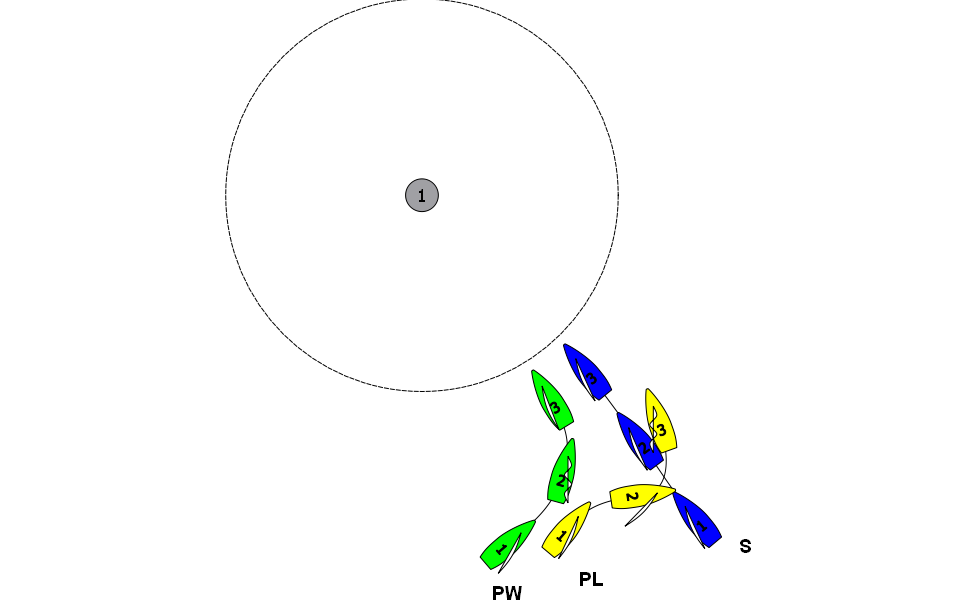
Analysis: Rule 20 HAILING FOR ROOM TO TACK allows PL to hail because she’s on a close-hauled course, S is an obstruction to both her and PW, PL will have to change course substantially to avoid S, and of course S is not a mark so there’s no issue of whether SW is fetching the obstruction. Rule 20 requires PW to tack as soon as possible or to hail, “You tack!” and she elects to tack as soon as possible, which is pretty much immediately. The same rule requires PL to tack as possible after PW tacks, but “as soon as possible” for PL is after she passes S, so that’s when she tacks. No rule is broken; PW is simply screwed.
I can hear you saying “But PW could have hailed ‘You tack!’ and then claimed room to pass behind S!” Unfortunately, the Preamble to Section C says that if rule 20 applies (and it surely applies here, as PL has already hailed for room to tack) then rule 19 does not. So PL is under no obligation to give PW room to duck S, and if PW tries to go between PL and S, PL can bear away to avoid a collision between PW and S (see rule 14), and then protest. The protest committee should find that PW broke rule 11 (Windward/Leeward) and PL broke no rule.
It’s actually a little worse than that for PW, because even if she manages to duck S without fouling PL, she’s still stuck for what to do when PL tacks just after she passes S, as required by rule 20. PW is required to give PL room to tack and clear her, but how can she do that when S is right in the way? So PW is likely to break rule 20 even if she didn’t break rule 11 when she ducked S.
The US SAILING Racing Rules Committee is proposing to change the Preamble to Section C so that rule 19 still applies in this situation. We still have to allow boats to hail when they’re inside the zone, and obviously such a hail could prevent a boat from sailing to the mark, so we still have to “turn off” rule 18 when rule 20 applies, and we propose to do so, inside rule 20 itself.
The ISAF Submissions from US SAILING are posted on the US SAILING website, at http://raceadmin.ussailing.org/Rules/ISAF_Rules_Submissions.htm, along with a convenient form for comments and suggestions. There are several submissions, and unfortunately they are hard to read because of the required ISAF format, but I urge anybody who is interested in what’s happening with the Racing Rules of Sailing to wade through those submissions and, if you find things you don’t like (or that you do like), fill out the comment form. These changes won't be acted on by ISAF until November -- they're only proposals at this point -- so now is the time for us to catch any mistakes we’ve made, or to turn us away from the direction we’re going, if the proposed changes aren’t good ones.
0ea4b61f-b03c-42ba-838b-87a1c6fdc5b7|0|.0