In his excellent rules blog “Unruly” (http://rulestalk.blogspot.com/), Matt Knowles poses the following question:
“Fleet racing downwind in Lasers, light air, approaching the pin end of a downwind finish. The boats enter the zone [as shown in the diagram below]. At position 3, Blue bears off to avoid Yellow and protests. What should the decision be?”
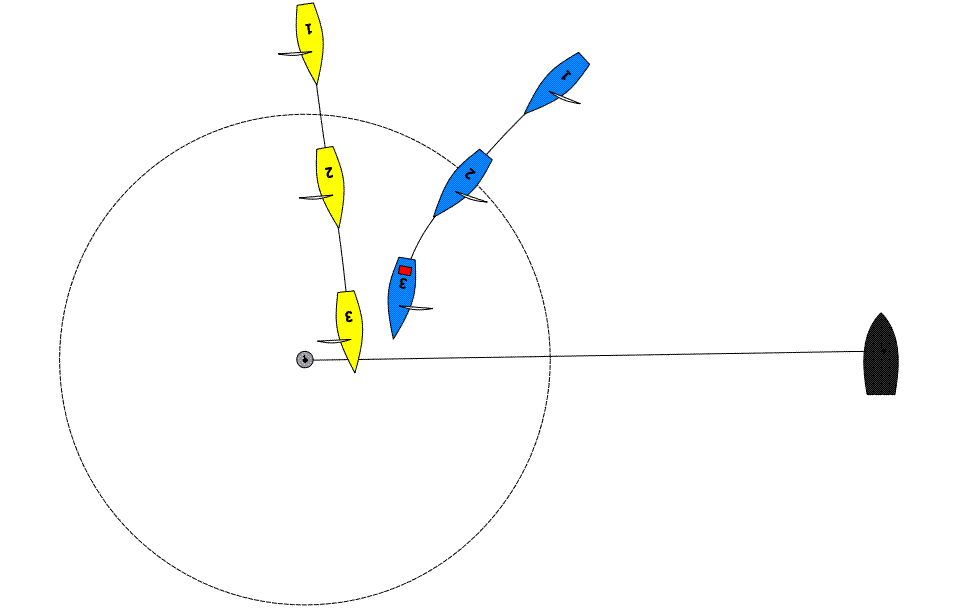
Matt’s answer (with which I agree) is as follows:
“Yellow enters the zone overlapped inside Blue, and is therefore entitled to mark-room.
“Mark-room is room for a boat to sail to the mark, and then room to sail her proper course while at the mark.
“Proper course is a course a boat would sail to finish as soon as possible in the absence of the other boats referred to in the rule using the term.
“At position 3, Yellow is at the mark and has finished. Blue must give her room to sail her proper course. However, because she has finished she does not have a proper course.
“Yellow fails to keep clear of Blue, who has right of way under rule 10. Rule 18.5 begins ‘when a boat is taking mark-room to which she is entitled...’ We must decide whether she is taking mark-room. Because here mark-room is room to sail a proper course, and she does not have a proper course, she cannot be taking mark-room. Yellow is therefore not taking mark-room, and cannot be exonerated by rule 18.5.
"Penalize Yellow for breaking rule 10.”
This answer, while correct, goes contrary to the obvious intent of the rule, so until there’s an ISAF Case on it you might have a bit of a problem convincing protest committees that Blue is required to give Yellow room at the mark right up until Yellow finishes, but not thereafter. I suppose you could bring a copy of Matt’s blog (or this one) with you to the protest room, but Matt and I are hardly officially blessed authorities on the rules, so the protest committee might safely ignore us. Alternatively, if you’re in Blue you might just want to give Yellow room all the way through the incident, as the rule clearly intended you to do.
The primary problem here is with the current definition of mark-room:
“Room for a boat to sail to the mark, and then room to sail her proper course while at the mark. However, mark-room does not include room to tack unless the boat is overlapped to windward and on the inside of the boat required to give mark-room.”
In addition to Matt’s example, there’s another problem with this definition – the "sail to the mark" part doesn’t work well near the edge of zones around passing marks, where the proper course for a boat is to sail toward the next mark, not toward the passing mark. Under the current definition, if boats are running on opposite tacks past a passing mark surrounded by navigable water and the port-tack boat (P) enters the zone clear ahead of the starboard-tack boat (S) but S establishes a late inside overlap in the zone, P can turn toward the mark and force S to the wrong side of it – again, clearly not what was intended by the rule.
The ISAF Section C Working Party, which re-wrote Part 2, Section C of the RRS (i.e., rules 18, 19 and 20), didn’t actually go out of business in 2009 when those rules came into effect, but was appointed by the ISAF Racing Rules Committee to monitor problems with, and reactions to, the new Section C rules – getting help from people like Matt, of course. The WP, of which I confess to being a member, has been aware of Matt’s problem (as well as the passing-mark problem) for some time, and just this week, Richard Thompson, another member of the WP, presented to the ISAF Racing Rules Committee the WP’s latest thoughts on how to fix it. Here’s what the WP is thinking about:
PROPOSED Definition Mark-Room
Mark-Room for a boat is
(a) room for her to leave the mark on its required side, and
(b) when her proper course is to round the mark or pass close to it, room for her to sail to the mark and room to round or pass as close to it as she could in the absence of the boat required to give her mark-room.
However, mark-room does not include room for her to tack unless the boat required to give her mark-room is overlapped to leeward and outside of her, and only if she would be fetching the mark after her tack.
The proposed change in the last sentence solves an entirely different problem, and I won’t address it here. Note that the new definition, unlike the current one, would first state the basic requirement, to allow the boat entitled to room the opportunity to pass on the mark’s required side. It would then amplify this requirement in the situation where a boat’s proper course is to round the mark or pass close to it. So at a passing mark that the boats will not sail near, only part (a) applies, and the port-tack boat in my example above cannot use her right to mark-room to drive the starboard-tacker to the wrong side of the mark. Part (b) is intended to catch the meaning of the current “sailing to” and “at the mark” requirements, but without requiring the reader to decide which of these states applies at a given time. It also removes the requirement for room to sail a proper course at the mark – all the boat with mark-room would be entitled to do is round the mark as closely as she would have done in the absence of the other boat.
In addition to solving Matt’s problem, this would correct a problem originally pointed out by Butch on this blogsite, shortly after the new Section C rules came out: The proper-course phrase allows a long-keeled boat considerably more room at the mark than she has traditionally been allowed.
The wording above is not a formal proposal as yet; the WP did not feel the proposal had received sufficient consideration by this year’s deadline for ISAF Submissions. The only time the WP can now submit a proposal to ISAF is August 1, 2025 for consideration at the ISAF Annual Conference in November 2011. Unless the submission is made on an “emergency basis”, even if it is approved the changes would not go into effect until January 2013.
Clearly, I think the proposal solves Matt’s finishing-line problem, but I could be wrong. If you have any ideas about this proposed change, please comment here (or, if you like, on “Unruly”), or drop me an e-mail message.
13502614-b31f-4c4d-96ea-3e58a64baaad|2|3.5
There's been a new spate of discussion about when, in thedefinition of mark-room, a boat is "sailing to the mark" andwhen she's "at the mark". Unlike the earlier discussion of this topic when the new rules firstcame out, most of this recent discussion comes out of match racing. In that discipline, in many races there aremore umpires than skippers and tacticians combined, to decide when precisetransition points have been reached; and for consistency of calls, everybodywants the umps to have as little latitude of interpretation as possible. Of course, in fleet and team racing, whichdo not have such resources, such precision is impossible to achieve; but itstill might be helpful to try to define what is meant.
I'veargued before in the UK-Halsey blogsite that the distinction between the rightsof a boat "sailing to the mark" and "at the mark" is notimportant for the purpose of rule 18.2, Giving Mark Room, because when a boatis nearly at a mark, her course "to the mark" and her proper coursearound it are essentially the same, so the exact moment when she ceases to besailing to the mark and is now at the mark is irrelevant. But there's a related issue, where thedistinction might be important: Rule18.5 says,
"When a boat is taking mark-room to whichshe is entitled, she shall be exonerated
(a) if, as a result of the other boat failingto give her mark-room, she breaks a rule of Section A, or
(b) if, by rounding the mark on her propercourse, she breaks a rule of Section A or rule 15 or 16."
The rules of SectionA deal with keeping clear, so both parts of the rule exonerate a boat forfailing to keep clear if she's simply taking mark-room to which she's entitled,and the other boat gets in her way; this makes sense, as the other boat wasn'tsupposed to do that.
Rules 15 and 16 area different matter. Rule 15 requires aboat that gains right of way by her own actions to initially give the otherboat room to keep clear, and rule 16 requires a right-of-way boat that changes courseto give the other boat room to keep clear. Exonerating a right-of-way boat from breaking these rules puts a mightyweapon in her hand. She can now carryout actions against the boat that owes her mark-room, which she could not doanywhere else on the racecourse.
The opportunity to take such aggressive actions withoutpenalty is, of course, the grist of the match racing mill, so naturally matchracers and umpires want to know exactly when a boat is "rounding themark"; seeing that this is in some way related to "at the mark",they want to know if"rounding themark" in rule 18.5 is the same as the transition in the definition of mark-roomfrom "sailing to the mark" to "at the mark".
My answer is "Being at the mark is related, but notidentical, to rounding it." To see why I say they're related, consider thesituation at a port-rounding leeward mark, where the inside boat (S) is onstarboard tack, with right of way over the port-tack boat (P) outside her. Suppose S is just entering the zone andshe's not at that moment sailing toward the mark. If she turns to her course to the mark in such a way that Pcannot keep clear, she breaks rule 16. Does she get exonerated for thatbreach? I think we'd all say, no, shedidn't change course "by rounding the mark", she did it while sailingto the mark. So she would getexonerated if she broke a rule of Section A (which she can't do, she's theright-of-way boat) but not for breaking rules 15 or, as in this case, 16.
On the other hand, suppose S has sailed to the mark and, forwhatever reason (maybe there's a current she misestimated) she ends up aimingat the wrong side of the mark and needs to turn to starboard at the lastsecond, to get to the correct side of the mark. She has right of way, so she doesn't need her mark-room to turnto pass on the right side of the mark; but if she turns so fast that she failsto give the other boat room to keep clear, ordinarily she'd run afoul of rule16. In this case, however, I think sucha turn is exonerated by rule 18.5. Shebroke rule 16 "by rounding the mark". In effect, her right to exoneration is the same as under the2005-2008 RRS.
Note that the turn of the boat at the edge of the zone mighthave pretty much the same radius at that of the boat at the mark – thedifference is that at the mark she turns sharply by rounding the mark, whereasat the edge of the zone she's turning sharply to sail to the mark, and that'snot an exonerated action.
So "at the mark" and "by rounding themark" are not synonymous, but they're related by the fact that a boat boatcannot be rounding the mark when she's still sailing to it, only when she's atit. (On the other hand, even if she's at the mark, a sharp turn that's not toround the mark would still get her into trouble if she breaks rule 16 when shedoes it.)
This gets us back to the question of when a boat is at amark. Unfortunately, it turns out to bedifficult to define the moment of arrival "at the mark" precisely(which is why the rule-writers didn't put a more precise definition into therules). For example, we might betempted to say that a boat is "at the mark" when the mark isalongside her, i.e., the mark is abeam of some part of her hull and equipmentin normal position. But that clearlydoesn't work – consider a boat like the one in the scenario above, whicharrives at the mark with the mark directly in front of her. Surely if she's only inches from the markshe's "at" it in any reasonable sense of the word; yet she's notalongside the mark. Conversely, a boatapproaching the mark might turn away from the mark so that the mark is abeam ofher bow, but if she's two of her lengths from the mark with nothing but waterbetween her and it, she's surely not "at" the mark in any reasonablesense.
Another approach to defining "at the mark", whichI think I like, is to look at the boat's proper course. If a boat's proper course is to sail towardthe mark in preparation for rounding it (taking into consideration other boatsshe needs to give mark-room to or keep clear of), then she's sailing "tothe mark"; if her proper course is to turn to round the mark (even if thatturn is counter to the direction to the next mark, and even if she's somedistance from the mark), she's "at" it. And, if she does turn to round it while taking mark-room to whichshe's entitled and she thus breaks rule 15 or 16, she's exonerated for doingso.
And that, I'm afraid, is the best we can do for the matchracers.
b15f556c-aa8d-40f4-881c-3f725c5203c3|0|.0