Racing Rules Blog

Butch Ulmer's discussion of the new rules changes

Proposed Change in the Definition of Obstruction

Posted by Rob Overton

The ISAF Section C Working Party has made two submissions to ISAF that deal with rules 18 and 19.  One is an "emergency" change in the definition of Obstruction, to go into effect January 1, 2010, and the other is a proposed ISAF Case dealing with the meaning of Room.

Before we get into the submissions themselves, let's look at the problem the working party is trying to solve.  There are a number of scenarios in which Rule 18, Mark-Room, and Rule 19, Room to Pass an Obstruction, appear to conflict.  Consider the following scenario, taken from a team-race call suggested by Matt Knowles.  The boats are at a reach mark to be followed by a run: 
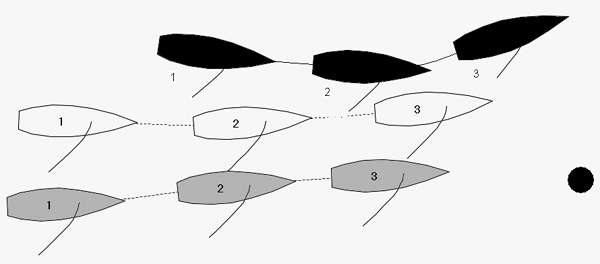

Black is clear ahead of both Grey and White when she enters the zone, and Grey is inside White when they the zone.  Grey and White are sailing faster than Black.  Grey sails to pass to leeward of Black, and White elects to sail between Grey and Black.  In doing so, White forces Black to luff up.  Black protests White under rule 18.2(b) for not being given mark-room, and White protests Grey under rule 19 for not giving her room to pass to leeward of Black.

White's argument is that Black is an obstruction to both Grey and White because they both owe Black mark-room (see definition 'Obstruction').  So when Grey elects to go to leeward of Black, she must give White room to do so, too.  By sailing up toward White between positions 1 and 2, Grey fails to give White room, causing White to sail too close to Black and thus forcing Black above her course to the mark.  White admits she broke rule 18.2(b) with respect to Black but claims she was compelled to do so.  She points out that when it became clear that Grey was not going to give her room under rule 19 at position 2, she could not avoid both Black and Grey.  So that means Grey should be disqualified, and White exonerated under rule 64.1(c) for her breach of rule 18.2(b).

Grey sees it a different way.  White is required to give mark-room to both Grey and Black, and from positions 1 through 3 that means giving them room to sail to the mark.  White could easily have seen that at position 1 that she would not be able to go between Black and Grey and still give mark-room to both of them, so she wasn't "compelled" to break rule 18.2(b).  Therefore White should not be exonerated.  Grey says she herself broke no rule; she was entitled to room under rule 18.2(b) and was simply taking the room to which she was entitled.

(Note that Grey can insure she is blameless by bearing off toward the wrong side of the mark to give White room to pass between her and Black, and protesting White.  Now White has clearly broken rule 18.2(b) by not giving Grey room to sail to the mark, and Grey has given room as required by rule 19.)

This apparent conflict between rules 18 and 19 is caused at least in part by the fact that Black is an obstruction to both White and Grey.  That's because the definition of Obstruction says a boat racing is an obstruction only if they both "required to keep clear of her, give her room or mark-room or, if rule 22 applies, avoid her."  If those words " give her room or mark-room" were removed, then White's case disappears.  Black would only be an obstruction as long as both Grey and White are clear astern of her, and after that, Grey would be under no obligation to give White room to pass to leeward of Black.  

This is the substance of the submission the Section C Working Party has put forward to ISAF.  The definition Mark-Room would say "… However, a boat racing is not an obstruction to other boats unless they are required to keep clear of her or, if rule 22 applies, avoid her. …"

But wait; think about the following scenario:
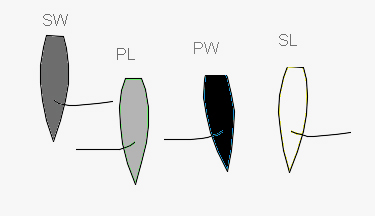

Under the current definition, PW is an obstruction to both PL and SW because, even though PW has right of way over neither of them, they both owe her room to pass SL.  This means that SW must give PL room to pass between her and PW.  Under the proposed definition, neither PL nor PW would be obstructions to SW.  SW would still be required to give PL and PW room to pass SL because SL has right of way over all those boats; but why should SW give PL room to avoid PW?  

The answer is a basic principle, not explicitly stated in the Racing Rules of Sailing, but nonetheless clearly implied:  Room is defined as the space needed for a seamanlike maneuver, and it is not seamanlike to break the rules.  Because SW owes PL room to pass between her and SL, and because PL cannot do that without giving room to PW, thus SW must give PL room to give PW room.  

Because this is not explicit in the rules, nor in the ISAF Cases, the Section C Working Group has proposed a new ISAF Case that makes this principle explicit.  The summary of the proposed Case says "When a boat is entitled to room, the space she is entitled to includes space to comply with the rules."

Before making these submissions, the working group spent a lot of time thinking of scenarios where the change to the definition of Obstruction might cause problems.  Despite our efforts, we could think of none.  Can you think of any place on the racecourse where the words "give her room or mark-room" are necessary in the definition of Obstruction?  If you can, please let me know by commenting on this blogsite, or contact any of the members of the Section C Working Party: Ben Altman, Chris Atkins, Dick Rose, Richard Thompson, or myself, by e-mail.  E-mail addresses for Ben Altman, Dick Rose and me are on the US SAILING website, at http://raceadmin.ussailing.org/Rules/Committee.htm. 
Posted on: 8/30/2009 at 2:34 AM
Actions: E-mail | Kick it! | DZone it! | del.icio.us
Post Information: Permalink | Comments (7) | Post RSSRSS comment feed

Comments

R. G. Newbury Canada

Thursday, September 03, 2025 5:16 AM

R. G. Newbury

The definition of obstruction does not need amendment. The proposed 'Case' merely codifies the intent of the present definition, that 'room' means 'room to comply with the rules'.
In the posited case, I would penalize both White and Grey.  White under 18.2(b) as she admits, and Grey under 19.2(b), as an outside boat at the obstruction.

(Well of course, it really means both of them are to be penalized under Rule 59(a). 'A stupid doofus may be penalized for failing to anticipate a requirement to give room, or mark room, or to keep clear'.)

Up to about position 2, Grey neither acted pro-actively to require White to luff behind Black, and allow her room to also keep clear (ok. give her mark room). After position 2, Grey's only proper course of action was to bear off on the wrong side of the mark, and give room for White to pass on the wrong side also (on the supposition that Black would round the mark closely, in the absence of White and Grey).
Given that this was a team race, I wonder whether that was not in fact the course of action which White wanted to force Grey into taking. The scenario that Grey would passively sail on, without taking action is not, I think, a real world example. If Black and Grey are on the same team, it would make perfect sense for Grey to force White behind Black, while expecting that Black would give Grey room to round, which room would not be freely given to anyone on the other team.

Regarding the  definition. Let it stay the same. If clarity is needed then the requirement to anticipate, AND the requirement to be fair, need to be addressed in the rule.

Rule 19.2(a) gives a ROW boat a choice, but places no limits upon the choice, so that non-ROW boats are not disadvantaged.

19.2(a) should read something like:
(a)   Subject to this subsection, a right-of-way boat may choose to pass an obstruction on either side. An overlapped leeward boat which chooses to pass to weather of an obstruction may only do so, if, at the time she hails her intention, or first alters course to pass the obstruction to weather, any overlapped boat to weather is able to give room for her to pass to weather of the obstruction. If the weather boat is able to respond and is required to alter course to provide room, the right-of-way boat shall pass to weather of the obstruction. If the weather boat is unable to respond due to its obligations to other boats, the leeward boat shall pass to leeward of the obstruction. If the right-of-way boat chooses or is required to pass to leeward of the obstruction, she shall allow room to any weather overlapped boat to also pass to leeward of the obstruction.

In the posited case, this would require Grey to call for White to luff up behind Black up until about position 2.5 at the point where White is irrevocably locked under Black. Thereafter, Grey not having acted responsibly by anticipating what she had to do, she would have to bail out, and allow room for White to do so as well. As noted, this does not seem to be a reasonable situation, and I suspect it arises because this was a team race situation.

As to the wording of the proposed change, I agree that it may not be *necessary* to have those words in the definition, they do clarify the instances  where giving room/keeping clear etc. apply.


This codifies where the onus lies and when it comes into play. It particularly clarifies the state of play when 2 port tackers meet a starboard tack boat. Far to often, the leeward boat brushes off the windward boat, by refusing to allow room for the windward boat to duck the starboard tacker.


najevi Australia

Saturday, September 05, 2025 5:30 AM

najevi

The proposed emergency change is not necessary to disqualify White in the above scenario however, I do not think that the proposed change will do any harm either.

There are atleast two flaws in White's argument and these can be easily identified within the existing rules:

1. White argues that Black is an obstruction to both Grey and White but this is not the case.
Black is not an obstruction to Grey because Black is on the same team and it is reasonable to assume that Black will maneuver so that Grey "could pass without changing course substantially."
By contrast, Black is an obstruction to White because Black is on the opposite team and it is reasonable to assume that Black will maneuver so that White "could _not_ pass without changing course substantially." (In this case White should reasonably expect Black to close the door on White at the mark rounding.)

Obstruction: An object that a boat could not pass without changing course substantially, if she were sailing directly towards it and one of her hull lengths from it. An object that can be safely passed on only one side and an area so designated by the sailing instructions are also obstructions. However, a boat racing is not an obstruction to other boats unless they are required to keep clear of her, give her room or mark-room or, if rule 22 applies, avoid her.

So White's argument that Grey must give White room to pass to leeward of Black is based on a false premise. It is a nice try but I think it attempts to apply Fleet race reasonning in a Team race scenario and is therefore flawed.

1b. I might also argue that Black is not even an obstruction to White in this particular scenario because Black "can be safely passed on only one side." i.e. White cannot safely pass Black to leeward because Rule 11 requires that White "keep clear" of Grey.

2. White's argument is further based on the premise that "Grey elects to go to leeward of Black." This a false premise because it is not supported by the evidence visible at the time of the incident. Even if, at the protest committee hearing, Grey concedes that this was her planned course that piece of information is not something that White could have relied upon at the time of the incident. Let's not kid ourselves here - White's decision not to sail astern of Black prohibited Grey from sailing to windward of Black. Case 27 upholds that Grey is not required to anticipate that White will break Rule 18.2(b). White effectively compelled Grey to sail to leeward of Black and this is very different than Grey (the right-of-way boat) making a choice per 19.2(a) which is what Rule 19 is predicated on.

19.2(a) A right-of-way boat may choose to pass an obstruction on either side.

In the discussion, something has been made of the fact that this was a team race and that Black and Grey are on the same team. Even if Black concedes that her intended proper course is to round the mark while leaving enough room for Grey to sail to leeward of Black then that is still Black's proper course and White is required by Rule 18.2(b) to allow Black to sail whatever course Black chooses.

Mark-Room: Room for a boat to sail to the mark, and then room to sail her proper course while at the mark.

Black earned that privilege by entering the zone while clear ahead of White. White has no grounds to protest Black's chosen proper course even if that course might leave a door open for Grey to safely round the mark.


Different for Fleet race vs Team race

If the race was a fleet race and not a team race then Rule 18.2(b) would have required both White and Grey to sail astern of Black. This is the only reasonable course to choose because Black's proper course (i.e. in the absence of White and Grey) would be to sail close to the mark as she rounds. (Perhaps allowing for any current and/or any anchor line obstruction.)

If you study the diagram but imagine that White promptly did as Rule 18.2(b) obliged her to do and altered her course to sail astern of Black then you will notice that Grey would not have overlapped Black until shortly after position 3. White cannot succesfully claim that "Grey has elected to sail to leeward of Black" until Grey overlaps Black to leeward. Even for a short while after Grey overlaps Black to leeward Grey could successfully duck behind and sail astern of Black so the evidence could not possibly support White's premise until Grey has approached so close to Black that Grey ducking behind Black is no longer an option.

Furthermore, I would argue that Case 27 makes it clear that White is required to assume that Grey will not break Rule 18.2(b) and therefore, assume that Grey will also sail astern of Black. (Again this would be the only reasonable assumption in the Fleet race scenario and not in the Team race scenario.)


Back to the team race scenario

A technical point which might simply be an error of scale in the drawing above. I believe the zone for a team race has a 2 boat length radius and not 3 boat lengths. viz.

D1.1 Changes to the Definitions and the Rules of Part 2
(a) In the definition Zone the distance is changed to two hull lengths.

So in point of fact Black does not enter the 2 boat length zone until about half a boat length before position 2. (I note that Black was still clear ahead of White when black entered the 2 boat length zone. Indeed White only begins her leeward overlap of black at position 2.) Therefore White's reference to Grey's course between position 1 and position 2 has no bearing on the case since neither boat was required to give mark room to Black until just a moment before position 2.

Grey's course might just as easily have been construed as Grey anticipating White sailing astern of Black and Grey planning to follow White as both boats sail astern of Black.

My point with drawing attention to this technicality is that in a team race the zone is smaller and
so Black's intended course (closing the door on White) is so unambiguous that White really had to choose to either duck behind Black or sail to leeward of the mark. Her choice but I think we can all see which is the most seamanlike.

najevi Australia

Saturday, September 05, 2025 5:41 AM

najevi

The proposed emergency change is not necessary to disqualify White in the above scenario however, I do not think that the proposed change will do any harm either.

There are atleast two flaws in White's argument and these can be easily identified within the existing rules:

1. White argues that Black is an obstruction to both Grey and White but this is not the case.
Black is not an obstruction to Grey because Black is on the same team and it is reasonable to assume that Black will maneuver so that Grey "could pass without changing course substantially."
By contrast, Black is an obstruction to White because Black is on the opposite team and it is reasonable to assume that Black will maneuver so that White "could _not_ pass without changing course substantially." (In this case White should reasonably expect Black to close the door on White at the mark rounding.)

Obstruction: An object that a boat could not pass without changing course substantially, if she were sailing directly towards it and one of her hull lengths from it. An object that can be safely passed on only one side and an area so designated by the sailing instructions are also obstructions. However, a boat racing is not an obstruction to other boats unless they are required to keep clear of her, give her room or mark-room or, if rule 22 applies, avoid her.

So White's argument that Grey must give White room to pass to leeward of Black is based on a false premise. It is a nice try but I think it attempts to apply Fleet race reasonning in a Team race scenario and is therefore flawed.

1b. I might also argue that Black is not even an obstruction to White in this particular scenario because Black "can be safely passed on only one side." i.e. White cannot safely pass Black to leeward because Rule 11 requires that White "keep clear" of Grey.

2. White's argument is further based on the premise that "Grey elects to go to leeward of Black." This a false premise because it is not supported by the evidence visible at the time of the incident. Even if, at the protest committee hearing, Grey concedes that this was her planned course that piece of information is not something that White could have relied upon at the time of the incident. Let's not kid ourselves here - White's decision not to sail astern of Black prohibited Grey from sailing to windward of Black. Case 27 upholds that Grey is not required to anticipate that White will break Rule 18.2(b). White effectively compelled Grey to sail to leeward of Black and this is very different than Grey (the right-of-way boat) making a choice per 19.2(a) which is what Rule 19 is predicated on.

19.2(a) A right-of-way boat may choose to pass an obstruction on either side.

In the discussion, something has been made of the fact that this was a team race and that Black and Grey are on the same team. Even if Black concedes that her intended proper course is to round the mark while leaving enough room for Grey to sail to leeward of Black then that is still Black's proper course and White is required by Rule 18.2(b) to allow Black to sail whatever course Black chooses.

Mark-Room: Room for a boat to sail to the mark, and then room to sail her proper course while at the mark.

Black earned that privilege by entering the zone while clear ahead of White. White has no grounds to protest Black's chosen proper course even if that course might leave a door open for Grey to safely round the mark.


Different for Fleet race vs Team race

If the race was a fleet race and not a team race then Rule 18.2(b) would have required both White and Grey to sail astern of Black. This is the only reasonable course to choose because Black's proper course (i.e. in the absence of White and Grey) would be to sail close to the mark as she rounds. (Perhaps allowing for any current and/or any anchor line obstruction.)

If you study the diagram but imagine that White promptly did as Rule 18.2(b) obliged her to do and altered her course to sail astern of Black then you will notice that Grey would not have overlapped Black until shortly after position 3. White cannot succesfully claim that "Grey has elected to sail to leeward of Black" until Grey overlaps Black to leeward. Even for a short while after Grey overlaps Black to leeward Grey could successfully duck behind and sail astern of Black so the evidence could not possibly support White's premise until Grey has approached so close to Black that Grey ducking behind Black is no longer an option.

Furthermore, I would argue that Case 27 makes it clear that White is required to assume that Grey will not break Rule 18.2(b) and therefore, assume that Grey will also sail astern of Black. (Again this would be the only reasonable assumption in the Fleet race scenario and not in the Team race scenario.)


Back to the team race scenario

A technical point which might simply be an error of scale in the drawing above. I believe the zone for a team race has a 2 boat length radius and not 3 boat lengths. viz.

D1.1 Changes to the Definitions and the Rules of Part 2
(a) In the definition Zone the distance is changed to two hull lengths.


So in point of fact Black does not enter the 2 boat length zone until about half a boat length before position 2. (I note that Black was still clear ahead of White when black entered the 2 boat length zone. Indeed White only begins her leeward overlap of black at position 2.) Therefore White's reference to Grey's course between position 1 and position 2 has no bearing on the case since neither boat was required to give mark room to Black until just a moment before position 2.

Grey's course might just as easily have been construed as Grey anticipating White sailing astern of Black and Grey planning to follow White as both boats sail astern of Black.

My point with drawing attention to this technicality is that in a team race the zone is smaller and
so Black's intended course (closing the door on White) is so unambiguous that White really had to choose to either duck behind Black or sail to leeward of the mark. Her choice but I think we can all see which is the most seamanlike.

Geoff Becker United States

Monday, September 07, 2025 4:24 PM

Geoff Becker

I guess the ISAF Section C working party missed the major mistake made during the last revision to Rule 18.2(c).  In fact they completely, and apparently unknowingly, changed the game of team racing.  Both of the situations above are what I call "judge rules".  These are rules that only matter to judges and don't appear in practice.  If the leeward boat in the first example decides to go inside a boat he has to give mark room, I say good luck to him.  In the second example, which is even less likely, the starboard boat that would have to allow the port boats room to avoid the obstruction, should avoid this situation altogether.

OHara United States

Friday, October 02, 2025 8:51 PM

OHara

(1) Yes. To my way of thinking, your change resolves the conflict in your scenario.

(2) I think no. The 18-19 conflict comes up at leeward mark roundings, whenever B gets a late overlap between I and O.  I think there are enough variations on this situation that the arguments above will not resolve the conflict in all cases.

(3) I could think of no cases broken by your definition change, if your Case to clarify "room includes space to comply with the rules" has the desired effect.


I think the same conflict could have arisen under the 2005 rules as well, between two conflicting requirements of rule 18.  Also, your definition change does not resolve the conflict in the PO-PI-S situation described above (by johnB I think).  Finally, as you pointed out, there is a satisfactory resolution to the conflict if grey decides to give room, then protest.


Maybe your proposed Case should go in first. ISAF Rapid Team Race Call 2009/001 expresses the same principle.  I think this principle is helpful in common situations.

For example, look at "difficult situation 30" at Uli Finkh's rules quiz <game.finkh.net>.  Here, rule 19 is applied to a 'mark-room' boat.

I think it sad that situations as common as this lead to a "difficult" rules situation.  I would not be able, while racing, to think through this rule 19 application, but I believe I could correctly apply the principle of your proposed Case.
-Keith

Rob Overton United States

Sunday, October 11, 2025 10:49 PM

Rob Overton

Keith,  thanks for the feedback.  I tried to go to the URL http://game.finkh.net, but my server couldn't find that address.  Can you help us out here?
-Rob

Rob Overton United States

Sunday, November 01, 2025 4:03 AM

Rob Overton

Sorry, your comment seems to have been cut off.  But lately there's been some discussion amongst "rulies" about what it means for rules to conflict (which is why we got rid of the old preamble to Section C -- nobody could agree on this).  One leading rules-writer and active competitor says "Wait!  Nobody has given an example where rules 18 and 19 conflict.  They just both apply at times."  And maybe he's right!  Consider the original example I gave in this blog, of the boats reaching toward a mark to be left to starboard.  You'll recall that Grey owes White room to go below Black under rule 19, and White owes Grey mark-room under rule 18.  As I noted in the description of the incident, if Grey simply bears off at position 2 and gives White room, she can then protest White under rule 18 for forcing her to sail below her course to the mark, i.e., for depriving her of mark-room.  I reckon she wins that protest every time, and we'll all get the message: White risks disqualification is she uses rule-19 room to deprive a boat of rule-18 mark-room – just as she would risk disqualification if she used right of way to do the same thing.  The point is that the rules don't conflict, they both apply.  Grey has her obligations, and White has hers.  If in exercising her rights under one rule, White breaks another rules, well, she should be penalized (or take a penalty herself).  

Comments are closed