In my blogs on the new Section C, I've gone through a number of changes in the rules that, in my opinion, will change the fleet-racing game in a major way, in a minor way, or not at all. I think it might be useful for me to summarize what I think the changes are, with a brief description of each major rules change and an assessment of how I think it will affect the game we play.
Rule 18 and associated definitions
Definition Zone and when rule 18 begins to apply. The zone around a mark is now 3 lengths rather than 2, and rule 18 now applies when the first of two boats is at the zone rather than when they are "about to pass" it. Game changes: (1) A larger zone requires an earlier "inside move" and overlaps have to be established or broken earlier. This is a major game change. (2) In very heavy air, the old rule may have applied more than 3 lengths from the mark, because boats were "about to round" earlier; under such conditions rule 18 may actually apply less far from the mark than before. On the other hand, boats are unlikely to luff each other or otherwise carry out aggressive maneuvers in such weather, so I rate the impact of this game change as minor.
Definition Mark-Room. The new definition defines much more clearly what is meant by room at a mark: room to sail to the mark; and then room to take a proper course around the mark. No game change during the approach, but at the end of the rounding an inside boat with room now gets more room, because her optimal radius turn is much larger than her "seamanlike" radius turn. This game change is not, in my opinion, major. Note that Butch disagrees.
Room to tack. The definition of mark-room says, "However, mark-room does not include room to tack unless the boat is overlapped to windward and on the inside of the boat required to give mark-room." I interpret this to mean that if a boat is overlapped on the inside and to windward, she does get room to tack, and I think this is what we already thought the rule said (even if it didn't), so no game change.
No change in right of way. The old rule gave right of way as well as room to a boat that was clear ahead (or inside and became clear ahead) at the zone. We used to say she "owned the zone". The new rule 18 does not change right of way, so, for example, a boat on starboard tack still has right of way over a boat on port tack (though if she owes the port-tack boat mark-room, her right of way is severely limited). In practice, this makes little or no difference to the game – it just makes the rules easier to understand and remember. No game change.
No point where rule 18.1 "turns off" rule 18. The old rule 18 applied "until both boats have passed [the mark]." The new rule deletes these words, so, just as with other rules like port/starboard etc., rule 18 no longer applies when the situation no longer requires it. In this case, since "mark-room" is only defined when the boat entitled to it is sailing to the mark and when she is at the mark, all parts of rule 18 dealing with mark-room effectively "turn off" when the boat entitled to mark-room is past the mark. In practice, I don't think the difference between this and the old rule's "both boats" criterion causes a game change. There may be a game change with respect to rule 18.3, Tacking When Approaching a Mark because mark-room is not an issue in that rule. So rule 18.3 presumably continues to apply until both boats leave the zone. For example, even if you are the leeward boat with luffing rights, if you tacked in the zone you can't luff the other boat above close-hauled, even after you have passed the mark, as long as you or she is in the zone. This change was clearly unintended, and will no doubt be reversed in 2013. Until then, I don't think it will have much impact on windward-leeward courses, where boats rarely luff each other even to a beam reach after they round the mark, let alone above close hauled. If the next leg is, say, a beam reach, a boat that tacks in the zone and then luffs after passing the mark might get in trouble. So let's say this is a moderate change.
Rule 18.1(c). The provision that rule 18 does not apply between a boat approaching a mark and one leaving it is new, but it only clarifies the sentence of old rule 18.1 that said rule 18 began applying only to boats that were [both] about to round." (A boat leaving the mark and a boat approaching the mark are almost never "about to round" it at the same time.) So, little or no game change.
Rule 18.2(c) turns off 18.2(b). Rule 18.2(b) is the "lock-in" rule, which says that if a boat was clear ahead or overlapped at the zone, then she gets mark-room throughout the rounding, regardless of her overlap status later. Rule 18.2(c) makes that clearer, and then says, "However, if either boat passes head to wind or if the boat entitled to mark-room leaves the zone, rule 18.2(b) ceases to apply." As far as leaving the zone is concerned, this is what we all thought the rule said anyway (even if it didn't). But the words about tacking are new, and could, in certain circumstances, cause a huge game change. Suppose a boat approaches a leeward mark clear astern of a pack of other boats, in light air. Rather than granting them mark-room as required by rule 18.2(b), she quickly luffs up, passes head to wind, and bears off for the mark. According to rule 18.2(c), 18.2(b) no longer applies, so that means rule 18.2(a) applies. As soon as she gets an overlap on the other boats, she's entitled to mark-room. Of course, some of them will have gone around the mark by then, but maybe not all. To those boats, this would be a big change in the game.
This change was inadvertent, and will probably be reversed by 2010, if not sooner, on an "emergency" basis. Everybody makes mistakes, and this time, we did.
Rule 18.3, Tacking When Approaching a Mark. The old rule said that for it to apply, the tacking boat had to "complete her tack" in the zone. The new rule only requires that she be subject to rule 13 (i.e., between head to wind and close-hauled) in the zone. In almost all cases, this is equivalent; to see this, sketch a zone on a piece of paper and look at how boats enter it to round a windward mark. You'll see that boats which complete their tacks in the zone were subject to rule 13 in the zone, and vice-versa. So why the change? Well, under the old rule a boat could start to tack, realize she was about to break rule 18.3, and simply fail to complete the tack. This gave her room at the mark, and because the rules of Section C overruled those of Section A she wasn't breaking rule 13. So, the new rule is a game change – but only if you knew about this problem in the old rule 18.3, which I'll bet you didn't.
Rule 18.4, Gybing. This is the rule that requires a right-of-way boat to jibe at a jibe mark, or at a leeward mark where she has to jibe to round it. The change is that now this rule does not apply at a gate mark. This means that a boat can enter the zone of, say, the left-hand gate mark on starboard tack, continue more or less across toward the right-hand gate mark, force an oncoming port-tacker to jibe, and then turn and go back to the left-hand gate mark – without breaking any rule. Under the old rules, if the starboard-tacker's course before she jibed took her farther from the left-hand gate than her proper course around it would allow, she would have had to continue on to the right-hand mark to avoid breaking rule 18.4. Now, not so. This is, I believe, a substantial game change.
Rule 18.5, Exoneration. The effect of this rule is to replace the old Section C preamble, which said that when rules of Section C conflicted with those of Sections A or B, the Section C rules took precedence. There are two effects of this change: (1) Rule 14, Avoiding Contact, is not mentioned; now, if you break rule 14 you are not exonerated unless you were forced to do so by another boat breaking a rule (see rule 64.1(c)); and (2) breaches of rules 15 and 16 are now only exonerated when the boat is at the mark and sailing her proper course. I think most of us thought that the old preamble really didn't apply to rule 14 anyway, so I'm rating (1) as an insignificant game change. On the other hand, old rule 18.2(d) used to exonerate boats from rule 16 if they were "changing course to round or pass [the] mark." The only places I can think of where this is different from sailing her proper course around the mark is as boats approach the mark (under the old rules, a leeward boat presumably could have luffed an inside leeward boat as hard as she liked, as long as she was turning toward the mark) and in certain cases as they leave it, where a leeward boat entitled to mark-room can now only luff to her proper course. For example, at a leeward mark, if a clear-astern boat goes inside a boat that was clear ahead at the zone, the outside boat can only luff up to approximately close-hauled to "shut the door" without worrying about rule 16. Under the old rule, it was unclear whether she was similarly restricted by rule 16, or whether she could go head-to-wind without breaking rule 16; it all depended on how you interpreted "course … to round the mark". So I'd rate this game change as moderate.
Rule 19
Rule 19.2(a). This rule simply answers a rules FAQ – it's implied by the definitions of "keep clear" and "right of way". No game change.
Rule 19.2(b). In the new rules, there are no zones around obstructions unless they are also marks. In general, this won't affect the game much – except in match racing, we never put zones around obstructions, anyway; we simply gave room to boats overlapped inside us. But now there's a move that works at fixed obstructions such as sea walls and shoals: Suppose two boats are on the same tack and barely overlapped, with the leeward boat almost clear ahead and about to be outside boat at the obstruction. Two lengths before the mark, she luffs and then bears off sharply, breaking the overlap. If she does this right, it's difficult for the other boat to reestablish the overlap, so there's a good chance there won't be an overlap before they reach the obstruction, and so the boat ahead doesn't have to give the other boat room. Even if the clear-astern boat establishes an inside overlap at the last moment, it's possible that the other boat can't give room at that point, in which case she doesn't have to. I'd say this is a substantial game change.
No special exoneration/precedence over Sections A and B. As I mentioned above, under the old rules if there was a conflict between rules of Section C and those of Sections A or B, the Section C rules took precedence. In the new rule 18, this is replaced by rule 18.5, Exoneration (see above), but there is no such provision in rule 19. So if a right-of-way boat fails to give room when she's required to, the other boat must try to solve the problem while still keeping clear – which might mean tacking or going the other side of the obstruction – and protesting. Only if she has no other options may she simply push in where there's not enough room and foul the outside boat – under those circumstances she'll be exonerated under rule 64.1(c). This is a major game change.
Rule 19.2(c). There's only one change here from the old rules – under the new rules, the prohibition against "going in there" at a continuing obstruction only applies to boats that are required to keep clear before they go in. That's because a boat with right of way can simply steer at the inside quarter of the boat ahead and force her to move away from the obstruction in order to keep clear. Thus, the restriction is moot in such cases. No game change.
Rule 20
Hailing when the other boat is fetching the mark. Under the old rule, it was not clear what was supposed to happen at an obstruction that was also a mark, if a boat hailed another boat when the hailed boat was fetching. Most experts taught that the hailed boat had to tack and protest, but they had to resort to rule 2 or rule 14 to get to that answer. The new rule says exactly what those lecturers and writers were saying, so I'd say there's no game change – at least if you read those books or went to those talks.
520e7d11-4d36-43c3-8e0f-3dbdfde07d3f|0|.0
The 2009-2012 Racing Rules of Sailing feature a couple ofchanges that haven't received much attention, what with all the hullabalooabout the changes to Section C. One ofthese is the change to rule 23.2 (formerly, 22.2) regarding interfering with aboat on a different leg (or doing her turns). This probably won't come up a lot in fleet racing except near the end ofa regatta when one boat wants to push another boat back in the fleet, but itcertainly comes up in team and match racing.
Thenew rule is a direct copy of the 2005-2008 match-race rule: "Exceptwhen sailing her proper course, a boat shall not interfere with a boattaking a penalty or sailing on another leg." The old rule (numbered 22.2) said "A boat shall not change course if her onlypurpose is to interfere with a boat … on another leg or lap of thecourse." So the old rule requiredintent and a change in course, but the new rule only requires that a boat notbe sailing her proper course at the time of interference.
The new rule is plainly simpler, but has somesubtle ramifications. First, becauseintent is no longer part of the rule, it applies equally to both boats involved– if one boat cuts across to another leg to interfere with another boat and theother boat is not sailing her proper course when the interference occurs, thenboth boats break the rule (or maybe only the boat that didn't cut the course).
Well, that seems OK, doesn't it? Why would the boat on the other leg besailing anything other than her proper course? The answer might be, to avoid the attacking boat! Consider the followingscenario:
It's the last race of a series, and RuleBeater is five points behind Just There for the championship. But Rule Beater hasn't used herthrow-out, while Just There has already had a bad race so she can'tafford to throw out this one. Thatmeans Rule Beater can win the championship if she can force JustThere back into the fleet, to, let's say, 15th place. Rule Beater doesn't care what placeshe gets in this race, as she's going to throw out the race anyway.
The course is windward-leeward, twicearound. Rule Beater covers JustThere before the start and manages for them both to get terrible starts;but Just There gets free, sails well on the first windward leg and comesto the port-rounding mark in 12th place, just ahead of RuleBeater. So Rule Beater,instead of following Just There around the mark, reaches across belowthe mark on starboard tack and then hardens up again, meeting Just Thereas she's bearing off for the downwind leg. Rule 18 doesn't apply between them because Just There is leavingthe mark and Rule Beater is approaching it. They're both on starboard tack and Just There is towindward, so she must keep clear. Soshe luffs up to a close-hauled course, putting herself just to windward of RuleBeater, who now cannot tack for the mark without breaking rule 16.
Then … (drum roll here) Rule Beater protests Just Therefor breaking rule 23.2! She's right,because (a) the boats are clearly on different legs of the course; (b) JustThere is not sailing her proper course; and (c) Just There isinterfering with Rule Beater, who wants to tack and go back to themark.
This all has to do with the definition ofProper Course, which is defined as "[a] course a boat would sail to finish as soon as possible inthe absence of the other boats referred to in the rule using theterm." So when Rule Beaterforces Just There to luff up away from her course to the next mark,there is no question that Just There is not on her proper course –because in the absence of Rule Beater, she would surely have simplysailed downwind toward the leeward mark!
It's possible that Rule Beater isbreaking rule 23.2 as well – she's clearly interfering with Just There,and if she's not on her proper course, she might be in trouble. ISAF Case 78 says in part that whileexecuting a tactic to slow another boat, " a boat … breaks rule 2 if she intentionally breaks another rule toincrease the likelihood of the tactic succeeding." So if Rule Beater breaks rule 23.2"intentionally", she breaks rule 2 as well, in which case her DSQ forthe rule-2 breach is non-discardable, meaning she has to count it in her seriesscore, even if she retires immediately in acknowledgment of breaking rule 23.2(see rules 64.1(a) and (b)). This wouldclearly defeat her purpose in getting Just There disqualified ormaking her do her turns.
Note that rule 23.2, like almost all otherPart 2 rules, only looks at the moment in question. In general, if a rule references a boat's course, as rule 23.2does, it's irrelevant how she got there, only what her course is at thetime. (There are exceptions to thisprinciple, as for example rule 18.3, which uses the past tense to describeevents that had to occur before the rule could come into effect, and rule18.2(b), which uses the relationship of boats at the edge of the zone todetermine mark-room later; but such rules refer clearly to the earliercriterion.) The fact that RuleBeater reached over (i.e., sailed below her proper course) to intercept JustThere is irrelevant, as long as she turned to her proper course (in thiscase, close-hauled) before interfering. This seems like a huge loophole to me.
Another issue is the meaning of the word"shall not interfere". Thisis not a defined expression, and seems to me to be much stronger than"shall keep clear" or "shall give room". I think that arguably, even luffing one'ssails to windward of a boat interferes with her; and certainly exercising rightof way over a keep-clear boat, as Rule Beater did, or using a right toroom to keep a right-of-way boat from sailing her course, as Just Theredid, is interfering. And as long as RuleBeater's proper course is to tack back to the mark, I think Just Thereis interfering with her by simply being, well, just there. But what if they're close to the mark and RuleBeater's proper course is to gybe around and go back to the mark? Does that mean Just There is not"interfering" with her? Thisseems like a reasonable statement, to me, but it bothers me that somehow ProperCourse, a defined term, can be involved in interpreting "Interfere",which is undefined.
Finally, we come to the issue is what ismeant by "on different legs", but I'll leave that thorny question fornow. Suffice it to say that you can'tuse the rule C7.2(c) definition from match racing, except to decide how to doMR penalty turns. There's a Team RaceRapid Response Call about to come out that gives some insight into this issue;stay tuned.
052cf450-495e-498b-81a7-b03ce1158c5b|0|.0
One of the interesting things about rules changes is that many people, including rules experts, discover “problems” or “features” in the new rules, implying that these problems or features are new. In some cases, these problems or features were actually in the old rules, and the experts apparently never noticed. A good example of that is the issue, lately raised, of anticipation in rule 18.2.
To understand the issue, we need to take a look at the new rule 18, Mark-Room. The part of this rule that has raised the question of anticipation is in section 18.2(b), which says:
(b) If boats are overlapped when the first of them reaches the zone, the outside boat at that moment shall thereafter give the inside boat mark-room. If a boat is clear ahead when she reaches the zone, the boat clear astern at that moment shall thereafter give her mark-room.
As I pointed out in an earlier blog, this rule has the same overall effect as rules 18.2(b) and (c) of the 2005-2008 RRS. The only major differences in application are that the new zone is bigger (3 hull lengths from the mark instead of 2), and now rule 18 only applies at and inside the zone, whereas the old rule applied “when boats are about to round or pass” the mark. This second change is not as big as it might seem; a now-defunct ISAF Case attempted to define “about to round” without actually doing so, but that Case implied that, in moderate conditions with most boats, a boat was first “about to round” when she was at the two-length zone.
There’s one exception to rule 18.2(b), and it’s contained in rule 18.2(e), which says:
(e) If a boat obtained an inside overlap from clear astern and, from the time the overlap began, the outside boat has been unable to give mark-room, she is not required to give it.
My understanding of this rule is that if boats are already overlapped inside you, or if you are sailing into an outside overlap from clear astern, you will have to give the inside boat mark-room when you reach the zone. On the other hand, if, at the last moment, a boat comes from behind and establishes an inside overlap and you simply cannot give her mark-room, then you don’t break rule 18.2(b) when you fail to do so.
So, where does anticipation come in? Well, if you’re headed for a leeward mark with four boats overlapped inside you, you can’t simply head for the mark and then, at the zone, say “sorry, boys and girls, but I can’t give you room.” Rule 18.2(b) requires you to give those boats mark-room when you (or they) reach the zone, and if you fail to do so, you have to do your turns or face disqualification. The rules do not require you to give mark-room outside the zone, but if you have boats inside you, you have to anticipate before you get to the zone that rule 18.2(b) will eventually apply to you, and start moving over so you will be able to give room at the zone, in order to comply with rule 18.2(b). This is a lot like having to give mark-room outside the zone, though technically it’s not the same.
The interesting thing, to me at least, is that this situation was equally true (actually, more often true because of the smaller zone) under the 2005-2008 RRS: Boats were required to give room to boats inside them when they became “about to round”, which according to the ISAF Case generally meant when they reached the zone, and the only exemption was almost the same in the old rules as in the new ones – old rule 18.2(e) said, in part, “If the outside boat is unable to give room when an overlap begins, rules 18.2(a) and 18.2(b) do not apply.” This exemption was broader than current rule 18.2(e) in that it applied no matter how the overlap was established; but it clearly did not exempt boats from anticipating the need to give room to boats inside them when they were well outside the zone, if that’s what it took to enable them to give room when they were “about to round”, i.e., later on.
So, just as a port-tack boat has to anticipate the need to tack or duck a starboard-tack boat well before they meet, an outside boat has to anticipate the need to give mark-room to boats inside her well before she gets to the zone. And I think that was true under the old rules, too.
27e54087-47ab-4e09-a014-8dc7bde559f0|0|.0
Note: This is the fifth and last blog in my series on the new Section C rules that came into effect January 1. In these blogs, I’ll refer to the 2005-2008 Racing Rules of Sailing as the “old rules” and to the 2009-1012 version as the “new rules”.
The focus of these blogs is on changes in the game induced by the new rules of Section C, and on places where it looks as if there might be a game change, but I believe there will be none.
In my last blog, we looked at rule 19, in particular the lack of zones around obstructions that aren't marks. In this, the last of the series, we look at rule 18.4, the rule that requires inside right-of-way boats to jibe at jibe marks and at leeward marks they have to jibe to round. The change is simple: rule 18.4 no longer applies at gates, and it's the third big game change in the new Section C.
Throughout this blog, I refer to the gate marks as if we were looking downwind at them: the one to be left to port is the "left-hand mark" and the other one is the "right-hand mark".
Game Change 3. Rule 18.4 (in both the new rules and old rules) says that if a boat needs to jibe at a mark she can sail no farther from the mark than her proper course, before she jibes. The main purpose of this rule is to ensure safe roundings at port-rounding leeward marks – an outside port-tack boat needs to know whether the inside starboard-tack boat is going to jibe and go around the mark or keep going straight, and rule 18.4 says she’s got to jibe. But with the advent of leeward gates, this rule causes a problem: it wasn't at all clear whether a starboard-tack boat S sailing across to the right-hand mark and cutting through the left-hand mark’s zone had to jibe, or whether she could proceed across to the other mark. This effectively removed the safety feature of the rule – a port-tack boat, P, headed for the left-hand mark didn't know whether S is required to jibe or not. So the new rules simply remove rule 18.4 at gates.
What does this mean, tactically? Not much for a port-tacker headed for the left-hand gate mark, because she didn't know whether inside starboard-tackers had to jibe or not, anyway. It does mean that a starboard-tack boat headed for the right-hand mark will be able to change her mind, jibe and head for the left-hand gate mark instead; her status under old rule 18.4 was unclear but it was certainly possible a protest committee could have disqualified her for not jibing when her proper course to the left-hand mark required it.
Other than that, the removal of rule 18.4 at gates just makes the game simpler and clearer for everybody. Without that rule, it's simply a question of ordinary right of way and mark-room as laid out in rule 18.2(b). Let's look at three common situations:
1.At the left-hand mark, a boat coming in on starboard tack is in very good shape. She was almost certainly inside all the port-tackers at the zone, and also has right of way. Port-tack boats outside her don't know if she's going to jibe or not until she actually does so, and if and when she does jibe for the left-hand mark the port-tack boats outside her have to give her room to sail to the mark, and then to round it on her proper course. In short, life is good for the starboard-tacker. Tactical lesson: If you want the left-hand gate mark, be the starboard inside boat.
2.At the right-hand mark, a boat coming in on starboard tack has right of way but will generally enter the zone overlapped outside the port-tackers, so she has to give them all mark-room. This includes room for them to approach the mark on port tack, as well as room to jibe to get there, because that's what sailing to the mark entails for them, and then room to sail on starboard tack to the mark (if necessary). However, they can only take the room necessary to carry out those actions in a seamanlike way, and no more, because they are keep-clear boats both before the jibe (port/starboard) and after the jibe (windward/leeward). This means that if one of the inside boats "takes too much room" and fouls the outside starboard/leeward boat, the inside boat has to take her turns or face disqualification.
3.Inside both zones. Theoretically, the zones around the two gate marks should never overlap, but in practice they sometimes will – after all, to avoid this the RC has to put the marks 6 boatlengths apart, so if there are, say, 40-foot boats in the race, the marks have to be almost a football field apart to avoid overlapping the zones. Fortunately, if the zones only overlap slightly there won't be much of a problem because the area of intersection is directly between the marks, far enough downwind so it doesn't get used much. But suppose two boats do find themselves in both zones at the same time? Who decides which mark they have to go to?
Generally, but not always, either boat can go to the mark where she'll be inside boat. This has nothing to do with the rules, just the geometry. But what if they each want to cross and go the mark at which they're outside? If they were overlapped at the zone, then they're each the "outside boat" at the mark they each want to go to, so nobody gets mark-room. The right-of-way boat thus gets to decide which mark they go to, because she's got right of way and rule 18.4 is turned off. If the boats were not overlapped at the zone then the boat that was clear ahead at either of the two zones can sail to the mark for that zone. Rule 18.2 gives her the right to "sail to the mark", so the boat that was clear astern can't prevent her from doing that, even if she has right of way.
I suppose that it's possible that one boat was clear ahead at one zone and the other was clear ahead at the other; maybe they've been sailing around aimlessly and going back and forth. Then I say each should go to the mark she's nearest, and forget we ever brought the subject up.
A more tactical answer to the overlapping zones would be, "What are these boats doing there in the first place?" If there was a reasonable chance of encountering other boats at the gate, why didn't the boat that wants to round the left-hand mark go to the left of the fleet, so she comes in on starboard tack and inside at the mark, and why didn't the boat that wants the right-hand mark go to the right, so at least she's inside at the right-hand mark? To round leeward marks successfully, especially in big fleets, make your "inside move" earlier rather than later. As usual, the rules tend to reward tacticians who think ahead
09a91e12-44b3-465e-a1b5-5e5e7e045e57|0|.0
Note: This is the fourth in my series of blogs on the new Section C rules that came into effect January 1. In these blogs, I’ll refer to the 2005-2008 Racing Rules of Sailing as the “old rules” and to the 2009-1012 version as the “new rules”.
The focus of these blogs is on changes in the game induced by the new rules of Section C, and on places where it looks as if there might be a game change, but I believe there will be none.
In my last blog, we looked at what appears to be a huge difference between old rule 18 and new rule 18 (Mark-Room): the old rule granted right of way to boats that would ordinarily have to keep clear under the rules of Section A (port/starboard, windward/leeward, etc.). The new rule 18 doesn’t do that. And although that looks like a huge game change, I claimed it would make no difference at all, other than making it easier to remember which boat has right of way.
In this blog, we take up rule 19. The first thing you’ll notice when you read this rule is that there are no longer zones around obstructions that aren’t marks!
Non Game-Change 3. I think this is the place where I’ll get the most argument, but in removing zones around obstructions I think we didn’t change the game much at all, at least for normal fleet racers.
But first, why did the working group that drafted the new Section C take the zone away from around obstructions? Doesn’t this make the rules more complicated, rather than simpler? The answer is that in this case we were trying not so much to simplify the rules as to make them agree with how sailors actually behave. I claim that, sailing under the old rules, sailors never (or almost never) put zones around obstructions, even though old rule 18 required them to do so!
Let me give one example: A group of boats are approaching the leeward mark, with one clump clear ahead and in the zone, and another coming up from behind, just outside the zone. In theory, under old rule 18 each of the boats in the first clump was an obstruction to all of the boats in the second clump, because she was clear ahead of them when she entered the zone. So the boats in the second clump had to, in theory, keep track not just of the zone around the mark, but also of the zones around each of the boats ahead. This means that, in theory at least, one boat might say “No room! Keep clear!” to a boat clear astern of her at the zone around the mark, and the other boat’s response might be “OK, but I was clear ahead when we first came within 2 lengths of that boat up ahead, and therefore you have to keep clear!” In this kind of situation, old rule 18 imposed not just a single obligation on a pair of boats, but numerous obligations, which might well contradict each other. Of course, in practice we didn’t do that – we ignored all the zones around other boats and only kept track of which boats were clear ahead or overlapped when they reached the zone around the mark.
Because no sailors were putting zones around boats racing, even when the rules required them to do so, we first considered removing just the zones around obstructions that were boats racing (that is, when both the other boats were required to keep clear of them or give room to them – see the definition of Obstruction). But then we considered how sailors in fleet races looked at obstructions in general, and realized that almost never were sailors thinking in terms of zones there, either! In most cases, non-continuing obstructions such as moored boats, islands, pier ends, etc. aren’t things boats turn at but things they pass; and generally, outside boats simply give inside boats room as required. (When passing continuing obstructions, the zone didn’t come into play under either the old rules or the new ones.) So if we took the zones away from around obstructions that aren’t marks, we’d make the rules easier to remember (only put zones around marks) and not change the game much at all. If there are obstructions that are effectively marks, where boats turn to a new course as they pass them, the regatta organizers should designate those obstructions as marks when they write the sailing instructions.
There is clearly a play at obstructions that is allowed now but would have been illegal under the old rules. Consider two boats on the same tack, approaching the corner of a pier, with the windward boat (W) overlapped inside, but almost clear astern of, the leeward one (L), and suppose that L isn’t restricted by rule 17 (i.e., she has “luffing rights” on W). Under the old rules L couldn’t luff inside the zone (well, the rule actually didn’t say that, but that’s how we sailed), but under the new rules, she definitely can, as long as she gives W room to keep clear (rule 16.1) and doesn’t run her into the pier (rule 19.2). So when they’re about 2 lengths from the pier, L can luff, causing W to luff as well; then bear off and break the overlap. Under the new rule, as long as there’s no overlap L doesn’t have to give W room. Of course, if W reestablishes the overlap to windward and inside L, L immediately has to begin to give her room – but if she’s unable to do so starting from when the overlap begins, she is not required to give room (see rule 19.2(c)). And generally W will not get the overlap, as she has to bear off to get around the obstruction.
Note that if W tries to establish a new overlap very close to windward of L, she’s likely to break rule 11, windward/leeward. And she’s only exonerated for that breach if she can argue that L “compelled” her to do so (see rule 64.1(c)). That will be hard to do if she could have borne off and gone below W. So the moral on rule 19.2 is, if the other boat is not giving you room and there’s some way to bail out, do so and protest, rather than forcing your way in and breaking other rules.
So there is a difference in the game! True, but how often does this happen? Most races are reasonably free of obstructions, and this play only works if the leeward boat has luffing rights, is almost clear ahead, and is able to stay ahead while she passes the obstruction (or is so close to it that she can’t give room when the overlap begins). Recall that under the old rules, this play was legal as long as the luff was outside the zone – and despite that, I’ve only seen it used at obstructions a couple of times in all the years I’ve been racing, judging, and umpiring. So I stand on my claim – removing zones around obstructions will not substantially affect the fleet-racing game.
By the way, I said “fleet racing” in that last paragraph for a reason. In match racing, obstructions can be a big issue (consider, for example, a spectator boat, or the RC boat before the competitors are approaching to start), and there, the removal of zones, together with no change in right of way, will have a huge impact. A boat clear ahead of her competitor at the zone around an obstruction used to have right of way while the boats were passing it, until they were both past it. This meant, for example, that if the boats were passing to windward of the obstruction, the boat ahead could bear off and jibe around the obstruction, right in front of the other boat, and not break rule 11 (when a windward/leeward overlap was established) or rule C2.4 (when she jibed), even if the trailing boat had to take avoiding action. But under the new rule 19.2 she’s not relieved of her responsibility to obey rules 11 and C2.4, so the leading boat has to keep clear of the other boat when she becomes windward boat, and jibing around an obstruction is just like jibing in open water, under the rules. If the trailing boat is close astern of the other boat, this gives her substantially more control, in my opinion, than she had under the old rules. But I admit I haven’t competed or umpired yet under the new rules, so maybe this won’t be as big a deal as I anticipate.
652b50f1-fa43-4d45-9054-83049054dd1c|0|.0
I am using the illustration below to call attention to one of this year's rule changes.
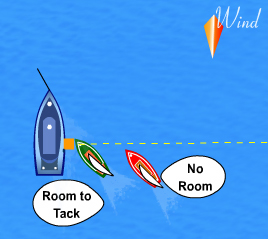
Consider first that what you see is a starting line with the Committee Boat at the port end. In both the old and new rules, the leeward boat had no right to hail for room to tack because the pertinent rule (19.1 old rules and 20.1 new rules) did/does not apply at a starting mark surrounded by navigable water or at its anchor line. See Rule 19.2 old rules, Preamble to Section C new rules.Fine for a start! Green can luff head to wind and hope for the best.
Now consider the illustration as depicting a finish line situation. Under the old rules 19.2 went on to say that 19.1 did not apply " at a mark that the hailed boat can fetch". Red is fetching so Green was in a tough spot. Green was not entitled to room to tack and her hail had no merit.
This (to my way of thinking) is how it should be! Red is in control and is just going to make it by the Committee Boat's anchor rode. Green should have gybed out while she had the chance.
Now along come the new rules and while they say Green should not hail in a situation like this, if she does hail, Red must be bound by the hail!
What's wrong with this you ask?
Well it suddenly shifts control of the situation to the boat that sailed into a "coffin corner" and shouldn't have been there in the first place. Second, although the rules are quite clear that Green broke rule 20.3, it places a burden on Red to have to file a protest to protect her finish position. Third, imagine a situation where two or three boats are stacked up to weather of Red and they are all fighting for the lead. Suddenly, they all have to tack because of Green's hail. Might some other protests arise?? Seems quite likely.
Will Green come up with a story to justify her hail? You bet!
This change was included in the new rules in the interest of safety but I'm not buying into it.
If you can't hail at a starting mark surrounded by navigable water, why can you hail at a finish mark surrounded by navigable water?
I think there are some good changes in the new rules but this wasn't one of them.
e74213ec-2eb6-4a20-95cf-64e1d1e84811|0|.0
I THOUGHT YOU 'D BE INTERESTED TO SEE THE RESPONSE FROM ONE OF OUR READERS, DICK WHITE. MY RESPONSE TO HIM FOLLOWS:
From your blog. Seven times a starboard tack boat must keep clear of a port tack boat.
1. When tacking, rule 13
2. When acquiring right of way, rule 15
3. When changing course, rule 16
4. When port is inside boat at a leeward mark, rule 18.2(b)
5. When returning to the prestart side of the line to start, rule 21.1
6. When doing turns rule, 21.2
7. When backing up, rule 21.3.
8. At an obstruction, rule 19.2(b). Or, is this just a requirement to give room and not a requirement to Keep Clear?
9. When required to give Mark Room for a boat to sail it's proper course at the mark. Or, is this just a requirement to give room and not a requirement to Keep Clear? But, if a boat is entitled to room to sail it's proper course at the mark does that mean the boat required to give room must also keep clear so a boat may change course or tack without contacting the other boat, when changing course or tacking is part of it's normal maneuver to round the mark?
Dick White
Dear Dick,
I was careful to phrase my question "seven times when a starboard tack boat has to give way etc" because in most of these cases she doesn't have to "keep clear" of the port tack boat. I did not have Rule 15 and 16 on my list. I can buy into Rule 15 but I think 16 is a stretch.
Anyway, here's my list:
1. Inside boat at a mark (18.2 (a) & (b)
2. Returning from OCS (21.1)
3. Taking a penalty (21.2)
4. Moving astern (21.3)
5. Tacking (13)
6. Gybing (18.4)
7. Inside at a continuing obstruction 19.2 (c)
I think that 9 & 4 from your email are essentially the same.
6f8e04a1-e60d-47d5-8751-b49b424d306f|0|.0
HERE ARE A FEW GOOD TIPS FOR STAYING OUT OF TROUBLE ON THE RACE COURSE
1. LEARN THE RULES
a. A good working knowledge of the rules is worth 2 or 3 places in a big regatta.
b. Read Part 2 of the racing rules before you start a regatta.
c. Sail by the rules and insist that others do the same.
2. AVOID BEING PROTESTED
a. Don't push tactical situations when you are the "keep clear" boat.
b. Tack sooner rather than later, duck early.
c. Avoid contact even when you're right.
d. Always give room, even when you think you don't have to.
e. When there is doubt or contact, do a penalty turn or turns.
3. STAY OUT OF THE PROTEST ROOM
a. 50% of those who go into the "room" don't like the outcome. Bad odds!
b. If there is arbitration, listen to the arbitrator and heed his advice. If he says you're going to lose, he's probably right!
HERE'S A QUIZ
I think that there are seven times in the new rules when a starboard tack boat has to give way to a port tack boat. Can you name them? Send me an email with "BLOG QUIZ" in the subject line.
3374527e-e91a-4ea1-8b00-72a96a208818|0|.0
We just received our first shipment of Dave Perry's new edition of "Understanding the Racing Rules of Sailing through 2012". As I mentioned in an earlier posting, Dave's book is my bible on the rules and I wouldn't be without it. Indeed, I can't imagine any serious racer not having a copy. As he does in his rules seminars, Dave brings the rules to life with his writing. When combined with the simple-to-understand illustrations, you have the perfect recipe for digesting a tough and sometimes hard-to-understand entree.
The book takes each of the rules apart, piece by piece and explains what they mean and how they work. He often gives an historical perspective e.g. it used to be this way, now it's that way and cites ISAF cases by number where they help clarify a situation. You come away not only knowing the rule but often how it ended up saying what it says.
In the same blog posting where I referred to Dave's book as my rules bible, I recommended a book by Bryan Willis (2009-2012 The Rules in Practice) and called attention to the different perspective used in the Willis book. I think that someone who is serious about the racing rules should own both of them. There is no such thing as too much knowledge of the rules and I for one intend to read them side by side. IMHO a good understanding of the rules is worth two or three places in every major regatta you sail in.
Both books are in stock and available at the UK-Halsey store. The prefect gifts for the sailors you know!
7c1b510a-d858-49df-94eb-b78a113c7d7a|0|.0
Note: This is the third in my series of blogs on the new Section C rules that come into effect January 1, 2009. In these blogs, I’ll refer to the 2005-2008 Racing Rules of Sailing as the “old rules” and to the 2009-1012 version as the “new rules”.
The focus of these blogs is on changes in the game induced by the new rules of Section C, and on places where it looks as if there might be a game change, but I believe there will be none.
In my last blog, we looked at a restriction placed by the new rules on mark rounding – under the old rules a boat clear ahead was granted right of way and freedom from rule 16 (Changing Course) as long as she was turning to round the mark; under the new rules she is only given room to sail her proper course and only gets freedom from rule 16 as long as she is doing so. I argued that, at the end of the rounding, the old rule allowed her to turn past her course to the next mark without breaking rule 16, while the new rule only allows her to turn to that course – after that, she risks breaking rule 16.
In this blog, we’ll look at what appears to be a huge difference between old rule 18 and new rule 18 (Mark-Room): the old rule granted boats right of way to boats that would ordinarily have to keep clear under the rules of Section A (port/starboard, windward/leeward, etc.). The new rule 18 doesn’t do that. And although that looks like a huge game change, I don’t think it will make any difference at all, other than making it easier to remember which boat has rights.
Non-Game Change 2. The preamble to Section A of Part 2 (When Boats Meet) says “A boat has right of way when another boat is required to keep clear
of her” Old rule 18 says, in several places, that such-and-such a boat “shall keep clear of” the other boat. Putting two and two together, we get that the other boat was just granted right of way. So, for example, whereas a starboard-tack boat has right of way over a port-tack boat on the open race course, under the old rules a port-tack boat that was clear ahead at the zone got right of way over the starboard-tack boat behind her, and she kept that right of way throughout the rest of the rounding. Under the new rule 18, the words about keeping clear have been removed, so throughout the rounding, a starboard-tack boat always has right-of-way over a port-tack boat, a leeward boat always has right-of-way over a windward boat, etc.
Let’s see how this works for two boats overlapped at the zone at a leeward mark to be left to port. There are four cases: (1) they’re both on port tack; (2) they’re on opposite tacks with the starboard-tack boat inside; (3) they’re on opposite tacks with the port-tack boat inside; and (4) they’re both on port tack.
Case 1: Both on starboard tack. The inside boat is also the leeward boat, so she has right of way. She can do a “tactical rounding” (see my last blog) and the other boat has to give her room to do so. If she’s not restricted by rule 17, she can sail any course she wants as long as she doesn’t turn too sharply and break rule 16. If the inside boat falls astern of the other boat, she is technically required to keep clear, but usually there’s no issue as she’s going slower than the other boat. If there’s any danger of fouling the other boat she has to sail toward the mark (no tactical rounding!), and the other boat has to give her room to do so. No change in the game from old rule.
Case 2, inside boat on starboard, outside boat on port. The inside boat has right of way, and can sail anywhere she pleases, subject to rule 16. However, under rule 18.4 she cannot sail farther from the mark before she jibes than her proper course. No game change here, except at gate marks, which I’ll cover in another blog. When she jibes onto port tack, she becomes the keep-clear boat and only gets room to sail to the mark and then round it – no change in the game.
Case 3, inside boat on port tack, outside boat on starboard. Now the inside boat is required by rule 10 to keep clear, so she only has the right to sail to the mark, and the outside boat is required to give her room to do so. Room to sail to the mark generally means room to sail to a point where she can begin a tight, seamanlike rounding, but if there are other boats around that she is required to keep clear of or to whom she owes room, she is entitled to additional room to sail around them (because it would be unseamanlike to break the rules). If she wants a tactical rounding, she should jibe to starboard so she’ll be the leeward, right-of-way boat. No game change. When the outside boat jibes to go around the mark, the inside boat must still keep clear under rule 11. No game change.
Under the old rules, if the outside, right of way boat fell astern of the inside boat she lost her right of way and had to keep clear. This would appear to have given the inside boat more power, but in practice in fleet racing the previously inside boat would normally continue on the course she was originally on, and if she swung wide for a tactical rounding it wouldn’t matter because the other boat was clear astern and unable to prevent such a move regardless of right of way. At the mark, the rights of the inside/clear-ahead boat are substantially the same under the new rules as under the old ones (see my first blog).
Case 4, both boats on port tack. The analysis here is identical to that for case 3, except that the outside boat never jibes. No game change.
Now let’s look at what happens when one of the boats is clear ahead at the zone. This time, there are three cases: (1) They are on the same tack; (2) they’re on opposite tacks with the starboard-tack boat ahead; and (3) they’re on opposite tacks with the port-tack boat ahead.
Case 1, boats on same tack. No change from the old rules because the boat ahead has right of way under rule 12. If they are on starboard tack and the boat ahead jibes, she keeps her right of way under the old rules but loses it under the new rules; however, in practice she will only jibe when she’s at the mark, and at that point the boat astern has to give her room to go around the mark on her proper course, so she’s lost no actual rights. If they’re both on port tack, it’s a parade around the mark under both sets of rules. (Note that in team racing the situation is much different – under the old rules if both boats were on port tack the boat ahead could sail wide and then slow down, and if the boat astern sailed into an outside overlap, the inside boat could just sit there, allowing teammates to go inside her while the other boat had to sail all the way around her. Under the new rules she can still sail wide at first, but if the other boat sails into an outside overlap so the boat ahead becomes the windward boat, she is only entitled to mark-room. At that point she has to sheet in and go around the mark, because the definition of mark-room only includes room to round the mark “promptly” on her proper course; sitting there with sails luffing is not “promptly” rounding, and letting other boats without rights to pass inside her is surely not her proper course. But in fleet racing this ploy makes no sense – there’s no benefit to holding another boat up and letting the leaders get away while the boats behind close up the gap.)
So the only change from deletion of the change in right of way will be that now everybody will be able to see and remember who has right of way – it’s the same as on the open course.
c7884a5e-b0b9-4311-9209-126ea6d0bd53|1|5.0