The ISAF Section C Working Party has made two submissions to ISAF that deal with rules 18 and 19. One is an "emergency" change in the definition of Obstruction, to go into effect January 1, 2010, and the other is a proposed ISAF Case dealing with the meaning of Room.
Before we get into the submissions themselves, let's look at the problem the working party is trying to solve. There are a number of scenarios in which Rule 18, Mark-Room, and Rule 19, Room to Pass an Obstruction, appear to conflict. Consider the following scenario, taken from a team-race call suggested by Matt Knowles. The boats are at a reach mark to be followed by a run:
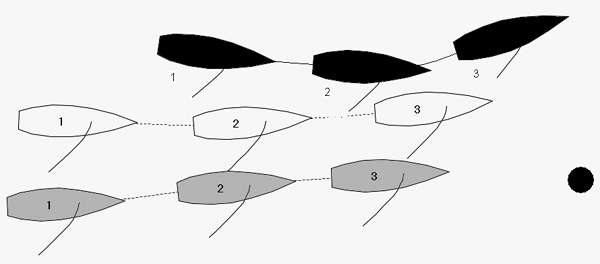
Black is clear ahead of both Grey and White when she enters the zone, and Grey is inside White when they the zone. Grey and White are sailing faster than Black. Grey sails to pass to leeward of Black, and White elects to sail between Grey and Black. In doing so, White forces Black to luff up. Black protests White under rule 18.2(b) for not being given mark-room, and White protests Grey under rule 19 for not giving her room to pass to leeward of Black.
White's argument is that Black is an obstruction to both Grey and White because they both owe Black mark-room (see definition 'Obstruction'). So when Grey elects to go to leeward of Black, she must give White room to do so, too. By sailing up toward White between positions 1 and 2, Grey fails to give White room, causing White to sail too close to Black and thus forcing Black above her course to the mark. White admits she broke rule 18.2(b) with respect to Black but claims she was compelled to do so. She points out that when it became clear that Grey was not going to give her room under rule 19 at position 2, she could not avoid both Black and Grey. So that means Grey should be disqualified, and White exonerated under rule 64.1(c) for her breach of rule 18.2(b).
Grey sees it a different way. White is required to give mark-room to both Grey and Black, and from positions 1 through 3 that means giving them room to sail to the mark. White could easily have seen that at position 1 that she would not be able to go between Black and Grey and still give mark-room to both of them, so she wasn't "compelled" to break rule 18.2(b). Therefore White should not be exonerated. Grey says she herself broke no rule; she was entitled to room under rule 18.2(b) and was simply taking the room to which she was entitled.
(Note that Grey can insure she is blameless by bearing off toward the wrong side of the mark to give White room to pass between her and Black, and protesting White. Now White has clearly broken rule 18.2(b) by not giving Grey room to sail to the mark, and Grey has given room as required by rule 19.)
This apparent conflict between rules 18 and 19 is caused at least in part by the fact that Black is an obstruction to both White and Grey. That's because the definition of Obstruction says a boat racing is an obstruction only if they both "required to keep clear of her, give her room or mark-room or, if rule 22 applies, avoid her." If those words " give her room or mark-room" were removed, then White's case disappears. Black would only be an obstruction as long as both Grey and White are clear astern of her, and after that, Grey would be under no obligation to give White room to pass to leeward of Black.
This is the substance of the submission the Section C Working Party has put forward to ISAF. The definition Mark-Room would say "… However, a boat racing is not an obstruction to other boats unless they are required to keep clear of her or, if rule 22 applies, avoid her. …"
But wait; think about the following scenario:
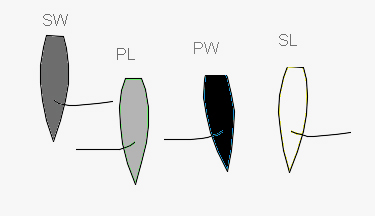
Under the current definition, PW is an obstruction to both PL and SW because, even though PW has right of way over neither of them, they both owe her room to pass SL. This means that SW must give PL room to pass between her and PW. Under the proposed definition, neither PL nor PW would be obstructions to SW. SW would still be required to give PL and PW room to pass SL because SL has right of way over all those boats; but why should SW give PL room to avoid PW?
The answer is a basic principle, not explicitly stated in the Racing Rules of Sailing, but nonetheless clearly implied: Room is defined as the space needed for a seamanlike maneuver, and it is not seamanlike to break the rules. Because SW owes PL room to pass between her and SL, and because PL cannot do that without giving room to PW, thus SW must give PL room to give PW room.
Because this is not explicit in the rules, nor in the ISAF Cases, the Section C Working Group has proposed a new ISAF Case that makes this principle explicit. The summary of the proposed Case says "When a boat is entitled to room, the space she is entitled to includes space to comply with the rules."
Before making these submissions, the working group spent a lot of time thinking of scenarios where the change to the definition of Obstruction might cause problems. Despite our efforts, we could think of none. Can you think of any place on the racecourse where the words "give her room or mark-room" are necessary in the definition of Obstruction? If you can, please let me know by commenting on this blogsite, or contact any of the members of the Section C Working Party: Ben Altman, Chris Atkins, Dick Rose, Richard Thompson, or myself, by e-mail. E-mail addresses for Ben Altman, Dick Rose and me are on the US SAILING website, at http://raceadmin.ussailing.org/Rules/Committee.htm.
62bf0ac9-4707-4cc9-bfbd-de7ad913f312|1|5.0
During a recent day race, the Race Committee signaled a course change to the right at the leeward mark. The change mark was not in the water at that time but the original mark was still in position because it was being used by other classes. The windward leg was short for the boats involved and the visibility was unlimited.
Although the course change was reasonably significant, the short length of the leg meant that the new mark would not be very far from the old mark.
As the leading boats neared the vicinity of the old mark, it was obvious that no new mark had been set. A mark boat with a mark in it was in sight but since the mark was in the boat, no one paid much attention to it.
Just before the lead boats reached the old mark (having decided to race to it), the mark boat dropped the new mark about 200 yards in front of one of the trailing boats. The trailing boat continued on to the new mark, rounded it and was first to finish. The lead boats tacked back to port, reached off to round the new mark and finished well behind the boat that had been trailing.
A request for redress was filed and after a short hearing, the Protest Committee granted redress and abandoned the race.
In the protest hearing, the Race Committee representative, in defense of what happened, asked two questions of the protestor:
1."Why didn't you just sail to the new spot indicated by the new bearing and range"?
2. "Suppose fog had set in-what would you have done then?"
A couple of points came out in response to question #1.
The first was that the mark boat was in approximately the right spot indicated for the change mark. However it had been in evidence throughout the race (given the good visibility and the short length of the legs). The assumption by the leaders was that if he were going to drop a new mark, he'd have done it already.
The second point was that all the boats were navigating by eyeball. No one had bothered with electronic navigation because the marks had been clearly visible from the starting line before the race started. Therefore, the position of the new mark became somewhat of a question as boats sailed away from the leeward mark.
The issue of decreased visibility is an interesting one. For cruising boats with electronic aids for navigation (which these were), one would expect no trouble finding a new mark assuming it is in the right position. However, what about smaller one design boats that have no electronic capabilities? Is it fair to continue a race when the mark can't be easily seen?
Obviously, the density of the fog or anything else adversely impacting the visibility has to be considered. Bad visibility is a relative term. One quarter of a mile is one thing, one quarter of a boat length is quite another.
Rule 33 deals with changing the next leg of a race and the first paragraph of the rule ends by saying that the new mark need not be in position when the course change is signaled. So when does it have to be in position?
There is no guidance in the rules or appeals on when a change mark should be in place so I checked with a number of experts including Mary Savage, Rob Overton, Dave Perry and Peter Reggio to get their opinions.
Here is an amalgamation of what they had to say:
As a competitor, you know that the race committee must tell you that the next leg is being changed before you reach the mark that starts that leg.
Also, the race committee has to tell you where the new mark will be using one of the methods found in Rule 33 (a) or (b).
You should have every expectation that the race committee will have the new mark in place in time for you to approach and round it using the tactics that you see fit to use in that race. There will probably be a difference in your tactics if the visibility is bad and you cannot see either the mark or your competition but you can assume that the mark is where the race committee said it would be.
Do not expect the race committee to abandon a race if the visibility deteriorates or even if they make a minor mistake. In general, this is not a road PRO's like to travel. If you feel that you have been disadvantaged by the race committee's actions (or lack of action), be prepared to request redress.
Common sense is the rule of the day for both competitors and race committees in this situation.
If you're the PRO or you're running the mark boat, put yourself in the competitors' shoes.
1. The new mark needs to be in the right spot.
2. The new mark needs to be in the water early enough for the boats to make a good approach.
3. If the mark boat has a problem, it should get to the right spot and fly Flag M.
If you're a competitor, remember race committees make mistakes so punch the position of the new mark into your GPS regardless of the conditions. If you're sailing a small boat without electronics and the visibility goes bad, time your tacks with your stopwatch and use your compass to keep track of the wind direction.
cd91ce13-6333-424b-b859-af9cadd90b45|0|.0