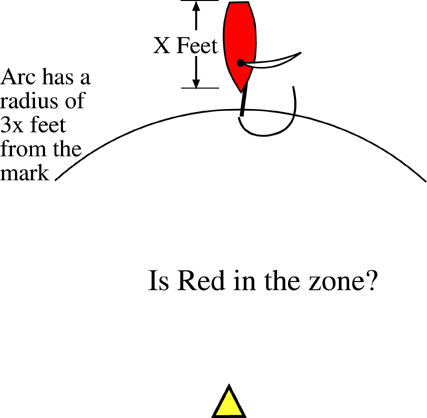
If you answered the quiz question "yes", you answered incorrectly because the boat in the diagram is not yet in the "zone". The definition of ZONE states that it is the area around a mark within a distance of three hull lengths (shown by the arc) but then it goes on to say "A boat is in the ZONE when any part of her hull is in the ZONE".
If you look again at the diagram, you'll see that part of the sprit and spinnaker are inside the arc defining the zone but no part of the hull has made it.
In every other situation where there is a question about a boat reaching a certain point (such as starting, finishing or establishing an overlap), the rules use that part of the boat that is furthest in front e.g. hull, crew or equipment. For the purposes of an overlap or finishing, the equipment must be in its normal position.
In my opinion, using hull length to determine when a boat is in the zone is inconsistent and confusing. If a boat's sprit or equipment is used to determine when she has an overlap or when she is finished, why not use it to determine when she is in the zone?
In fact, I think one could make a good argument that hull length plus the sprit should be used to determine the size of the zone. The rules increased the size of the zone from two lengths to three lengths in order to give boats more distance and time to sort out mark roundings and in particular, leeward mark roundings. Boats with their sprits extended are considerably longer than just their hull lengths and it seems logical that their zone size take this length increase into consideration.
I would be interested to hear what other sailors have to say about this.
Butch Ulmer
[email protected]
4388f7c1-29db-4f6d-8ed9-9ba3565663cb|1|5.0
The
following two-picture sequence provides visual evidence of why tacking
in the zone at a windward mark is such a dangerous thing to do.
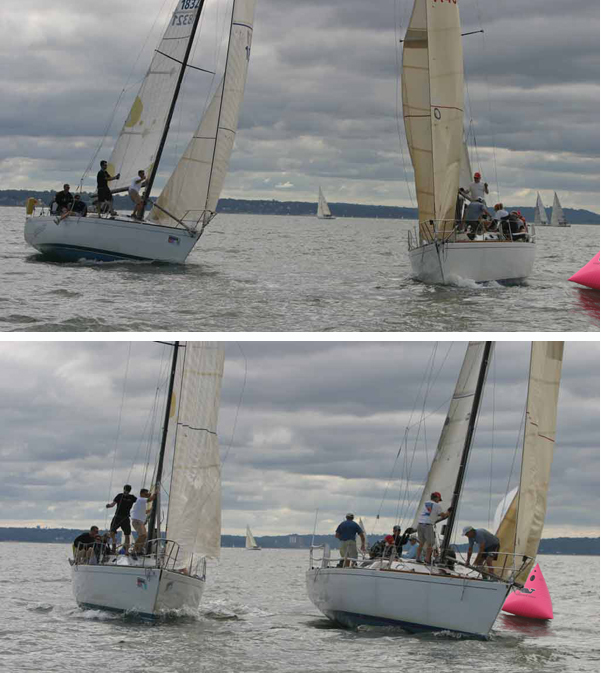
In the
first picture, the boat on the left is on starboard tack and the boat
on the right is either on port tack or has just passed head to wind and
is tacking. (Her angle of heel would indicate she's still on port tack
but her genoa seems to indicate that she has reached or passed head to
wind.
In the second picture, the port tack boat has probably completed her
tack or is just above a close hauled course and the starboard tack boat
has luffed above close-hauled and the boats appear to be overlapped by
a reasonable amount.
Let's look at the situation rule by rule.
THE RULES:
If the right hand boat is on port tack, Rule 10 ON OPPOSITE TACKS applies and states that …"a port tack boat shall keep clear
of a starboard tack boat".
If on the other hand, the boat on the right has passed head to wind,
Rule 13 WHILE TACKING applies. It says, "After a boat passes head to
wind, she shall keep clear" of other boats until she is on a
close-hauled course"
Right here it's worth looking at the first part of the
definition of KEEP CLEAR. It says "One boat keeps clear of another if
the other can sail her course with no need to take avoiding action…".
Clearly, given the proximity of the boats to each other and
the apparent speed of the boat on starboard tack, "avoiding action" on
her part is going to be a necessity. Whichever rule applies, the right
hand boat is in tough shape!
So far, the presence of the mark and the fact that both boats are in the ZONE
has had no impact on the situation. However, Rule 18.3 TACKING WHEN
APPROACHING A MARK puts the nail in the coffin of the boat on the
right.
Rule 18.3 applies when:
A. Two boats are approaching a mark on opposite tacks.
B. One of them changes tack and is subject to Rule 13 in the ZONE.
C. The other boat is fetching the mark.
Since all these conditions have been met, Rule 18.3 applies here. The rule goes on the say that the boat that tacked;
(a) shall not cause the other boat to sail above close-hauled to avoid her or prevent the other boat from passing the mark on the required side and
(b) shall give mark-room if the other boat becomes overlapped inside her.
The left hand boat appears to have overstood the mark but still
had to luff above close-hauled to avoid the boat that tacked. Note that
had she decided to duck under the boat that tacked (certainly a
possibility), she would be entitled to mark-room.
Taken in sequence, there are a string of rules that the port
tack boat could be protested for breaking. In each case, even if the
issue was in doubt (obviously there is no doubt here), a Protest
Committee is likely to come down in favor of the boat on starboard so
this is truly a "no win" scenario.
What should the port tack boat do?
1. Don't go to the port tack layline. It's just asking for trouble.
2.
If you find yourself there anyway (the wind does go left from time to
time), consider bearing off and sailing fast so that your tack to round
the mark will be outside the zone.
3. If you're on the layline and can do it, duck the starboard boat or
boats. Giving up a couple of boatlengths is better than a DSQ.
4. If you're on the port layline and clearly crossing the starboard
boat (s), don't tack at the mark. Continue on port tack and let the
starboard boat(s) round inside you. Once again, you'll be giving up a
little distance but that's better than the alternative.
Another factor to consider here is Rule 14 AVOIDING CONTACT.
The starboard tack boat is required to take avoiding action if he
thinks the port tack boat is not keeping clear. A Protest Committee is
going to listen carefully if the starboard boat says, " I altered
course to avoid contact".
Even if his judgment of the distance between the boats is questionable,
the PC is likely to give him the benefit of the doubt because he
avoided contact.
f485efb7-5290-418a-af9a-f1944cd06881|1|3.0
During a recent day race, the Race Committee signaled a course change to the right at the leeward mark. The change mark was not in the water at that time but the original mark was still in position because it was being used by other classes. The windward leg was short for the boats involved and the visibility was unlimited.
Although the course change was reasonably significant, the short length of the leg meant that the new mark would not be very far from the old mark.
As the leading boats neared the vicinity of the old mark, it was obvious that no new mark had been set. A mark boat with a mark in it was in sight but since the mark was in the boat, no one paid much attention to it.
Just before the lead boats reached the old mark (having decided to race to it), the mark boat dropped the new mark about 200 yards in front of one of the trailing boats. The trailing boat continued on to the new mark, rounded it and was first to finish. The lead boats tacked back to port, reached off to round the new mark and finished well behind the boat that had been trailing.
A request for redress was filed and after a short hearing, the Protest Committee granted redress and abandoned the race.
In the protest hearing, the Race Committee representative, in defense of what happened, asked two questions of the protestor:
1."Why didn't you just sail to the new spot indicated by the new bearing and range"?
2. "Suppose fog had set in-what would you have done then?"
A couple of points came out in response to question #1.
The first was that the mark boat was in approximately the right spot indicated for the change mark. However it had been in evidence throughout the race (given the good visibility and the short length of the legs). The assumption by the leaders was that if he were going to drop a new mark, he'd have done it already.
The second point was that all the boats were navigating by eyeball. No one had bothered with electronic navigation because the marks had been clearly visible from the starting line before the race started. Therefore, the position of the new mark became somewhat of a question as boats sailed away from the leeward mark.
The issue of decreased visibility is an interesting one. For cruising boats with electronic aids for navigation (which these were), one would expect no trouble finding a new mark assuming it is in the right position. However, what about smaller one design boats that have no electronic capabilities? Is it fair to continue a race when the mark can't be easily seen?
Obviously, the density of the fog or anything else adversely impacting the visibility has to be considered. Bad visibility is a relative term. One quarter of a mile is one thing, one quarter of a boat length is quite another.
Rule 33 deals with changing the next leg of a race and the first paragraph of the rule ends by saying that the new mark need not be in position when the course change is signaled. So when does it have to be in position?
There is no guidance in the rules or appeals on when a change mark should be in place so I checked with a number of experts including Mary Savage, Rob Overton, Dave Perry and Peter Reggio to get their opinions.
Here is an amalgamation of what they had to say:
As a competitor, you know that the race committee must tell you that the next leg is being changed before you reach the mark that starts that leg.
Also, the race committee has to tell you where the new mark will be using one of the methods found in Rule 33 (a) or (b).
You should have every expectation that the race committee will have the new mark in place in time for you to approach and round it using the tactics that you see fit to use in that race. There will probably be a difference in your tactics if the visibility is bad and you cannot see either the mark or your competition but you can assume that the mark is where the race committee said it would be.
Do not expect the race committee to abandon a race if the visibility deteriorates or even if they make a minor mistake. In general, this is not a road PRO's like to travel. If you feel that you have been disadvantaged by the race committee's actions (or lack of action), be prepared to request redress.
Common sense is the rule of the day for both competitors and race committees in this situation.
If you're the PRO or you're running the mark boat, put yourself in the competitors' shoes.
1. The new mark needs to be in the right spot.
2. The new mark needs to be in the water early enough for the boats to make a good approach.
3. If the mark boat has a problem, it should get to the right spot and fly Flag M.
If you're a competitor, remember race committees make mistakes so punch the position of the new mark into your GPS regardless of the conditions. If you're sailing a small boat without electronics and the visibility goes bad, time your tacks with your stopwatch and use your compass to keep track of the wind direction.
cd91ce13-6333-424b-b859-af9cadd90b45|0|.0
I am using the illustration below to call attention to one of this year's rule changes.
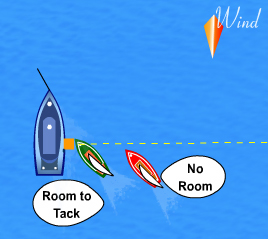
Consider first that what you see is a starting line with the Committee Boat at the port end. In both the old and new rules, the leeward boat had no right to hail for room to tack because the pertinent rule (19.1 old rules and 20.1 new rules) did/does not apply at a starting mark surrounded by navigable water or at its anchor line. See Rule 19.2 old rules, Preamble to Section C new rules.Fine for a start! Green can luff head to wind and hope for the best.
Now consider the illustration as depicting a finish line situation. Under the old rules 19.2 went on to say that 19.1 did not apply " at a mark that the hailed boat can fetch". Red is fetching so Green was in a tough spot. Green was not entitled to room to tack and her hail had no merit.
This (to my way of thinking) is how it should be! Red is in control and is just going to make it by the Committee Boat's anchor rode. Green should have gybed out while she had the chance.
Now along come the new rules and while they say Green should not hail in a situation like this, if she does hail, Red must be bound by the hail!
What's wrong with this you ask?
Well it suddenly shifts control of the situation to the boat that sailed into a "coffin corner" and shouldn't have been there in the first place. Second, although the rules are quite clear that Green broke rule 20.3, it places a burden on Red to have to file a protest to protect her finish position. Third, imagine a situation where two or three boats are stacked up to weather of Red and they are all fighting for the lead. Suddenly, they all have to tack because of Green's hail. Might some other protests arise?? Seems quite likely.
Will Green come up with a story to justify her hail? You bet!
This change was included in the new rules in the interest of safety but I'm not buying into it.
If you can't hail at a starting mark surrounded by navigable water, why can you hail at a finish mark surrounded by navigable water?
I think there are some good changes in the new rules but this wasn't one of them.
e74213ec-2eb6-4a20-95cf-64e1d1e84811|0|.0
I THOUGHT YOU 'D BE INTERESTED TO SEE THE RESPONSE FROM ONE OF OUR READERS, DICK WHITE. MY RESPONSE TO HIM FOLLOWS:
From your blog. Seven times a starboard tack boat must keep clear of a port tack boat.
1. When tacking, rule 13
2. When acquiring right of way, rule 15
3. When changing course, rule 16
4. When port is inside boat at a leeward mark, rule 18.2(b)
5. When returning to the prestart side of the line to start, rule 21.1
6. When doing turns rule, 21.2
7. When backing up, rule 21.3.
8. At an obstruction, rule 19.2(b). Or, is this just a requirement to give room and not a requirement to Keep Clear?
9. When required to give Mark Room for a boat to sail it's proper course at the mark. Or, is this just a requirement to give room and not a requirement to Keep Clear? But, if a boat is entitled to room to sail it's proper course at the mark does that mean the boat required to give room must also keep clear so a boat may change course or tack without contacting the other boat, when changing course or tacking is part of it's normal maneuver to round the mark?
Dick White
Dear Dick,
I was careful to phrase my question "seven times when a starboard tack boat has to give way etc" because in most of these cases she doesn't have to "keep clear" of the port tack boat. I did not have Rule 15 and 16 on my list. I can buy into Rule 15 but I think 16 is a stretch.
Anyway, here's my list:
1. Inside boat at a mark (18.2 (a) & (b)
2. Returning from OCS (21.1)
3. Taking a penalty (21.2)
4. Moving astern (21.3)
5. Tacking (13)
6. Gybing (18.4)
7. Inside at a continuing obstruction 19.2 (c)
I think that 9 & 4 from your email are essentially the same.
6f8e04a1-e60d-47d5-8751-b49b424d306f|0|.0
HERE ARE A FEW GOOD TIPS FOR STAYING OUT OF TROUBLE ON THE RACE COURSE
1. LEARN THE RULES
a. A good working knowledge of the rules is worth 2 or 3 places in a big regatta.
b. Read Part 2 of the racing rules before you start a regatta.
c. Sail by the rules and insist that others do the same.
2. AVOID BEING PROTESTED
a. Don't push tactical situations when you are the "keep clear" boat.
b. Tack sooner rather than later, duck early.
c. Avoid contact even when you're right.
d. Always give room, even when you think you don't have to.
e. When there is doubt or contact, do a penalty turn or turns.
3. STAY OUT OF THE PROTEST ROOM
a. 50% of those who go into the "room" don't like the outcome. Bad odds!
b. If there is arbitration, listen to the arbitrator and heed his advice. If he says you're going to lose, he's probably right!
HERE'S A QUIZ
I think that there are seven times in the new rules when a starboard tack boat has to give way to a port tack boat. Can you name them? Send me an email with "BLOG QUIZ" in the subject line.
3374527e-e91a-4ea1-8b00-72a96a208818|0|.0
We just received our first shipment of Dave Perry's new edition of "Understanding the Racing Rules of Sailing through 2012". As I mentioned in an earlier posting, Dave's book is my bible on the rules and I wouldn't be without it. Indeed, I can't imagine any serious racer not having a copy. As he does in his rules seminars, Dave brings the rules to life with his writing. When combined with the simple-to-understand illustrations, you have the perfect recipe for digesting a tough and sometimes hard-to-understand entree.
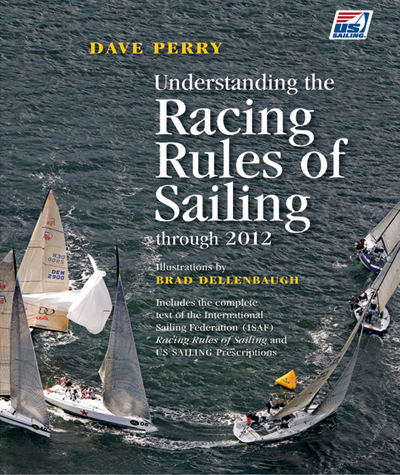
The book takes each of the rules apart, piece by piece and explains what they mean and how they work. He often gives an historical perspective e.g. it used to be this way, now it's that way and cites ISAF cases by number where they help clarify a situation. You come away not only knowing the rule but often how it ended up saying what it says.
In the same blog posting where I referred to Dave's book as my rules bible, I recommended a book by Bryan Willis (2009-2012 The Rules in Practice) and called attention to the different perspective used in the Willis book. I think that someone who is serious about the racing rules should own both of them. There is no such thing as too much knowledge of the rules and I for one intend to read them side by side. IMHO a good understanding of the rules is worth two or three places in every major regatta you sail in.
Both books are in stock and available at the UK-Halsey store. The prefect gifts for the sailors you know!
7c1b510a-d858-49df-94eb-b78a113c7d7a|0|.0
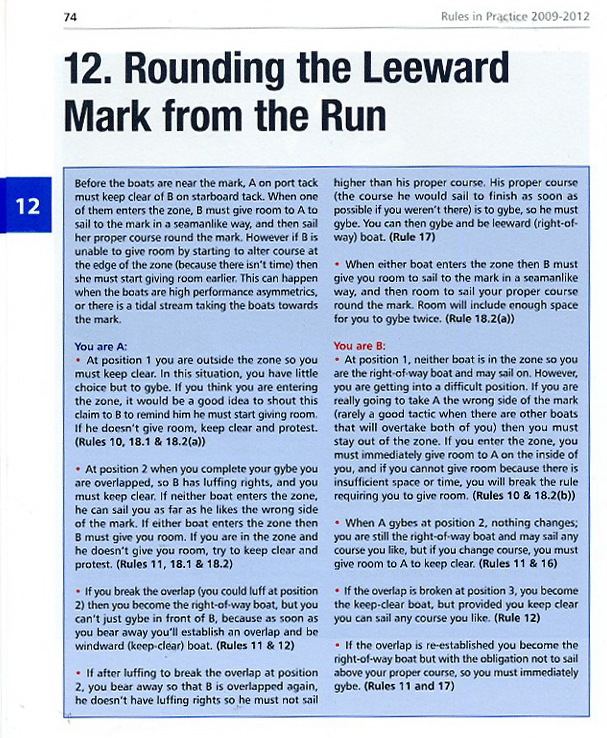
In my first blog posting about Mark-Room, I called your attention to the fact that a boat entitled to Mark-Room can always do a tactical rounding because she is entitled to sail her Proper Course while at the Mark. I called this a game change.
Our guest expert and rules author, Rob Overton has pointed out a flaw in my argument.
Let's assume that two boats on port tack run are overlapped when the leading inside boat enters the zone. Rule 18.2(b) says "the outside boat at that moment shall thereafter give the inside boat Mark-Room".
Mark-Room means the inside boat is entitled to "room to sail to the mark, and then room to sail her proper course while at the mark".
Rob's contention is that the "room" (see definition of room) to sail to the mark for a non right-of-way boat is just that…room, nothing more. Thus the inside boat can only sail directly to the mark until she is "at" the mark. Once "at" the mark, she can sail her proper course but if your bow is abeam of (at) the mark on a run, your proper course isn't going to end up creating much of a tactical rounding.
In other words if you are not entitled to the room to sail wide in preparation to do a tactical rounding, sailing your proper course while at the mark isn't going to help much.
Good Point-looks like more egg on my face!
In the same blog posting, I predicted that the terms "to the mark" and "at the mark" were going to create lot's of "opinion". This is a good example of what I meant!
For those of you who purchased 2009-2012 The Rules in Practice by Bryan Willis, Chapter 12 has some good pointers on this.
2ae6e808-baf8-4444-a985-5e28d72bed9a|0|.0
At the end of my last blog posting, I wrote a couple of paragraphs about what I thought was a conflict between two of the new rules.
Rule 19.2(a) which says," A right of way boat may choose to pass an obstruction on either side"
Rule 20.3 which says in part, "A boat shall not hail unless safety requires her to make a substantial course change to avoid the obstruction". My contention was that 19.2(a) allowed what 20.3 prohibited.
The answer, courtesy of US Sailing Judge Rick Hatch, lies in the preamble to the new SECTION C AT MARKS AND OBSTRUCTIONS. The last sentence of the preamble states "When rule 20 applies, rules 18 and 19 do not". . Since Green is an Obstruction for Blue and Red, Rule 20 applies and 18 and 19 do not. NO CONFLICT. Thank you Rick!
25b43c08-cc92-4200-825e-5ef3e9f706db|0|.0
The other day I was talking with my good friend, Bam Miller, owner of the Oyster Bay Boat Shop. The subject of the new rules came up and he asked if I had ever seen a word document called the PROTEST DIAGRAM KIT. I said "NO" so he sent it along.
Below is a sample of what you can do:
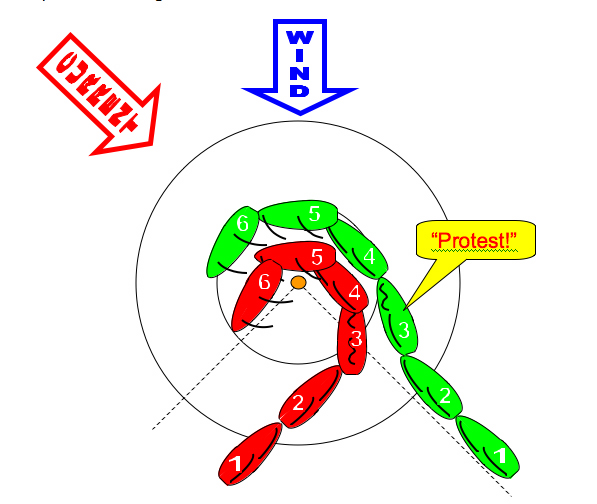
The file for the Protest Diagram Kit is attached here if you'd like to download it.
I don't know Angelo Buscemi but he certainly deserves a pat on the back for creating terrific visual aid.
protestdraw.doc (293.50 kb)
321b2541-0372-42b6-be15-83c83a4527c2|0|.0