ANOTHER GOOD RACING RULES BLOG
As the UK-Halsey Racing Rules Blog gains traction, I've learned of and had contact with another blogger that I'd like to recommend to you.
The blog is called "Racing Rules of Sailing…Look to Windward" and it is written by Jos M Spijkerman from the town of Sneek in the Netherlands. Jos has been blogging for the better part of a year now and "Look to Windward" has lots of information about the rules and many, many good sailing links.
Have a look…the web address is Look to Windward Blog
Last summer I visited Sneek during Sneekweek. Literally hundreds of boats racing on a beautiful lake! The thing I remember most about my visit was driving under an aquaduct to get into town. It was a crazy feeling to look up from a car and see a forty foot sailboat passing over you.
ANOTHER GAME CHANGE
We have had one posting from Rob Overton and hope to have many more. Rob has been helping me update the answers to all the UK-Halsey rules quizzes so that they reflect the upcoming changes ot the rules. While reading through one of his "updates", I came across a game change that really caught me by surprise.
In the existing rules, Rule 19.2 says that Rule 19.1 ROOM TO TACK AT AN OBSTRUCTION does not apply at an obstruction that is also a mark the hailed boat can fetch. So a leeward boat (see illustration below) in Red's place is not entitled to room to tack as long as the boat to windward (Blue) is fetching (and subsequently fetches) the mark. This has always seemed fair to me… the assumption being that the leeward boat had to see the situation developing and should have acted sooner to extricate himself.
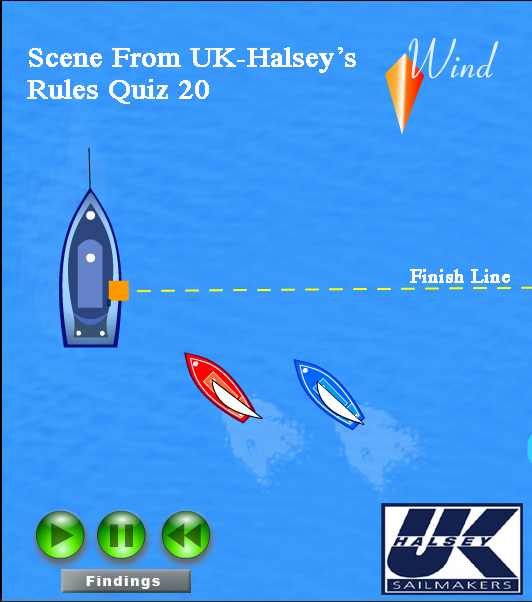
The new rules (Rule 20.3) say that Red "shall not hail (for room to tack) if the obstruction is a mark that the hailed boat is fetching BUT if she does hail, the windward boat is now obligated under new Rule 20.1 to respond to that hail by either tacking or hailing back "You tack" and then giving room.
So the game change is that the right of way boat not only has to respond to an improper hail and give up a tactical advantage and to obtain justice after the fact, she may have to protest the leeward boat under Rule 20.3 for making the improper hail. I can just imagine some of the stories the jury will have to listen to when it comes to the improper hail.
Here's another interesting point. The first part of new Rule 20.3 says "A boat shall not hail unless safety requires her to make a substantial course change to avoid the obstruction". So the leeward of two close hauled port tack boats when confronted with a starboard tack boat cannot hail for room to tack if she can duck by altering her course to leeward by a few degrees.
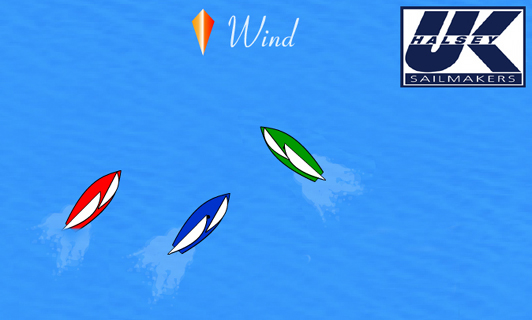
Now read Rule 19.2 (a) which says a right-of-way boat may choose to pass an obstruction on either side. If the right-of-way boat (Blue) in the situation above wants to pass the obstruction (the starboard tack boat) on his starboard hand, why can't he hail for room to tack? Does he break Rule 20.3 by hailing?
There will be more written about this!
95348778-7ad3-4ed3-883d-9eb506c73b2f|1|5.0
Available in the UK-Halsey online store
As the date for the new rules to go in effect creeps closer and closer, serious sailors are going to be looking out for new sources of "rules intelligence". Here's one worth knowing about.
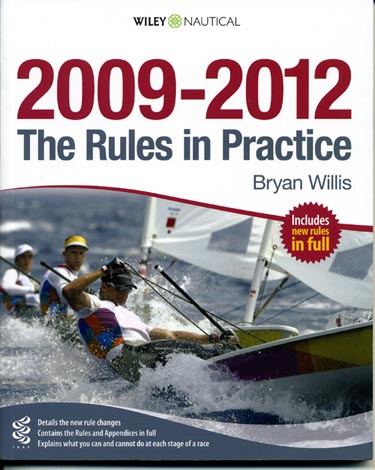
I recently came across a new racing rules book written by Bryan Willis that I highly recommend. The name of the book is "2009-2012 The Rules in Practice". My rules bible has always been Dave Perry's book and while that allegiance will not change, I suspect that I'll be referring to this book regularly, particularly before sailing in major regattas.
A short CV of Bryan Willis appears later in this blog posting and as I'm sure you'll agree, he's well qualified on the subject. What I have found unique about this book is that his emphasis is not on the rules themselves but rather on explaining what your options are in a given tactical situation.
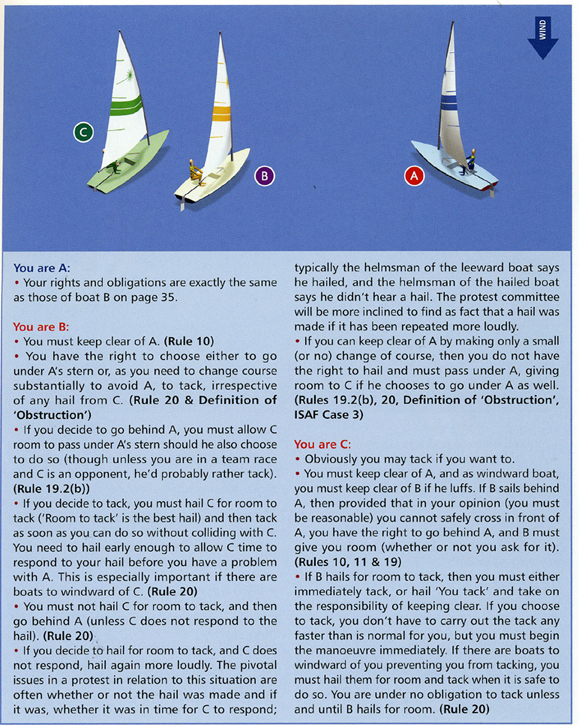
The book is replete with the typical boat-to-boat encounters we see in every race. Willis puts you in each boat and then explains what you can (and cannot) do and what you should (and should not) do. At the close of each explanation, he cites the rule numbers that pertain but that's it.
This is a different and great perspective and everyone who reads this book will find themselves saying, "I remember doing that…what was I thinking?"
The illustrations in the book are well done and the writing is clear and easily understood. A copy belongs on every sailor's bookshelf. To get yours from the UK-Halsey online store just click here:
BRYAN WILLIS chairs international juries at major events throughout the world. He was Chairman of the Jury for the Sydney Olympics and Chairman of the Jury and Chief Umpire for the last three editions of the America's Cup. He is vice-chairman of the ISAF Rules Committee on which he has served for over 25 years. He has chaired the ISAF Race Management Committee and the ISAF Race Officials Committee and was instrumental in the development of umpiring.
8b9d3fc2-b30c-436f-8d2e-006a8dd26694|1|5.0
This posting deals with a new, added definition called Mark-Room.As you will see, there is a lot to this definition and, in my opinion, there will be a lot of discussion about some of the wording in it. I will post enough to get you thinking but for sure you'll be seeing a lot more written about Mark-Room.
Mark-Room Room for a boat to sail to the mark, and then room to sail her proper course while at the mark. However, mark-room does not include room to tack unless the boat is overlapped to windward and on the inside of the boat required to give mark-room.
First of all, to understand what mark-room is, you will have to have your rulebook handy because it uses a bunch of other definitions as part of the text e.g. room, proper course, mark, etc.
Second, note that a boat will be entitled to mark-room while sailing to the mark and then room to sail her proper course while at the mark.
I predict that "sailing to the mark" and being "at the mark" are phrases that will create no small amount of "opinion".
There is one thing that jumped right out at me and that's the part about room to sail your proper course while at the mark.
As things stand now, Rule 18.2 (a) requires an outside boat to give an inside overlapped boat room to round or pass… and if the inside boat is a right of way boat, the outside boat must also keep clear.
In practice what this means is that the inside boat gets room to do a tactical rounding if she's a right of way boat but if not, she is entitled to just enough room to round in a seamanlike way.
Under the new rules, the inside boat will always be entitled to do a tactical rounding because she can sail her proper course while at the mark.
THIS IS A GAME CHANGE!
74072c42-2a1b-4b99-a0f9-4f034df28a75|0|.0
Welcome to the initial posting of my racing rules of sailing blog. I’ve been spurred to writing in this public forum because of the numerous and substantial changes to the rules of the game as of January 1st,2009.
As you will see, the new rules change the nature of the game in many ways as they deal with the most complicated parts of the rules, SECTION C… AT MARKS AND OBSTRUCTIONS.
To help you understand the changes, I will from time to time, post the old rule or definition as well as the new one so you can compare one to the other.
Let's look at one of the new definitions:
ZONE "The area around a mark within a distance of three hull lengths of the boat nearer to it. A boat is in the zone when any part of her hull is in the zone."
The existing definition is entitled the TWO-LENGTH ZONE and it will no longer exist after January 1st. It is defined as:
"The area around a mark or obstruction within adistance of two hull lengths of the boat nearer to it."
Note the changes:
1. The size of the zone has increased from two hull lengths to three hull lengths.
2. There is no zone around an obstruction.
3. A boat is NOT in the zone unless her hull is in the zone.
#3 above is a “first” in that the criteria for being in zone is just your hull. In all other instances that I can think of in the rules (starting, finishing, overlap) the criteria is not just your hull but it also includes equipment and in some cases your crew. Now it’s just your hull! So if you are sailing a sprit boat, a boat with a bowsprit or a boat with a spinnaker pole extension, you have to remember that these appendages don’t count when it comes to being in the zone.
a6a2c3bc-4f9a-4702-b2d6-7f3c050a5956|1|4.0