In his excellent rules blog “Unruly” (http://rulestalk.blogspot.com/), Matt Knowles poses the following question:
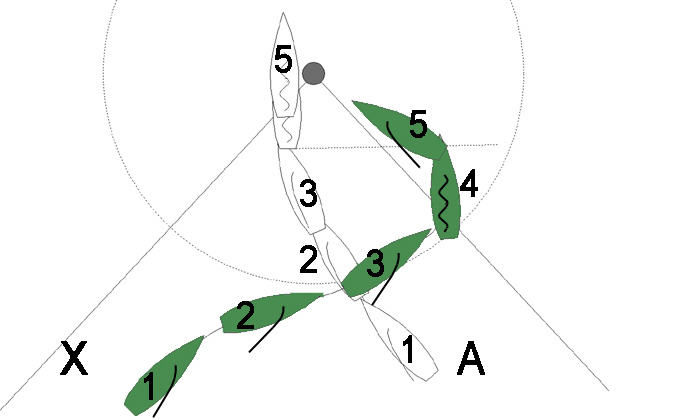
“Fleet racing downwind in Lasers, light air, approaching the pin end of a downwind finish. The boats enter the zone [as shown in the diagram below]. At position 3, Blue bears off to avoid Yellow and protests. What should the decision be?”
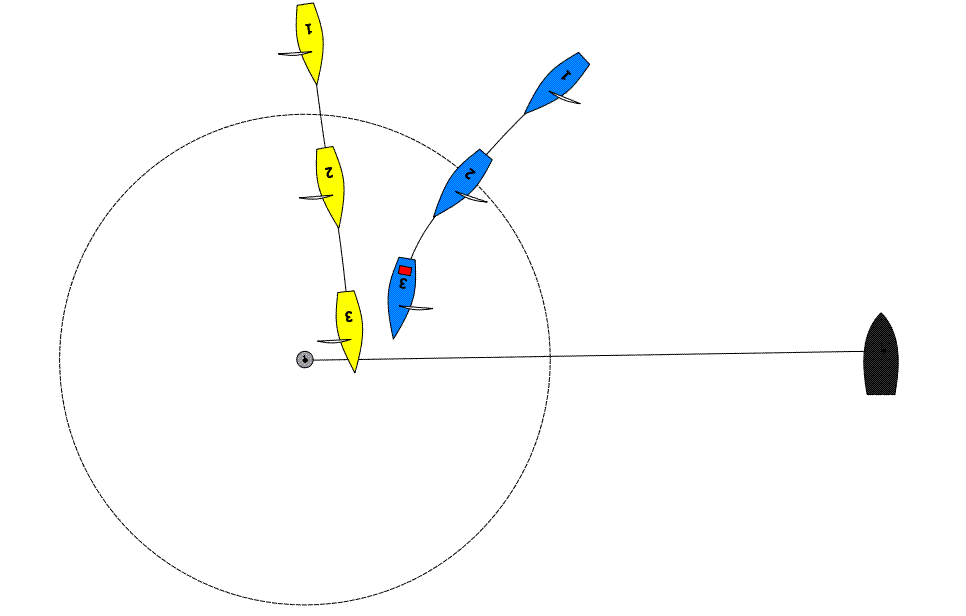
Matt’s answer (with which I agree) is as follows:
“Yellow enters the zone overlapped inside Blue, and is therefore entitled to mark-room.
“Mark-room is room for a boat to sail to the mark, and then room to sail her proper course while at the mark.
“Proper course is a course a boat would sail to finish as soon as possible in the absence of the other boats referred to in the rule using the term.
“At position 3, Yellow is at the mark and has finished. Blue must give her room to sail her proper course. However, because she has finished she does not have a proper course.
“Yellow fails to keep clear of Blue, who has right of way under rule 10. Rule 18.5 begins ‘when a boat is taking mark-room to which she is entitled...’ We must decide whether she is taking mark-room. Because here mark-room is room to sail a proper course, and she does not have a proper course, she cannot be taking mark-room. Yellow is therefore not taking mark-room, and cannot be exonerated by rule 18.5.
"Penalize Yellow for breaking rule 10.”
This answer, while correct, goes contrary to the obvious intent of the rule, so until there’s an ISAF Case on it you might have a bit of a problem convincing protest committees that Blue is required to give Yellow room at the mark right up until Yellow finishes, but not thereafter. I suppose you could bring a copy of Matt’s blog (or this one) with you to the protest room, but Matt and I are hardly officially blessed authorities on the rules, so the protest committee might safely ignore us. Alternatively, if you’re in Blue you might just want to give Yellow room all the way through the incident, as the rule clearly intended you to do.
The primary problem here is with the current definition of mark-room:
“Room for a boat to sail to the mark, and then room to sail her proper course while at the mark. However, mark-room does not include room to tack unless the boat is overlapped to windward and on the inside of the boat required to give mark-room.”
In addition to Matt’s example, there’s another problem with this definition – the "sail to the mark" part doesn’t work well near the edge of zones around passing marks, where the proper course for a boat is to sail toward the next mark, not toward the passing mark. Under the current definition, if boats are running on opposite tacks past a passing mark surrounded by navigable water and the port-tack boat (P) enters the zone clear ahead of the starboard-tack boat (S) but S establishes a late inside overlap in the zone, P can turn toward the mark and force S to the wrong side of it – again, clearly not what was intended by the rule.
The ISAF Section C Working Party, which re-wrote Part 2, Section C of the RRS (i.e., rules 18, 19 and 20), didn’t actually go out of business in 2009 when those rules came into effect, but was appointed by the ISAF Racing Rules Committee to monitor problems with, and reactions to, the new Section C rules – getting help from people like Matt, of course. The WP, of which I confess to being a member, has been aware of Matt’s problem (as well as the passing-mark problem) for some time, and just this week, Richard Thompson, another member of the WP, presented to the ISAF Racing Rules Committee the WP’s latest thoughts on how to fix it. Here’s what the WP is thinking about:
PROPOSED Definition Mark-Room
Mark-Room for a boat is
(a) room for her to leave the mark on its required side, and
(b) when her proper course is to round the mark or pass close to it, room for her to sail to the mark and room to round or pass as close to it as she could in the absence of the boat required to give her mark-room.
However, mark-room does not include room for her to tack unless the boat required to give her mark-room is overlapped to leeward and outside of her, and only if she would be fetching the mark after her tack.
The proposed change in the last sentence solves an entirely different problem, and I won’t address it here. Note that the new definition, unlike the current one, would first state the basic requirement, to allow the boat entitled to room the opportunity to pass on the mark’s required side. It would then amplify this requirement in the situation where a boat’s proper course is to round the mark or pass close to it. So at a passing mark that the boats will not sail near, only part (a) applies, and the port-tack boat in my example above cannot use her right to mark-room to drive the starboard-tacker to the wrong side of the mark. Part (b) is intended to catch the meaning of the current “sailing to” and “at the mark” requirements, but without requiring the reader to decide which of these states applies at a given time. It also removes the requirement for room to sail a proper course at the mark – all the boat with mark-room would be entitled to do is round the mark as closely as she would have done in the absence of the other boat.
In addition to solving Matt’s problem, this would correct a problem originally pointed out by Butch on this blogsite, shortly after the new Section C rules came out: The proper-course phrase allows a long-keeled boat considerably more room at the mark than she has traditionally been allowed.
The wording above is not a formal proposal as yet; the WP did not feel the proposal had received sufficient consideration by this year’s deadline for ISAF Submissions. The only time the WP can now submit a proposal to ISAF is August 1, 2025 for consideration at the ISAF Annual Conference in November 2011. Unless the submission is made on an “emergency basis”, even if it is approved the changes would not go into effect until January 2013.
Clearly, I think the proposal solves Matt’s finishing-line problem, but I could be wrong. If you have any ideas about this proposed change, please comment here (or, if you like, on “Unruly”), or drop me an e-mail message.
13502614-b31f-4c4d-96ea-3e58a64baaad|2|3.5
In my most recent two blogs on this site, I’ve pointed out a couple of problems with the current rule 20: A boat hailed for room to tack can’t legally pass the hail on to a boat that’s to windward of her; and a leeward port-tack boat approaching a starboard-tack boat can legally use rule 20 to “scrape off” the boat to windward of her, then duck the starboard-tacker. Both of those are unintended consequences of the way rule 20 is written, and the US Racing Rules Committee has proposed to change the rule in 2013, to fix those problems.
In this blog, I’ll explore another problem with current rule 20: It starts with the words “When approaching an obstruction, a boat sailing close-hauled or above may hail for room to tack and avoid another boat on the same tack,” so if a boat hails for room to tack when she’s not on a close-hauled course (say, she’s on a reaching leg) then she doesn’t break any rule.
OK, I agree that’s a technicality. But what isn’t a technicality is that the hailed boat doesn’t have to respond if the hailing boat is not sailing close hauled or above, because in that circumstance rule 20 doesn’t apply. Suppose Larry is sailing a slow, old cruising boat and Will is to windward in his brand-new hot racing boat. They’re both on starboard tack approaching a pile of rocks that Larry isn’t fetching, and Larry hails for room to tack. Will looks under the boom and sees that Larry isn’t even close to what Will thinks of as a close-hauled course, so he shouts “You’re not close hauled! I don’t have to tack!”
Of course, Larry might protest and later, after somebody picks him up off the rocks, convince a protest committee that he was indeed close hauled when he hailed, but so what? His boat is gone. Rule 20 is supposed to be a safety rule, and as such, it should require Will to tack and, if he thinks Larry was below his close-hauled course, protest. In order for that to happen, the rule needs to apply regardless of the hailing boat’s course.
Both US SAILING and the Royal Yachting Association (the British equivalent of US SAILING) are proposing to move the expression about the hailing boat’s course down into the section about when a boat shall not hail. This, I think, fixes the problem: the windward boat has to either tack or hail “You tack” and give the other boat room to tack and avoid her. So under that rule, Larry’s boat will float to sail another day.
There’s one problem with the British proposal, though, which in my opinion makes the US proposal better: The Brits simply move the course issue into rule 20.3 When Not to Hail, leaving rule 20 as beginning,
“When approaching an obstruction, a boat may hail for room to tack and avoid another boat on the same tack. After a boat hails, …”.
We felt that with nothing about a close-hauled course, nor about needing to change course for the obstruction, etc., this introduction gives too little information about what the rule is all about and where on the race course it should be used; so new readers will simply say “What the hey?”
To solve this problem and to make the rule look more like the other rules of Section C (and of the rest of Part 2), we’re proposing to move all of the stuff about when a boat can hail to the front of the rule. So our rule 20 would begin:
“When approaching an obstruction, a boat may hail for room to tack and avoid a boat on the same tack, but she shall not hail if
(a) she is sailing below close-hauled,
(b) she can avoid the obstruction safely without making a substantial course change, or
(c) the obstruction is a mark and a boat that is fetching it would be required by rule 20.2(b) to change course as a result of the hail.
This proposal and the rest of the US SAILING Racing Rules submissions to ISAF are available at http://raceadmin.ussailing.org/Rules/ISAF_Rules_Submissions.htm. Please take a look at them and tell me what you think. These changes won't be acted on by ISAF until November, so now is the time for us to catch any mistakes we’ve made, or to turn away from the direction we’re going, if the proposed changes aren’t good ones. Fill out the response form on the page above, send me an email, or submit a comment to this blogsite. Whatever way you choose to comment, I’ll be happy to read it and either suggest to the US Racing representatives to ISAF that we change our submission, or discuss the matter further with you.
9ae05432-8f21-45f1-bf0b-28abc85b77be|0|.0
Situation: In a dinghy race, two boats, PL and PW, are on port tack, approaching S on starboard tack. S is on the starboard-tack layline outside the zone (see diagram). PL is bow-out on PW but overlapped with her, and PL will have to change course substantially to avoid S. At position 1, she hails PW for room to tack. At the moment she hails, there is no chance PL will be able to tack short of S, but PW can do so easily, and does. Then PL ducks S and tacks on her hip. PL fetches the mark nicely but PW, alas, does not. PW protests. What is your call?
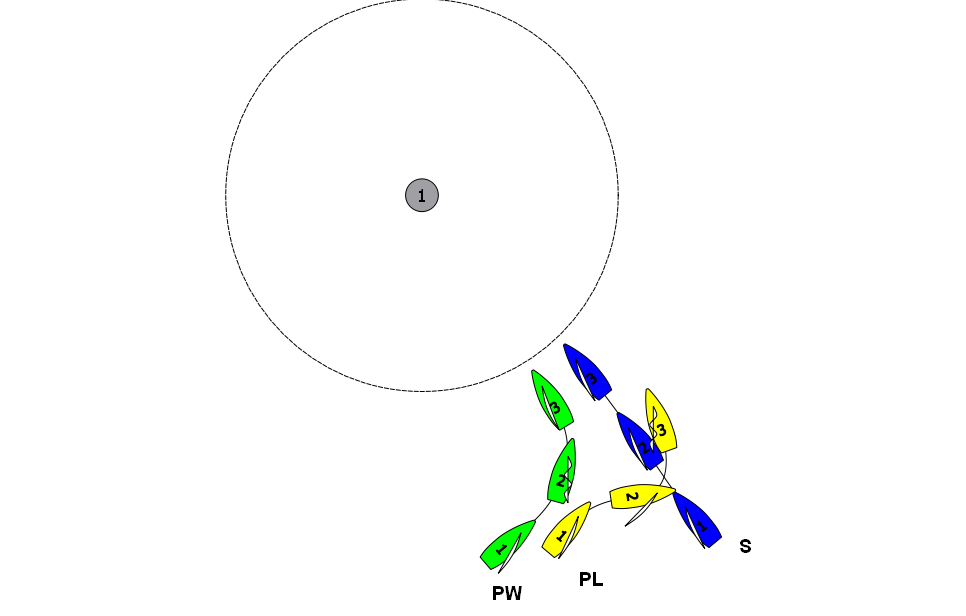
Analysis: Rule 20 HAILING FOR ROOM TO TACK allows PL to hail because she’s on a close-hauled course, S is an obstruction to both her and PW, PL will have to change course substantially to avoid S, and of course S is not a mark so there’s no issue of whether SW is fetching the obstruction. Rule 20 requires PW to tack as soon as possible or to hail, “You tack!” and she elects to tack as soon as possible, which is pretty much immediately. The same rule requires PL to tack as possible after PW tacks, but “as soon as possible” for PL is after she passes S, so that’s when she tacks. No rule is broken; PW is simply screwed.
I can hear you saying “But PW could have hailed ‘You tack!’ and then claimed room to pass behind S!” Unfortunately, the Preamble to Section C says that if rule 20 applies (and it surely applies here, as PL has already hailed for room to tack) then rule 19 does not. So PL is under no obligation to give PW room to duck S, and if PW tries to go between PL and S, PL can bear away to avoid a collision between PW and S (see rule 14), and then protest. The protest committee should find that PW broke rule 11 (Windward/Leeward) and PL broke no rule.
It’s actually a little worse than that for PW, because even if she manages to duck S without fouling PL, she’s still stuck for what to do when PL tacks just after she passes S, as required by rule 20. PW is required to give PL room to tack and clear her, but how can she do that when S is right in the way? So PW is likely to break rule 20 even if she didn’t break rule 11 when she ducked S.
The US SAILING Racing Rules Committee is proposing to change the Preamble to Section C so that rule 19 still applies in this situation. We still have to allow boats to hail when they’re inside the zone, and obviously such a hail could prevent a boat from sailing to the mark, so we still have to “turn off” rule 18 when rule 20 applies, and we propose to do so, inside rule 20 itself.
The ISAF Submissions from US SAILING are posted on the US SAILING website, at http://raceadmin.ussailing.org/Rules/ISAF_Rules_Submissions.htm, along with a convenient form for comments and suggestions. There are several submissions, and unfortunately they are hard to read because of the required ISAF format, but I urge anybody who is interested in what’s happening with the Racing Rules of Sailing to wade through those submissions and, if you find things you don’t like (or that you do like), fill out the comment form. These changes won't be acted on by ISAF until November -- they're only proposals at this point -- so now is the time for us to catch any mistakes we’ve made, or to turn us away from the direction we’re going, if the proposed changes aren’t good ones.
0ea4b61f-b03c-42ba-838b-87a1c6fdc5b7|0|.0
Three keelboats, L, M and W are all on the same tack, with L to leeward, M in the middle, and W to windward. They are approaching a rock pile that L needs to substantially change course to avoid but M and W do not. L cannot tack without fouling M and M cannot tack without fouling W. The rock pile is not a mark. (See diagram below.)
At position 1, L hails M for room to tack. M hears the hail but W does not, or at least there’s no response from her. So at position 2, M hails W for room to tack, and W immediately tacks in response to the hail; but she also hails “Protest!” and puts up a red flag. M tacks immediately after W, and L tacks immediately after M.
W files her protest correctly, and there is a hearing. Assuming the facts found are as stated above, what is the correct decision for the protest committee?
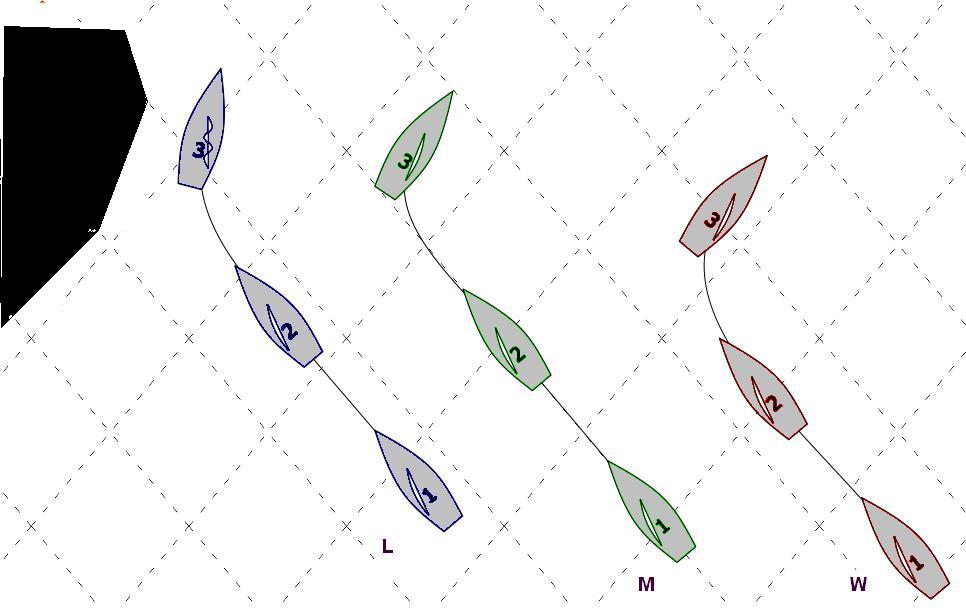
I think most of us would say that Rule 20 worked here exactly as it was intended to do – L needed room to tack to avoid the rocks, and she hailed M correctly as described in the first paragraph of rule 20.1. M passed the hail on to W, and everybody responded as rule 20.1 requires. But actually, there’s nothing in the rule that allows M to pass on the hail to W. L’s hail is perfectly legal, because passing the obstruction requires a substantial change of course for her. But M’s hail is not legitimate because there is no obstruction that requires her to change course at all. M does not have to change course substantially to avoid the rocks, and although as a right-of-way boat L is an obstruction to M, at the time of her hail M does not need to change course to avoid her – and if L were to tack, she would no longer be an obstruction to M. So M’s hail does not conform to the requirements of rule 20, and she breaks the first sentence of rule 20.3, When Not to Hail. Disqualify M.
This answer seems wrong, to me and to lots of other people in the rules community including the entire US Racing Rules Committee. So this year, we are proposing to ISAF to change rule 20 by adding a sentence: " A boat that has been hailed for room to tack may always hail for room to tack and avoid a third boat.” If ISAF accepts our submission, the rule will change in 2013.
We’ve proposed some other changes, too, and I’ll cover them in future blogs. The entire list of rules submissions to the 2010 ISAF Conference in November will soon appear on the US SAILING website; when that happens, I’ll be interested in any comments about them.
3a48a62e-2e3f-4b80-9718-56f513ca69c7|0|.0
In the course of umpiring, I of course see plenty of fouls. Mostly, they’re caused by boat-handling errors – in situations where boats are maneuvering very closely, a few inches one way or another can make the difference between a well-executed play and a foul. And all the rules Part 2 of the RRS are involved, at one time or another.
But patterns do sometimes emerge, and we saw a definite pattern at the Opti Team Race Nationals this July that led me to think that rule 15 is not well understood, even at the top level of Opti sailors, where coaches are common.
The team-race rules are almost exactly the same as the regular rules for fleet racing, making me think that maybe lots of top Opti sailors are ignorant of (or ignoring) rule 15 in fleet racing as well; so I thought a brief review might be a good idea.
The situation the umpires saw repeatedly is roughly the one shown in UK-Halsey Quiz 8. One boat (Green in the quiz) is on starboard tack, luffing her sails just below the starting line and another boat (Red) comes in on starboard tack from behind her. Red establishes an overlap very close to leeward of Green (in the case of Optis, a few inches away) and almost immediately makes contact with the other boat. In the quiz, Red doesn’t change course during the incident, but at the Opti TR Nationals we saw a number of incidents where the overtaking boat also luffed up toward the boat that was luffing her sails on the line.
Either with a change of course or without, Red breaks rule 15, ACQUIRING RIGHT OF WAY, which says: “When a boat acquires right of way, she shall initially give the other boat room to keep clear, unless she acquires right of way because of the other boat’s actions.”
In the starting-line case, the overlap is clearly not established because of Green’s actions: she was just sitting on the line minding her own business. And if Red comes in too close to Green, there’s nothing Green can do to keep clear. If she trims in, she’ll slide down into Red because she hasn’t established any lift on her foils; if Green just sits there, Red runs into her boom.
The amazing thing, to us, was that frequently after this happened Red protested Green and Green did her turn. Of course, this means that the umpires never got involved in that protest, so all we could do is bemoan the fact that the wrong boat was spinning. And of course having one boat already at the back of the fleet at the start is not a great way for a team to win. We wondered afterwards, how many races would have had the opposite outcome if Green had known her rules and stood up for her rights!
On the open race course, and even before the start, the call between rule 15 and the right-of-way rule (such as rule 11, requiring the windward boat to keep clear) comes down to subtleties: Did the windward boat do something, like bear off, that established the overlap? Did the new keep-clear boat do all she could to keep clear? Did the other boat give her room to do so? But at the starting line, with one boat almost dead in the water and the other boat coming in to leeward of her with good way on, there’s rarely a close decision. The boat coming from astern was at least partially responsible for the overlap, so rule 15 almost always applies, and there’s really nothing the new windward boat can do to avoid the contact. So, if there’s contact very soon after the overlap is established, it’s almost always because the boat coming from astern didn’t initially give the new windward boat room to keep clear.
So next time you’re the boat luffing on the line, don’t take any nonsense from a boat that comes in to leeward of you and starts yelling “Up, up!” or something like that. If you have room to do so, trim in and hike out, so you’ll keep clear of the other boat; if you don’t have room and there’s contact, protest under rule 15.
ffb8041b-4209-4354-8281-8542494dc46c|1|5.0
Rule 32.1 says, in part, “After the starting signal, the race committee may shorten the course (display flag S with two sounds) or abandon the race (display flag N, N over H, or N over A, with three sounds), as appropriate, …
(a) because of an error in the starting procedure,
(b) because of foul weather,
(c) because of insufficient wind making it unlikely that any boat will finish within the time limit,
(d) because a mark is missing or out of position, or
(e) for any other reason directly affecting the safety or fairness of the competition.”
The rule goes on to say that if even one boat has sailed the course and finished within the time limit, if any, the race committee cannot abandon a race without considering the consequences for all boats in the race or series.
The parts of rule 32.1 I’d like to address here are the clause in (e) and the lack of any time limit for when the race committee might abandon a race. Lately, I’ve heard about and experienced two rather bizarre applications of (e) above. In both cases, the abandonment happened after the race was concluded – in fact, after all the sailors, and the race committee, were off the water.
The first situation was at a major regatta a few years ago. There was some confusion about what mark to round, and consequently some boats in the fleet went around the wrong mark. They were protested, the protest committee disqualified them for not sailing the course, and they then filed for redress, claiming that the fault was the race committee’s, not theirs.
The protest committee met to consider the redress issue, and brought in a number of skippers, as well as the race committee chairman, as witnesses. They determined that the error had in fact been entirely due to the race committee’s error, but rather than abandoning the race they decided to give average points to the four boats that had gone around the wrong mark.
Meanwhile, the race committee chairman had also become convinced that the error was his. He considered the consequences of abandonment to the boats that had rounded the mark correctly, but on balance he felt that it was unfair for some boats to have to go around a longer course than others, so he decided that the race should be abandoned. The abandonment was announced while the protest committee was still holding the redress hearing. You can imagine their surprise when they came out of the room and discovered that the race they had just been contemplating had been abandoned without their consent! There was, of course, a redress hearing, and I confess I don’t remember the final outcome. But according to the rules, the boats filing for redress had to demonstrate that the abandonment was “improper”, and I know that many judges (including myself) interpret that word very narrowly: Basically, for an action by the race committee to be improper, it has to either break a rule or be so egregiously unfair that it fails the “sniff test” for propriety (as for example when a race committee shortens a Junior regatta race because the local long-shot kid is winning). In our abandonment case, the race committee’s decision appears to have complied with the rules, and I’m not sure it meets the standard of impropriety. They did consider the consequences of abandonment on all the competitors, as required by rule 31.1, and having some boats disqualified for a race committee mistake was surely unfair to those boats.
The second case occurred just a few weeks ago. Again, it was a major regatta; this time, a team-race event. At the finish of one important race, the umpires mistakenly thought a boat had hailed the umpired to resolve a protest decision (displaying a yellow flag as required by Appendix D). So they penalized one of the boats involved in the incident that had led to the protest. That boat had already finished, so she was obliged to do two turns, return to the course side of the line, and finish again. She did so, and as a result her team lost the race.
The losing team requested redress, citing both the blown call and the race committee’s scoring – they claimed the race committee should have scored the boat’s first finish because the penalty was illegally imposed by the umpires. The protest committee decided not to award redress because rule D2.4(c) says, in part, “There shall be no request for redress or appeal by a boat arising from a decision, action or non-action by an umpire.” The blown call was clearly an action by an umpire, so redress could not be granted for it. And the race committee had scored the boat correctly because she had indeed done her turns and finished again.
Then the race committee chairman got into the act. He felt that the umpire’s action had been clearly unfair, so, after considering the consequences of abandoning the race on the other team (they would lose a victory they had not actually won on the water), he abandoned the race. The race was re-sailed the next morning, and the team that had been scored as winning the original race won the re-sail, so there was no request for redress.
Note that in both cases above, the race committee action had the effect of overruling a protest committee decision. In the first case, the abandonment granted a particular redress remedy different from what the protest committee had come up with; and in the second case, the abandonment effectively granted redress where the rules specify that no redress is permitted. Also note that in both cases, the race was long over.
There are lots of other examples of races abandoned after they have been completed, and last year both US SAILING and the British Royal Yachting Association submitted changes to rule 32.1, limiting the time when a race committee can abandon a race. (We wanted to end this option when the race committee came ashore; the RYA wanted to end it after the racing was completed.) The proposals were opposed by the ISAF Race Officials Committee on the grounds that they constituted unwarranted interference in the race committees’ business, and the Racing Rules Committee rejected them.
This leaves an interesting question: When is the last time a race committee can abandon a race? They apparently can do so after the race is over and everybody is ashore, and I don’t see anything that would prevent them from abandoning a race several days after it was run but during the regatta, if they determine that the race in question was “unfair” and if they consider the impact of abandonment on the other boats. (“Well, Mary, what will be the effect on the other boats if we abandon the race?” “Well, Bob, the boats that are now scored in that race will lose those scores.” “OK, Mary, thanks. We’ve now considered the effect of abandonment on the other boats. Race abandoned.”)
But what if the race committee discovers some unfairness in a race, after the last race is run? After the prizes have been given out? After everybody has gone home? How about a week, month, or even a year later? Can the race committee of the America’s Cup in 1987 (when the New York Yacht Club lost the Cup) decide that the last race of that Defense was unfair, and abandon that race?
This is certainly an interesting question, and I’m not sure it will be resolved anytime soon, given the ISAF RRC rejection of the American and British submissions last year.
But the more I think about it, the less I think the problem is the timing of these abandonments. I think the key problem might be that “fairness” is too vague a word. What is fair to one boat may seem grotesquely unfair to another, and, unlike a protest committee, the race committee need not hear both sides of that argument.
Suppose a race begins in 8 knots of breeze, and the first of two windward/leeward laps goes well. Then the wind dies out and fills in from astern. The tail-end boats catch the new breeze, and it becomes clear that they will sail around the hole where the leaders are sitting, becalmed, and the last will be first.
The race committee observes this and says, “Hey, that’s unfair, isn’t it? Those leaders worked hard in good breeze to go to the front of the fleet, and now the tail-enders are going to sail right around them and finish first, simply because they were lucky enough to be where the wind filled in first.” Can they abandon the race? I think rule 32.1 says “Yes,” but I’m not happy with that. Aren’t vagaries in the wind (even unfair vagaries) part of sailboat racing?
How about if, in the middle of a dinghy race, a large cruising boat cuts across the race course? If only a few boats make it across the boat’s bows and the rest are delayed substantially, I’m guessing that the race committee would abandon the race under rule 32.1(e). But how about if the only boats affected are at the back of the fleet? I’m guessing most race committees wouldn’t abandon for them. How fair is that?
It seems to me that this whole fairness issue is a slippery slope.
Should the rule be changed, maybe by limiting rule 32.1(e) to unfairness caused by race committee actions? And if you think there should be a time after which a race committee should not be able to abandon a race, what do you think that time limit should be?
c09361a4-098a-4cd2-9088-08dc8e1c232e|1|5.0
I just spent a couple of weeks judging and umpiring, first at the Baker Cup (US High-School Team Race Championships) and then at the National Intercollegiate Championships for Women, Team Racing and Co-Ed Dinghies. All these events were in predominantly light wind, so a big part of the responsibility of my fellow judges and umpires, and myself, was to enforce rule 42 PROPULSION.
There are three different “authoritative” sources regarding rule 42. First is the rule itself. Second is the Official ISAF Interpretation.(http://www.sailing.org/tools/documents/42interpretations2010final-%5B8881%5D.pdf)
And third is the Class Rules of the class involved. In the case of the Baker Cup, there are no class rules, as no class is specified in the sailing instructions (the boats were Club 420s supplied by the Organizing Authority, but class rules did not apply). In the case of the collegiate championships, the class is “Collegiate Dinghies” as defined in the Collegiate Dinghy Class Rules (http://www.collegesailing.org/archive/2009-2012_PR_And_2009_CDCR.pdf).
At all the events above save the ICSA Team Race championships, I was asked to present my view of rule 42 at the Competitors’ Meeting, as a guide to what the judges or umpires would be looking for. The gist of my comments is below. Note that in these comments I use the colloquial term “cheating” for breaking rule 42. I don’t mean that breaking rule 42 is any worse than breaking some other rule, I just mean that the boat involved was trying to propel the boat illegally and thus breaking a rule intentionally, i.e., cheating.
The people who drafted rule 42 (and I was one of them, at least for parts of it) did not think that good seamanship meant sitting like statues in the boat; we all know that there is nothing more seamanlike (or more pleasing) than a well-executed roll tack, or a combination of rudder and heel that turns a boat perfectly with minimum drag. The perfect rule would allow such acts of seamanship and penalize all the things people might do to propel the boat without good seamanship.
The rule consequently is a bit complicated. It has three parts: 42.1 tells us what the rule is all about and contains some exceptions to prohibited actions; 42.2 lists some actions that are simply prohibited whether or not they propel the boat; and 42.3 lists more exceptions, which are actions allowed even if they do propel the boat.
The rule is designed to reward good seamanship and to penalize “air rowing” or sculling around the course (in addition to lots of other actions we never even think about, such as literally paddling, or running the motor). Most rule-42 violations are either the result of poor seamanship or deliberate efforts to break the rule.
Let me give an example. A dinghy comes to the leeward mark. As she begins to round, the crew moves to leeward and heels the boat. This action steers the boat around the mark with minimum use of the rudder, and is good seamanship, so it’s allowed under the rule. Then, when the boat reaches a close-hauled course, the crew flattens it. According to the rule 42.1, it’s legal to “adjust the trim of sails and hull”, so the flattening is simply good seamanship, allowed under the rule. (The ISAF Interpretations say that this flattening is illegal if it has “the effect of a stroke of a paddle”, but in Club 420’s this basically can’t happen, and in any case, I think the Interpretation is wrong because rule 42 doesn’t say anything even vaguely like that. But if you’re sailing, say, a Vanguard 15, you might want to bring the rig up smoothly and use the flattening to take a higher angle rather than to gain speed; that’s apparently legal even under the ISAF Interpretations.)
So what can go wrong? Well, what judges see all the time is this: Either the roll was too small or too great and the skipper had to use too much rudder during the rounding, or the flattening was mistimed, or the sheet was too tight or too loose. Either way, the boat ends up sitting more or less dead in the water, at the leeward mark. Then the skipper (or skipper and crew) solves this problem by stepping down to the leeward tank to heel the boat again, and then coming back up to windward to flatten the boat again. This is “rocking”, which is prohibited by the rule. As a fellow judge once put it to me, you don’t get two bites out of that apple!
For another example, consider the start. Just before the starting signal, a boat headed below close-hauled heels to leeward, turns up to close-hauled, and then flattens. The heel facilitates steering and the flattening is trimming the hull to its new upwind heel angle, so all of this is good seamanship and doesn’t break rule 42 (with the same caveat as above, regarding “stroke of a paddle” in the Interpretations – very easily-driven boats should probably moderate that flattening a little, or use it to gain gauge instead of speed).
But consider a boat that finds herself halfway into the second row just before the start. She’s already close hauled, trying to get to the line before the starting signal, but in bad air. To gain way, she heels and then flattens. The original heel was not to facilitate steering (the boat didn’t turn) and so the purpose of the combined heel and flattening is simply to propel the boat, which is illegal. (Note that this rocking need not actually propel the boat – the mere action is illegal according to rule 42.2(b).) When I’m on-the-water judging for large fleets, I especially watch the boats that are a half-length behind or going too slowly, one or two seconds before the starting signal – they’re the ones most likely to cheat in order to get a seat in the front row at the start.
There’s one action at the starting line that’s allowed even though we might not think of it as the best seamanship. If a boat is moving slowly and is above close hauled, she’s allowed to scull her way down to a close-hauled course. This rule-42 exception might be thought of as a “mercy clause” – if the wind is very light, a boat caught in irons might have no other way to turn to a close-hauled course and get moving again other than sculling to turn the boat. We didn’t want to leave boats sitting in irons, so we allowed that specific action. But note that the exception is very restrictive: the boat must be above close-hauled when she starts sculling, and she has to turn toward a close-hauled course (which might mean going through head to wind and onto the opposite tack).
Easily the most common action whistled in the high-school and college championships this year was illegal sculling – either the boat was below close-hauled and the driver wanted to turn down further without gaining way, or she sculled one way and then reversed the helm and sculled the other way, or she backed her mainsail and sculled as if to turn the boat downwind without actually turning the boat (“crabbing”). All of these actions are illegal – as is sculling into the second jibe of a two-turn penalty, which we saw (and whistled) a few times.
Out on the course, we did see some pumps and other prohibited actions that were attempts to establish overlaps at zones or to get bow-out at the finish. These actions are all well understood by the competitors to be illegal, and were simply the result of yielding to temptation in a stressful moment. They’re also cheating, so nobody really had much of a problem with the umpires calling those actions. One call involved ooching in non-surfing conditions*, and that did raise some questions: the crew of a boat was flexing her knee repeatedly and forcefully as she stood holding the boom out, dead downwind. The rule says “sudden forward body movement, stopped abruptly”, and the girl’s coach argued that rapid motions of the knee were not motions of the body, just the knee; but our attitude was, the knee bone’s connected to the thighbone and the … well, you get the gist. Besides, if she wasn’t ooching, what was she doing? Dancing to the beat of a different drummer?
Almost all the other violations we saw were isolated actions, such as roll tacks or jibes in the college championships that broke the college class rules (i.e., the mast aggressively left the perpendicular more than once) or rocking after a jibe was complete. These violations were probably just bad seamanship; several coaches pointed out to us that the boats carried out the maneuver so badly that they didn’t actually gain from it. But rocking breaks rule 42.2, which simply bans the action regardless of whether it propels the boat. (To see why the rule is written this way, imagine trying to judge whether a crew rocking their boat actually propelled her, when she was sailing downwind in a good breeze – any rule that required such judgment would be unenforceable.)
So to avoid getting penalized under rule 42 we should learn how to do really good roll tacks and jibes that don’t break the rule, and learn exactly how and when to heel the boat when rounding a mark, to steer without using the rudder, then flatten the boat. In other words, we should practice good seamanship until it’s second nature. And we should curb the temptation to yanking on the mainsheet just as we get to the zone or by jibing and over-flattening right at the finish line to go bow-out on the boat alongside us – that’s not only not good seamanship, it’s cheating.
*The Class Rules for the Collegiate Dinghy Class allow ooching, but only in surfing conditions.
0bfb7e01-f339-41ab-81c7-11fe187a1fed|0|.0
Two boats, A and B, enter the zone at the windward mark on the same tack. A enters the zone clear ahead of B. After they’re both in the zone, B tacks twice while A just sails on inside the zone. The question is, does B, who was clear astern at the zone, still have to give A mark-room under rule 18.2(b)?
When I first heard this question, my immediate answer was “No.” After B tacks, the boats become on opposite tacks on a beat to windward and therefore rule 18 no longer applies (see rule 18.1(a)). It seemed to me that if the whole rule turns off, so does every part of it, including rule 18.2(b). When B tacks back, rule 18 applies afresh and because both boats are inside the zone, rule 18.2(b) can’t come into play because neither boat enters the zone during this new application of rule 18. In effect, my argument was that rules have no memory of the previous times they applied. When a rule begins to apply, it’s a new situation entirely, and what happened the last time the rule applied is irrelevant.
My second thought was that the answer doesn’t much matter, at least in fleet racing. If B is already clear astern of A and tacks twice while A just sails on, B is going to be so far behind A that mark-room just isn’t going to come into play.
Then last month, the ISAF Team Racing Rapid Response Working Party took up this issue in a proposed Rapid Response Call. (The answer is important in team racing because boats frequently stop at marks, and if the non-tacking boat is dead in the water or nearly so, the boat that tacks twice can easily become overlapped inside her.) The working party was asked to select one of two alternative answers, essentially “Yes, the boat that was clear astern at the zone still has to give the other boat mark-room under rule 18.2(b)” and “No, the boat that was clear astern at the zone no longer is required by rule 18.2(b) to give mark-room” (my answer). To my surprise, the committee voted five-to-one in favor of “Yes” – exactly the opposite of my interpretation!
Here’s the argument supporting the group’s answer: The new version of rule 18.2(c), in force since January 1, 2010, says:
(c) When a boat is required to give mark-room by rule 18.2(b), she shall continue to do so even if later an overlap is broken or a new overlap begins. However, if the boat entitled to mark-room passes head to wind or leaves the zone, rule 18.2(b) ceases to apply.
Note that only the boat entitled to mark-room is mentioned. By inference, the only way she can lose those rights under rule 18.2(c) is by tacking or leaving the zone – the rule is clearly written so that the other boat cannot affect those rights by her own actions, and in fact that was the reason for the urgent change in the rule (see my earlier blog on this topic). The implication in our windward-mark scenario is that even though rule 18 is clearly not in effect during the time the boats are on opposite tacks, the overall wording of rules 18.2(b) (which says “thereafter”) combined with the new 18.2(c) preserve the memory of how the boats entered the zone, when rule 18 applied earlier.
Regardless of the actual meaning of the words in rule 18 (which is all we’re supposed to go on), the “yes” answer seems fairer – why should a boat that is required to give room “thereafter” (rule 18.2(b)), even if overlaps change (rule 18.2(c)), be able to get out of that obligation by tacking twice? Shouldn’t this be just like coming from clear astern and establishing a new overlap?
OK, now let’s continue this question a little further: What if both boats tack? In particular, what if B tacks first (turning rule 18 off), then A also tacks? Now they’re on the same tack again, so rule 18 applies again. Does B still owe A mark-room under rule 18.2(b)?
Here, we’d like to say no, because rule 18.2(c) says “if the boat entitled to mark-room passes head to wind or leaves the zone, rule 18.2(b) ceases to apply,” and clearly A, the boat entitled to mark-room, passes head to wind when she tacks. But that interpretation has two big problems, at least in my mind. First, when A passes head to wind, rule 18 doesn’t apply (remember, B had already tacked so at that point A and B were on opposite tacks on a beat to windward). So now we’re not just saying rule 18 has memory; parts of it apply even when the overall rule doesn’t! And second (although this might seem a little technical), while rule 18 isn’t in effect there is no boat “entitled to mark-room”. So how do we apply the words of rule 18.2(c) to boat A?
I’d like to ask the readers of this blog three simple questions:
- Do you think if B tacks twice and A doesn’t, that B still must give A mark-room under rule 18.2(b)? In other words, does rule 18 have “memory” of the last time it applied, as long as the boat entitled to mark-room doesn’t tack and doesn’t leave the zone?
- Do you think that if both boats tack, the boat that was clear astern at the zone is still required to give the other boat mark-room when they’re on the same tack again?
- How clear is rule 18 on this issue? In other words, do the answers to questions 1 and 2 seem obvious to you?
In closing, I should add that I’m perfectly prepared to discover that I’m the only one who thinks there’s a problem here, and that everybody else agrees that the current rule is perfectly clear, one way or the other. So, let me know!
5c5bea88-de9c-4910-8f10-4dfd06048c2d|0|.0
I think there are two separate issues here. The first is consistency in
the rules. Consistency is good because consistent language makes the
rules easier to read and, more importantly, easier to remember. So on
that level, Butch is definitely right: using boat and equipment to
determine starting, finishing and overlaps, and then using just hull
length to determine whether a boat is in the zone is inconsistent, and
to that extent it's wrong.
But the other consistency issue is between how the zone is defined
and how we decide whether a boat is in the zone. Right now, both use
hulls only – the zone is 3 hull lengths (2 for match and team racing,
and when the SIs change the definition), and whether a boat is in the
zone is determined by her hull only. So Butch's idea of using hull and
equipment for entering and leaving the zone would induce an
inconsistency there. (Note that Butch does not commit on whether the
equipment would need to be in proper position.)
Butch would solve this new inconsistency by changing the definition
of zone size to include the length of a boat including hull and
equipment. That would make all the definitions consistent – starting,
finishing, overlapping, zone size and being in the zone. Again, this
proposal avoids the issue of whether the equipment must be in normal
position, but in my opinion that's not the most important issue, which
is practicality.
What would it mean for the size of the zone to be defined by the
overall length of the boat nearer to the mark (let's say, with crew and
equipment in normal position)? Consider a class with a 24-foot hull and
a 5-foot sprit, including a little piece of batten to keep the sheets
from wrapping around the sprit. This boat enters the zone when she's
about 90 feet from the mark. Let's say she's just dropping her chute as
she enters. As soon as her sprit is retracted, the zone instantly
shrinks by 15 feet, or about 5/8 her former length. Can she actually
leave the zone because of this? I think maybe she could, in light air
anyway. Then when did she enter the zone? Does rule 18.2(b) apply to
the overlaps that existed when she first entered the zone, or when she
enters the zone the second time?
I understand Butch's position, and I've got a different solution:
Base all the criteria on a boat's hull length. There's rarely a
difference between hull and (hull + equipment) at a windward start, and
we could live with hulls instead of hulls plus equipment for downwind
starts. The change from hull and equipment to simply hull to determine
finishes was already proposed this year, and actually was adopted by
ISAF for match racing, to get around the problem of defining "in normal
position", which judges and umpires don't seem to be able to resolve.
(In particular, if a boat drops her chute at a downwind finish, is the
chute "in normal position" while it floats out in front of her during
the drop?)
As for overlaps, as an umpire I can tell you that it would be a lot
easier to determine overlaps if the criterion for overlaps used only
hulls, rather than hulls and equipment. It's almost impossible to
determine whether the spinnaker on one boat overlaps a transom of
another, especially as the crew trims it in and out and the overlap can
be broken and re-established every few seconds, as a result.
Also, it's not clear how the rules work when the spinnaker of one
boat is floating out over the stern of another. The boats are
overlapped, certainly; but which one is leeward and which is windward?
If the boat behind moves slowly forward until her spinnaker touches the
backstay of the boat ahead, who just fouled whom? Umpires would say
that since the last point of certainty was when the boat behind was
clear astern, that boat should be treated as if she were still clear
astern, but this says, in effect, that they weren't overlapped when
they were.
All in all, I'm with Butch. Let's clear this up. Let's make boats'
hulls the only criteria for starting, finishing, zone size, and
overlaps. That would make the rules more consistent and also easier to
use on the water.
8a8c2d9c-94e1-4ff0-bf69-f19ba4628e0a|1|4.0
The 2009 ISAF AnnualConferences are over, and there have been some changes made to future versionsof the Racing Rules of Sailing (RRS). A few of those changes go into effect on January 1, 2010; the others won'tgo into effect until we have the next rulebook, in 2013. In this blog, I'll run though thechanges that go into effect this coming January 1.
When I show a rule below,any text that is struck through is in the current rule and will be deletedstarting in 2010, and any bold text is new for 2010.
There are six changes thatgo into effect this January 1: One change to rule 18, Mark-Room; one change tothe definition of Obstruction; onechange to the definition of Partyto a hearing; one change to Appendix B for windsurfers to agree with the changein rule 18; a new mark-room rule in Appendix C for match racing; and a bunch ofamendments to appendices having to do with advertising. The good news is, for most fleet sailors there willbe no impact from any of these changes.
IMMEDIATEChange 1, Rule 18.2(c)
This change simply corrects a mistake I and the restof the Section C Working Party made when we drafted the new rule 18, and isdiscussed at length in an earlier blog I published on this site. The change was proposed by the sameworking party who made the error in the first place, and had universal supportamongst sailors and rulies alike:
18.2 Giving Mark-Room
(c) When a boat is required to give mark-room by rule 18.2(b), she shall continue to do so even iflater an overlap is broken or anew overlap begins. However, if either boat passes head to wind or ifthe boat entitled to mark-room passeshead to wind or leaves the zone, rule 18.2(b) ceases to apply.
Without this change, a boatapproaching a leeward mark could spin just before she got to a pack of boatsthat she owed mark-room to, and then simply sail inside them without breakingany rules. This maneuver has beenused successfully a few times in both team racing and fleet racing, so the ISAFRRC felt this was important enough to warrant an urgent change. To work, the move had to be done inlight air, in slow, highly maneuverable boats such as Tech Dinghies orInterclubs, so unless you sail one of those classes you were never going to seeit – and even then, you might not have done so. In any case, the "spin and win" play won't workafter this coming January 1.
IMMEDIATECHANGE 2, Definition Obstruction:
This change removes boatsentitled to room or mark-room from the list of things that can beobstructions:
Obstruction An object that a boat could not pass without changingcourse substantially, if she were sailing directly towards it and one of herhull lengths from it. An object that can be safely passed on only one side andan area so designated by the sailing instructions are also obstructions. However, a boat racing is not an obstruction to other boats unless they are required to keepclear of her, give her room or mark-room or, if rule 22 applies, avoid her. A vessel underway, including a boat racing, isnever a continuing obstruction.
I discussed this issue atlength in a previous blog; in my opinion, it will clear up some potential"conflicts" between rule 18 (Mark-Room) and 19 (Room to Pass anObstruction), but it might also make it more difficult to see quickly whichboats around you are obstructions.
In order for this change towork properly, sailors must realize that if Boat O is required to give Boat Mroom at an obstruction, or mark-room at a mark, and Boat M is required to giveroom or mark-room to Boat I, then Boat O must give Boat M space to provide roomto Boat I. In the diagram below, Ois required by rule 18.2 to give M room to sail "to the mark". That means that in the absence of I, Mis only entitled to room to sail directly to a point near the mark where shewill begin to turn to round it. But because M owes mark-room to I, the space M needs to sail "tothe mark" includes the space she needs to give I to do likewise.
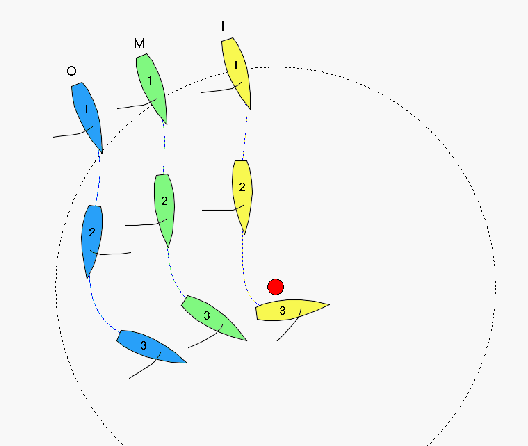
The Section C Working partyhad submitted a proposed new ISAF Case that said, "Room is defined as the space needed for a seamanlikemaneuver, and it is not seamanlike to break therules." This proposed Casewas not approved by ISAF, though the ISAF Racing Rules Committee agreed thatthe principle was valid in general. The reason they didn't approve the new Case was the followingargument: Suppose that two boatsare on starboard tack, approaching the starting line to start, and the Z Flagor Black Flag is flying from the RC boat (see rules 30.2 and 30.3). If the leeward boat luffs the windwardboat, she must give that boat room to keep clear (see rule 16.1). But if the windward boat breaks theplane of the starting line, she will break rule 30.2 or 30.3, so according tothe general principle above, it would not be seamanlike for her to do so. Thus, if in keeping clear she is forcedto enter the "forbidden triangle", she could get the leeward boatdisqualified and claim exoneration for breaking rule 30.2 or 30.3. This is clearly not the result we intendedwhen we drafted the Case! Ipredict that a new Case will be submitted next year, saying something like,it's not seamanlike to break to rules of Part 2 and rule 31. If you have some good words to achievethis succinctly and clearly, please let me know!
IMMEDIATECHANGE 3, Definition Party
This change came from theISAF Race Officials Committee, and is simply common sense. The problem came up as a result of aredress hearing at last year's US Olympic Trials (the Hall v. Rioscontroversy). The change is asfollows:
Party A party to a hearing: aprotestor; a protestee; a boat requesting redress or for which redress isrequested by the race committee or considered by the protest committee underrule 60.3(b); a race committee acting under rule 60.2(b); a boat or competitor that may be penalized underrule 69.1; a race committee or an organizingauthority in a hearing under rule 62.1(a).
Under the current rules, if a boat requests redressthen she is a "party" to the redress hearing (so she gets the rightto question witnesses, to remain in the room while other witnesses arequestioned, to ask for a reopening of the hearing under certain conditions, toappeal the decision, etc.); but if the redress hearing was originally requestedby the race committee or brought by the protest committee on the boat's behalf,then she is not entitled to those privileges. This is clearly unfair and unintended. In drafting the change, Charley Cook,the ISAF Race Officials Committee chairman, realized that the same privilegesshould be granted to race committees and protest committees when they wereinvolved in the situation that led to the hearing. For some reason, the ISAF Racing Rules Committee didn’t wantto make protest committees parties to hearings involving their own actions, sothey only extended the definition to race committees. Theoretically, this means that if a competitor files forredress based on an improper action of the protest committee and a new panel isformed to hear the redress request, then the old protest committee cannot bothtestify about their actions and defend them – they have to be excused from theroom during the argument phase of the protest (see rule 63.3(a) – I read"protest committee" there as meaning the current panel, not the old one). In practice this doesn't happen, and inany case the change is good, and shouldn't be very controversial.
IMMEDIATECHANGE 4, Appendix B
Appendix B, for windsurfing, restates rule 18.2(c);so when ISAF changed that rule (see CHANGE 1 above) they had to change AppendixB as well. For the record, here'sthe change:
Rule B3.1(c)
Rule 18.2(c) is changed to:
When a board is required to give mark-room by rule 18.2(b), she shall continue to do so even iflater an overlap is broken or anew overlap begins. However, if either board the board entitled to mark-roompasses head to wind rule 18.2(b)ceases to apply.
IMMEDIATECHANGE 5, Appendix C
This is a new rule for match racing, unrelated to anyof the other changes. It says:
C2.12 Rule 18.2(e) is changed to ‘If a boatobtained an inside overlap andfrom the time the overlap began,the outside boat has been unable to give mark-room, she is not required to give it.’
Obviously, if you're not a match racer this new rulewon't affect you directly. But it'san interesting change, and needs some explanation. Rule 18.2(e) says "If a boat obtained an inside overlapfrom clear astern and, from the time the overlap began, the outside boat has been unable to give mark-room, she is not required to give it." The phrase "obtained [the] insideoverlap from clear astern"was not in the 2005-2008 rules, and the match-race folks wanted to revert tothe old rule.
Why would they want that? Consider the situation shown in the diagram below, takenfrom Match Race Call UMP 34. Themark is to be left to starboard.
In this situation, when A and X enter the zone theyare on opposite tacks, so rule 18 does not apply to them; and so when X tacksrule 18 applies but rule 18.2(b) doesn't -- meaning that the only mark-room rule that could apply is rule18.2(a), which simply gives the inside boat mark-room. At about position 4, X becomes theinside boat, and as soon as X passes head to wind, A is required to give X mark-room. But A physically cannot provide thatroom, so X has to go the wrong side of the mark and when she protests, she winsthe protest. The reason rule18.2(e) doesn't apply here is that X established the overlap by tacking, notfrom clear astern. Note that rule18.3 doesn't apply because A is not fetching the mark – she has to tack to passto windward of it (see definition Fetch).
Under the new rule C2.12, A does not have to provideroom if she cannot do so from the time the overlap begins, i.e., from the timeX passes head to wind. On the faceof it, this seems like a good change, but I don't think it is wellthought-out. Consider the simpleand very common situation diagrammed below:
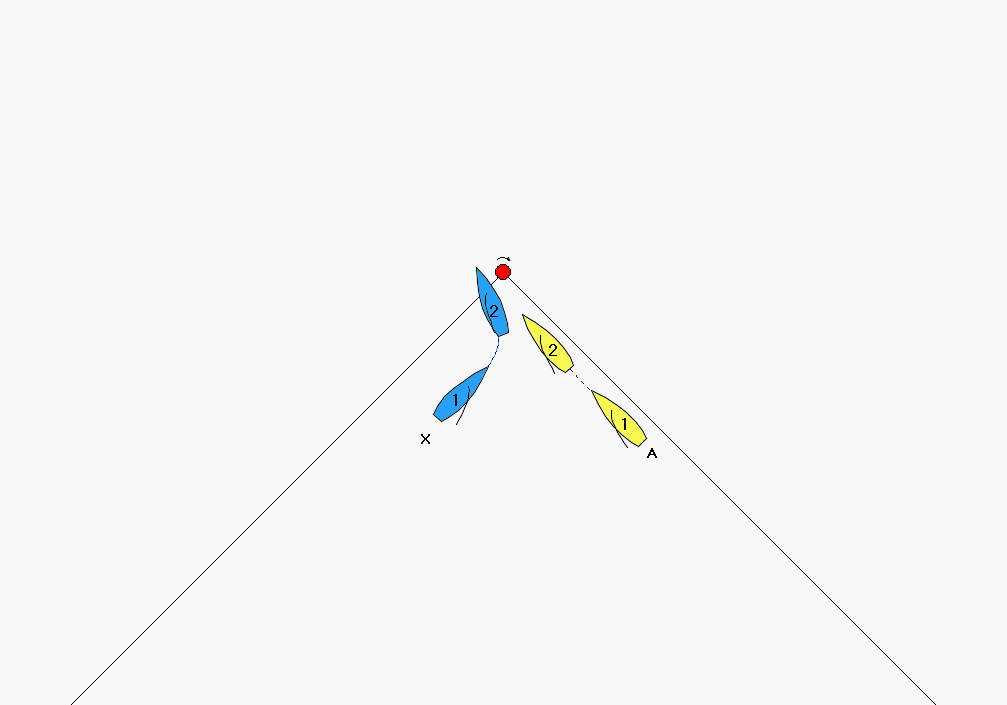
In this case, X tacks ahead and to leeward of A, andso close to the mark that she cannot physically give A mark-room. Using the same arguments as before, wesee that rule 18.2(a) applies from the time X passes head to wind, so she mustgive A mark-room. If she cannot doso and the boats are fleet racing, X breaks rule 18 when she fails to givemark-room – rule 18.2(e) does not apply because the overlap was established byX's tack, not from clear astern.
But if the boats are match racing under new ruleC2.12, X does not have to give A mark-room because there is no physical way shecan provide space for A between her and the mark. Rule C2.12 says that since she was not able to provide roomfrom the time the overlap began, she does not have to do so. A must go thewrong side of the mark, and if she protests she receives a green flag. Furthermore, if she interferes with X'smark rounding she may well break rule 23.2 (see my earlier blog on thistopic).
Note that rule 13 applies between positions 1 and 2,and X must keep clear of A while she's tacking; but if X is a length or soahead of A, that isn't hard for her to do. Additionally, after X completes her tack she must initiallygive A room to keep clear, but in the situation above A can easily keep clearby going the wrong side of the mark.
So, I think this is a new match-racing move for X,and guess what? It gives the boaton the left side of the leg control over the boat on the right – exactly theopposite of the current match race status!
IMMEDIATE CHANGE 6, Advertising
The last change is purely technical; it simplyconforms all the rules that refer to advertising to the wording in theAdvertising Code in ISAF Regulation 20. We used to have categories of advertising, with Category A being themost restrictive. These Categorieshave been eliminated in the Code, so ISAF removed the references to Category Ain the RRS, and at the same time cleaned up some other wording. There was clearly no urgency about thischange (most of which was in Appendix K, which is not even a rule), and the changewould normally have waited until 2013 to take effect; but because there weregoing to be other Immediate Changes (see 1-5 above) anyway, ISAF went ahead andmade the advertising edits "urgent", putting them into effect thiscoming January 1. For the record,here they are:
J1.2 Thenotice of race shall include any of the following that will apply and thatwould help competitors decide whether to attend the event or that conveys otherinformation they will need before the sailing instructions become available:
(1) that competitor advertising will be restricted toCategory A or that boats will be required to display advertising chosen andsupplied by the organizing authority (see ISAF Regulation 20) and otherinformation related to Regulation 20;
J2.2 Thesailing instructions shall include those of the following that will apply:
(1) that competitor advertising will be restricted toCategory A (see ISAF Regulation 20) and other information related toRegulation 20;
Appendix K
2 ADVERTISING
See ISAF Regulation 20. 2.1 Competitor advertising will be restricted to
Include other applicable Category A. asfollows: ______.
information related to
Regulation 20.
See ISAF Regulation 2.2 Boats may [shall] [may] be required to display
20.(d) 20. advertisingchosen and supplied by the
organizing authority.
Appendix LSee ISAF Regulation 21 ADVERTISING
20.3(d)
information on the suppliedbythe organizing authority
advertising material. as follows: ______.
60d81875-a115-40b3-968b-f8a06858a9b0|1|3.0