Sailing and/or racing on a super yacht is just like sailing on any other boat - only bigger: everything is much, much bigger.
On REBECCA, a 140'' Frers ketch I recently raced on in Palma de Mallorca for the Super Yacht Cup, the head reinforcement patch on the mainsail is the same size as a J-24 mainsail. The front mast asymmetric spinnaker is 11,789 sq feet. It seems that not so long ago an 80'' maxi boat was a really big boat, but the mizzen on REBECCA is bigger than the maxi class mainsails.
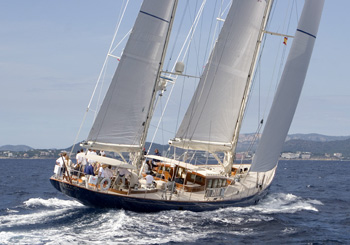 Remarkably, the most important body part to exercise in order to trim most sails on a super yacht is one''s index finger and/or big toe. The sheet loads generated on a super yacht require mostly captive winches that live hidden below deck. On REBECCA the sheet winches stop turning when the load gets to eight tons. That means the full main can�t be sheeted in when the wind is blowing more than 25 knots. The calculated load on the main sheet is 11,000 lbs. when the wind gets to 30 knots. When trimming the sails on a super yacht one has to consider what the sails are being asked to propel � 164 tons of boat through the water. Remarkably, the most important body part to exercise in order to trim most sails on a super yacht is one''s index finger and/or big toe. The sheet loads generated on a super yacht require mostly captive winches that live hidden below deck. On REBECCA the sheet winches stop turning when the load gets to eight tons. That means the full main can�t be sheeted in when the wind is blowing more than 25 knots. The calculated load on the main sheet is 11,000 lbs. when the wind gets to 30 knots. When trimming the sails on a super yacht one has to consider what the sails are being asked to propel � 164 tons of boat through the water.
The boat may not accelerate, but once you get something that big and heavy moving, it keeps moving. After sailing on REBECCA for the first time, UK-Halsey Mystic�s sail designer commented, �It is so strange to be sailing along at nine knots and then sail into a hole. The boat stands up and stops heeling, but it keeps moving at nine knots.
Racing these big boats is great fun and taken quite seriously, but some of the logistics are a bit different than your average weekend or weeknight race.
For practical and for fun reasons, most super yacht regattas are a series of pursuit races. Each yacht is given its starting time and, if the handicaps are done correctly, the finishes are very close, particularly by the last race. This also keeps these monsters from getting too close to each other in a crowded situation; only one boat starts at a time, unless two boats have the same rating. Also, unlike most sail boat races, in a super yacht regatta the engine is required until each individual''s start � just in case maneuvering help is needed. This system takes quite a great deal of pressure off the brain trust at the start.
While helmsmen, tacticians, trimmers, and bowmen are the crew members usually associated with the "important" roles of any crew, on a super yacht the one person that carries the most critical role is the engineer because all the sail handling power comes from hydraulic systems. If a pump or a gasket fail, there is not enough human muscle to tame the boat�s mammoth sails. This does happen occasionally, and it is a bit unnerving to be heading towards an obstruction at high speed without the ability to tack or gybe.
For the regatta we delivered a new No. 2 genoa. This is the only headsail, and it needs to be roller-reefed when the breeze comes on. The sail is 4300 square feet, or the same area as two America�s Cup Class mains. Even made out of Cuben Fibre, it weighted over 1000 pounds. Of the 25 crew on the boat, it takes 15 people to get the 11,789 square foot spinnaker up and down � and that�s with a dousing sock.
Assuming that the systems all work, racing these big boats is very much the same as any other boat. Well, most "normal" race boats don''t include a chef to make the lunches and snacks, and a crew to serve lunch and drinks. But, hey, pushing buttons can work up quite an appetite and thirst.
A serious challenge when racing these boats is the ability to concentrate. It is always tempting to watch the other yachts in the regatta. It is not that often that these boats get together; spectating while racing is difficult to avoid. However, because your only "feel" is a button, if you are trimming, you must keep a vigilant eye on what your button controls. If you are trimming the main and look at another boat and momentarily space out, you can overload the sheet and break the sail, battens, or pull something seriously large out of the deck -- a sure way not to be invited back.
Crossings situations and close finishes are quite a challenge, especially on windy days. Super yachts are not quite as responsive and have a slightly larger turning radius than most boats. On a close port/starboard crossing, all things such as easing sails, having the leeward runner off, and judging relative speeds is as important (maybe more important) when racing a super yacht. Considering you have a combined tonnage of over 300 tons aiming at one another at 12 knots, a collision would be disastrous. While racing REBECCA during the America�s Cup Jubilee in England, Lawrie Smith, who was helming, crossed one foot behind a 110'' yacht and jibed three feet in front of a maxi boat at the leeward mark. Lawrie seemed to know what he was doing. The other boats were a little less sure, at least judging by the size of their eyes and the length of their open jaws.
At the end of the day, racing on a super yacht is an experience, if offered, that should be taken up.
|