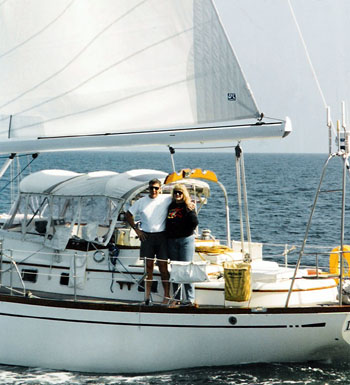
In last month�s newsletter, we reviewed Laurie Pane�s book CHASING SUNSETS: A PRACTICING DEVOUT COWARD�S CIRCUMNAVIGATION. The book is a great read for armchair sailors and potential world cruisers looking for information from someone who has �been there and done that.
Laurie writes about the sails he used in the following article exclusively for the UK-Halsey Online Newsletter.
We circumnavigated on DOLPHIN SPIRIT, a Mason 53, driven by UK-Halsey sails, traveling over 40,000 miles in six-and-a-half years. Not once, at sea, did we strike sustained winds over 35 knots.
That meant that we never even brought on deck our storm trysail and storm jib. Many cruisers obsess with preparations for heavy weather and neglect, or do not give proper attention to, the needs of light-air sailing � a much more common requirement.
DOLPHIN SPIRIT is cutter rigged, in my opinion absolutely the best cruising arrangement. We carried a 715 square foot main (in-mast roller furling), an 882 square foot 130% genoa (roller furled) and a 282 square foot 90% high aspect staysail (roller furled). Completing our active inventory was our 1,800 square foot cruising spinnaker.
Those UK-Halsey sails took us around the world without a hitch. All we had to do was to replace the sun-shield cloth once and to have two seams re-sewn after four years or constant use.
The roller-furled staysail was permanently in place. It did require use to partially roll up the genoa when tacking, but that was no real concern. Remember that a cruiser does not tack more than once a day, and then only after hours of contemplation and consideration.
A lot of our ocean passages were done under double-reefed main and staysail in 25 to 30 knot winds. This set-up gave us a steady 160+ miles every day, minimized heel (very important for the preservation of good marital relationships) and made the auto-pilot�s work very easy.
We reefed the genoa a lot, with little to no deterioration in our sailing performance off the wind. With a partially rolled genoa, we certainly could not point as high into the wind, but that was one of the reasons we had a motor. Ask yourself whether you would rather spend several hours under sail pounding into head winds and seas, or halve that time by using the motor to assist the sails.
Why did we pick UK-Halsey to supply our sails? They were price competitive, but certainly not the cheapest quote we received. What carried the day was that rarely found commodity � professionalism. The sales people listened, made suggestions, listened again, and said they didn�t know if they didn�t. The end result was a set of sails that did exactly what it was supposed to do flawlessly. Sure we spent a little more, but how much did we save in security, performance and longevity?
Lawrence Pane
The book is annotated with comments from Laurie�s wife Carole their young son Ryan. An example of the he said, she said style follows while talking about part of their northbound bash up the Red Sea:
After six days of being sand-blasted and dust-coated, the wind dropped to 15 knots so we took off. It immediately went back to 25 knots, and we pointed into head-seas all day. This meant we would reach the anchorage at Wadi Gimal after dark, and we never, never enter a new anchorage at night by choice. I spoke on the VHF with LADY KATHRYN who had just left that anchorage, and got the way points and directions. We took a deep breath and headed in � a very scary business, even under those conditions.
To make matters more interesting, after we had threaded our way through the reefs into position, the anchor chain jammed on the way down. Here was the situation; pitch black night; 25 knots of wind; island in front of us we could see only on radar; reef all around us that we could not see by eye, or on radar; me upside down in the anchor locker trying to unsnarl chain; Carole driving, trying to stay in the one spot; Ryan calling depths; some anxiety all around.
Then I got stuck getting out of the anchor locker, lost some skin and gained some bruises. The anchor finally went down, and we had lamb chops for dinner. The wind was again blowing at 30 knots, all the way up to Suez, so we stayed for two days, but were 60 miles closer to the Canal.
Carole: It was nerve-wracking. Laurie just said, �Keep the boat in the same position, there are reefs all around us,� and disappeared below to untangle the anchor chain. How do I do that, when there were no points of reference, the night was pitch black, and I had no idea if there was a current running? Was there a reef just in front of us? Behind us? I just used the compass to keep pointing in the right direction, applied power when I thought we had moved, and hoped for the best. Laurie FINALLY re-appeared and the anchor went down. Then he had the audacity to ask for dinner!
To buy the book and find more information about the Panes, go to www.chasingsunsetsthebook.com The cost of the 448-page paperback with color photos is $19.96.
|